
Baby Bottle Sizes and Nipples: What Fits Your Baby
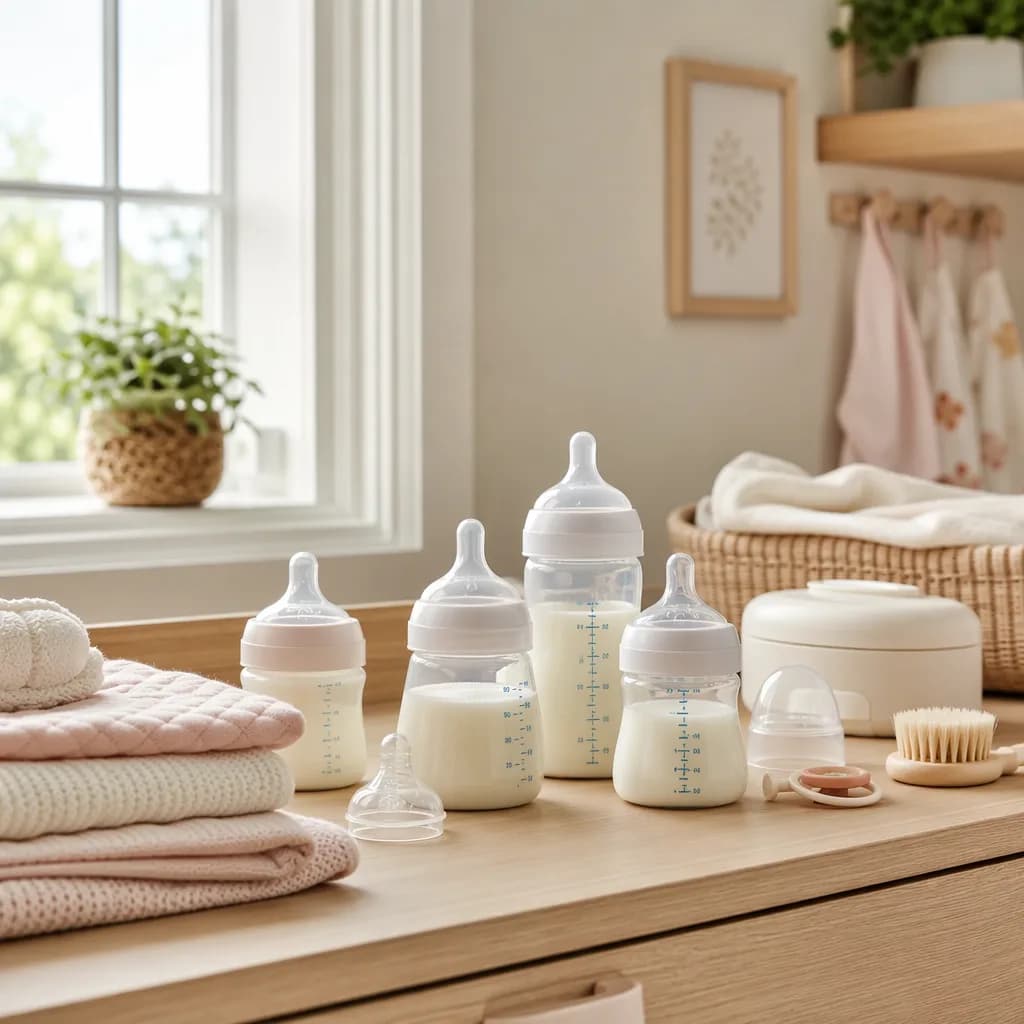
Quick guide to baby bottle sizes by age
Baby bottle sizes can look oddly specific at first: 2 oz, 4 oz, 5 oz, 8 oz, 9 oz, and 10 oz. The smaller bottles are usually easiest in the newborn days, while bigger bottles become more useful as babies take more milk per feeding.
Here’s a simple starting point:
| Baby’s age | Common bottle size | Typical feeding amount |
|---|---|---|
| First days | 2 oz or 4 oz | 1-2 oz per feeding |
| By end of first month | 4 oz or 5 oz | 2-4 oz per feeding |
| Around 6 months | 8 oz, 9 oz, or 10 oz | 6-8 oz per feeding |
Age helps, but it’s not a rule.
A 3-week-old taking small, frequent feeds may use bottles very differently than a 3-month-old who’s stretching time between feeds. Breastfed babies may also take smaller bottles more often, especially at daycare, where caregivers may offer paced feeds throughout the day.
A concrete example: if your newborn is taking 2 oz every 2 to 3 hours, a couple of 2 oz or 4 oz bottles may be much less frustrating than filling an 8 oz bottle and watching milk go unfinished. Small bottles can reduce waste, fit more easily in a cooler pocket, and make those sleepy feeds feel simpler.
If you’re packing bottles for an outing, our Diaper Bag Checklist for Newborns and Older Babies can help you think through the extras. For feeding on the go, it also helps to pair bottles with the right carrier, stroller, or car seat setup. Start with our Baby Carrier Buying Guide for New Parents, Stroller Buying Guide for Every Age and Lifestyle, or Infant Car Seat Guide: Fit, Install, Daily Safety.
Newborn bottles: what size works in the first weeks
For the first few weeks, start small. A few 4 oz or 5 oz newborn bottles are usually a better bet than buying a full matching set before your baby has tried them.
Newborns can be surprisingly particular about bottle shape and nipple style. One baby may latch calmly on a wide-neck bottle, while another fusses until you switch to a narrower nipple. Since newborns typically eat every two to three hours, you’ll want enough bottles to get through the day without washing one after every single feed, but not so many that you’re stuck with a brand your baby refuses. Many parents land somewhere between 4 and 12 bottles, depending on whether baby is exclusively bottle-fed or also nursing.
Tiny bottles are easier in real life, too. At 2:13 a.m., when you’re half-awake and trying to keep the lights low, a smaller bottle can feel less clumsy in your hand. It’s lighter, easier to angle, and simpler to tuck into a diaper bag for an early pediatrician visit.
In the first days, babies usually drink 1-2 ounces per feeding, then often move toward 2-4 ounces by the end of the first month. If you’re using formula or warming pumped milk, that matters. You may not want to warm a full 4 or 5 ounces if your baby usually finishes 2, because smaller portions can help you avoid wasting milk your baby doesn’t take.
Anti-colic vents and wide-neck bottles are both worth trying. Vented bottles can help reduce air bubbles, and wide-neck bottles are often easier to clean and comfortable for many babies. Still, no bottle fixes gas for every baby.
If your baby was premature or is medically fragile, ask your pediatrician or feeding therapist about bottle size and nipple flow. Their guidance matters more than the label on the package. Then you can think about the rest of your out-and-about setup, like a carrier, stroller, or infant car seat, once feeding feels a little less mysterious.
How bottle nipple flow sizes work
Bottle nipple flow size is simply how fast milk comes out when your baby sucks. Slow flow means milk comes out gradually. Medium flow is a bit quicker. Fast flow is for older babies who can handle more milk at once. Some brands also offer extra-slow flow for tiny or sensitive feeders, and variable flow or Y-cut nipples for thicker liquids, only if your pediatrician says to use them.
Here’s the tricky part: brands don’t all label nipple flow the same way. One brand’s Level 1 may not act like another brand’s Slow Flow. Stage 2 in one bottle line might feel too quick for your baby, while another Stage 2 is just right. So the label is a starting point, not a promise.
The goal is effort that looks comfortable. A good nipple flow lets your baby suck, pause, breathe, and swallow without struggling. You might see a steady rhythm: suck, suck, pause, breathe. Calm hands. Relaxed face. Milk staying mostly in the mouth.
For many full-term newborns, a slow-flow nipple is a common place to begin. A preemie or extra-slow nipple can make sense for very young newborns, sleepy feeders, or breastfed babies who are learning to switch between breast and bottle. If you’re packing bottles for an outing, toss an extra nipple option into the bag along with the basics from a Diaper Bag Checklist for Newborns and Older Babies. It’s a small thing that can save a feeding.
Faster isn’t better if your baby can’t keep up. Milk spilling from the corners of the mouth, coughing, sputtering, or ending feeds gassy and fussy can all be signs the flow is too fast. Sometimes sizing down helps more than pushing through. Feeding gear is a lot like choosing a carrier, stroller, or car seat: fit matters in daily life. If you’re sorting out the rest of the big baby items too, these guides can help: Baby Carrier Buying Guide for New Parents, Stroller Buying Guide for Every Age and Lifestyle, and Infant Car Seat Guide: Fit, Install, Daily Safety.
Signs the nipple flow is too slow or too fast
Bottle feeding can look simple from the outside, but babies often need time to figure it out. A little squirming, pausing, or fussing doesn’t always mean something is wrong. Still, if you’re seeing the same stress cues over and over, the nipple flow may not be a good match.
A nipple flow may be too slow if your baby:
- Pulls at the bottle in frustration
- Sucks hard but doesn’t seem satisfied
- Collapses the nipple while feeding
- Takes longer than 30 to 40 minutes to finish
- Falls asleep before finishing again and again
A too-slow nipple can turn feeding into a workout. Some babies get tired before they’re full, then wake hungry soon after. Others get mad halfway through and start pushing the bottle away, even though they still want milk.
A nipple flow may be too fast if your baby:
- Coughs or chokes during feeds
- Gulps loudly
- Has milk leaking from the corners of the mouth
- Gets wide-eyed during feeding
- Stiffens their body
- Pulls away from the bottle
Too-fast flow can feel scary in the moment. If your baby is working hard to keep up, pause the feeding, hold them upright, and let them catch their breath. Repeated coughing, choking, or stiffening is a good reason to try a slower nipple or adjust the feeding position.
Before moving up a nipple size, try paced bottle feeding first, especially if your baby is also breastfeeding. Hold the bottle more horizontally, give short pauses, and let your baby set the rhythm instead of tipping the bottle high and letting gravity do the work. It’s a small change that can make feeding calmer.
Here’s a real-life example: if your 2-month-old drains a 4 oz bottle in 6 minutes and spits up after, try a slower nipple before offering more milk. Fast drinking can look like hunger, but sometimes the milk is simply coming too quickly.
It also helps to keep a spare nipple or bottle in your outing kit, right next to the burp cloths and backup outfit in your Diaper Bag Checklist for Newborns and Older Babies. Feeding is easier when you’re not troubleshooting with a hungry baby in your arms.
Choosing the best bottle nipple flow for your baby
Start with the slowest nipple flow your baby can use comfortably. That usually means a slow newborn flow at first, then adjusting only if feeding cues tell you it’s time.
The age printed on the nipple package is a rough guide, not a rule. A Stage 1 nipple is often listed for 0-3 months, Stage 2 for 3-6 months, and so on, but babies don’t all feed the same way. Watch your baby’s body more than the label. If milk is spilling from the corners of their mouth, they’re coughing, gulping, or pulling away, the flow may be too fast. If they’re sucking hard, getting frustrated, falling asleep early, or feeds are dragging on and leaving them tired, the flow may be too slow.
Change one thing at a time.
Try the same bottle, the same milk amount, and the same feeding position, but switch only the nipple flow. That makes it much easier to tell what helped. For example, if your baby usually takes 3 ounces from a wide-neck bottle and seems worn out halfway through, test the next flow up with that same bottle and 3 ounces again. Don’t change bottle shape and nipple stage on the same day if you can avoid it.
Breastfed babies often do best with slow-flow nipples, especially when you’re trying to keep bottle feeds closer to the pace of nursing. A slower flow can make bottle feeding feel less like a quick pour and more like the steady work they’re used to at the breast.
Formula-fed babies may be ready to move up when feeds become very long or tiring. Still, go gently. A faster nipple isn’t better unless your baby feeds more comfortably with it.
If you’re packing bottles for an outing, toss in an extra nipple or two along with your usual feeding supplies. Our Diaper Bag Checklist for Newborns and Older Babies can help with that small, sanity-saving prep.
How many bottles and nipples do you really need
A practical starting point is 4 to 6 bottles if you’re mostly nursing, and 8 to 10 bottles if your baby is mostly bottle-fed. That gives you enough breathing room for night feeds, a diaper bag bottle, and the one that somehow ends up under the couch.
If you’re building a registry, don’t buy a full set of one brand right away. Babies can be surprisingly particular about bottle shape and nipple style, so it’s smart to try a small sample first. Pick a few well-reviewed shapes, see what your baby accepts, then buy more once you know what works.
Your real number depends on daily life. If you don’t mind washing after every feed, you can own fewer. If bottles go to daycare, sit in the sink overnight, or get packed next to wipes and backup clothes from your Diaper Bag Checklist for Newborns and Older Babies, you’ll want extras. Same idea as choosing gear from an Infant Car Seat Guide: Fit, Install, Daily Safety or a Stroller Buying Guide for Every Age and Lifestyle: the best number is the one that fits your actual routine.
Keep extra slow-flow nipples on hand too. They wear out, disappear, or need replacing right when your baby is hungry. Check nipples often, and replace them if they crack, get sticky, thin out, or the milk suddenly seems to pour faster than before.
Feeding gear is personal. Just like a Baby Carrier Buying Guide for New Parents, it’s about comfort, fit, and what makes the day a little easier.
When to move up to a bigger bottle or faster nipple
Bottle size and nipple flow are two separate decisions, and mixing them up can make feeding feel more confusing than it needs to be.
Move to a bigger bottle when your baby is regularly finishing the whole bottle and still seems hungry, or when the amount they usually take simply doesn’t fit anymore. In the first days, newborns usually drink 1-2 ounces per feeding. By the end of the first month, that often increases to 2-4 ounces, and by six months many babies take 6-8 ounces per feeding. So yes, there may come a point when the tiny newborn bottles are just too small.
But a bigger bottle doesn’t mean you need a faster nipple.
A baby can absolutely use an 8 oz bottle with a slow-flow nipple. That’s often the right setup if they need more milk but still do best with a calmer, slower pace. Think of the bottle as the container and the nipple as the speed setting.
Move to a faster nipple only when the current flow is making feeds too tiring or too slow. For example, if your baby is working hard, getting frustrated, or taking a long time to finish because the milk is coming too slowly, it may be time to try the next stage. Nipple stages are usually age-based, but your baby’s cues matter most.
Growth spurts can muddy the waters. Your baby might suddenly want more for a few days, then settle back down. If that happens, you may not need a permanent bottle or nipple change right away.
Call the pediatrician if you’re seeing poor weight gain, frequent choking, feeding refusal, or spit-up that seems painful. Those are worth checking.
And since bottles come with you everywhere, tuck the right size into your Diaper Bag Checklist for Newborns and Older Babies, right alongside the everyday gear you already trust, like the pieces from our Infant Car Seat Guide: Fit, Install, Daily Safety.
Frequently Asked Questions
What baby bottle size should I buy first?
Start with a few 4 oz or 5 oz bottles. They fit most newborn feeds, waste less milk, and are easier to hold during the early weeks.
Do newborns need slow-flow nipples?
Most newborns do well with slow-flow nipples. Some sleepy, premature, or breastfed babies may need extra-slow flow.
How do I know if the bottle nipple flow is too fast?
Coughing, gulping, leaking milk, pulling away, or looking panicked are signs the flow may be too fast.
When should I switch from 4 oz to 8 oz bottles?
Switch when your baby often finishes 4 oz and still wants more, or when their normal feed no longer fits comfortably in the bottle.
Can I use a bigger bottle with a slow-flow nipple?
Yes. Bottle size and nipple flow are separate choices. An older baby can use an 8 oz bottle with a slow-flow nipple if that pace suits them.
What is the best bottle nipple flow for breastfed babies?
A slow-flow or extra-slow nipple is usually best because it helps bottle feeds feel closer to nursing and reduces gulping.
Frequently asked questions
What size baby bottle should I start with for a newborn?
When should I switch to bigger baby bottles?
How do I know if the nipple flow is too fast?
How many bottles do I need?
References
Sources
External research this article was grounded in.
Related reading
More from the journal → gear
gearDiaper Bag Checklist for Newborns and Older Babies
Pack a calmer diaper bag with age-by-age newborn and older baby checklists, diaper math, outfit extras, feeding supplies, and parent must-haves.
13 min readJul 3, 2026- gear
Baby Carrier Buying Guide for New Parents
Not sure which baby carrier to buy? Start with real life: newborn naps, quick errands, longer walks, caregiver fit, safety, and easy cleaning.
14 min readJul 3, 2026 - gear
Stroller Buying Guide for Every Age and Lifestyle
A practical stroller buying guide by age, daily routine, space, travel needs, and safety features, so you can choose one that fits real family life.
13 min readJul 3, 2026