
Baby Milestone Chart: First Year Month by Month
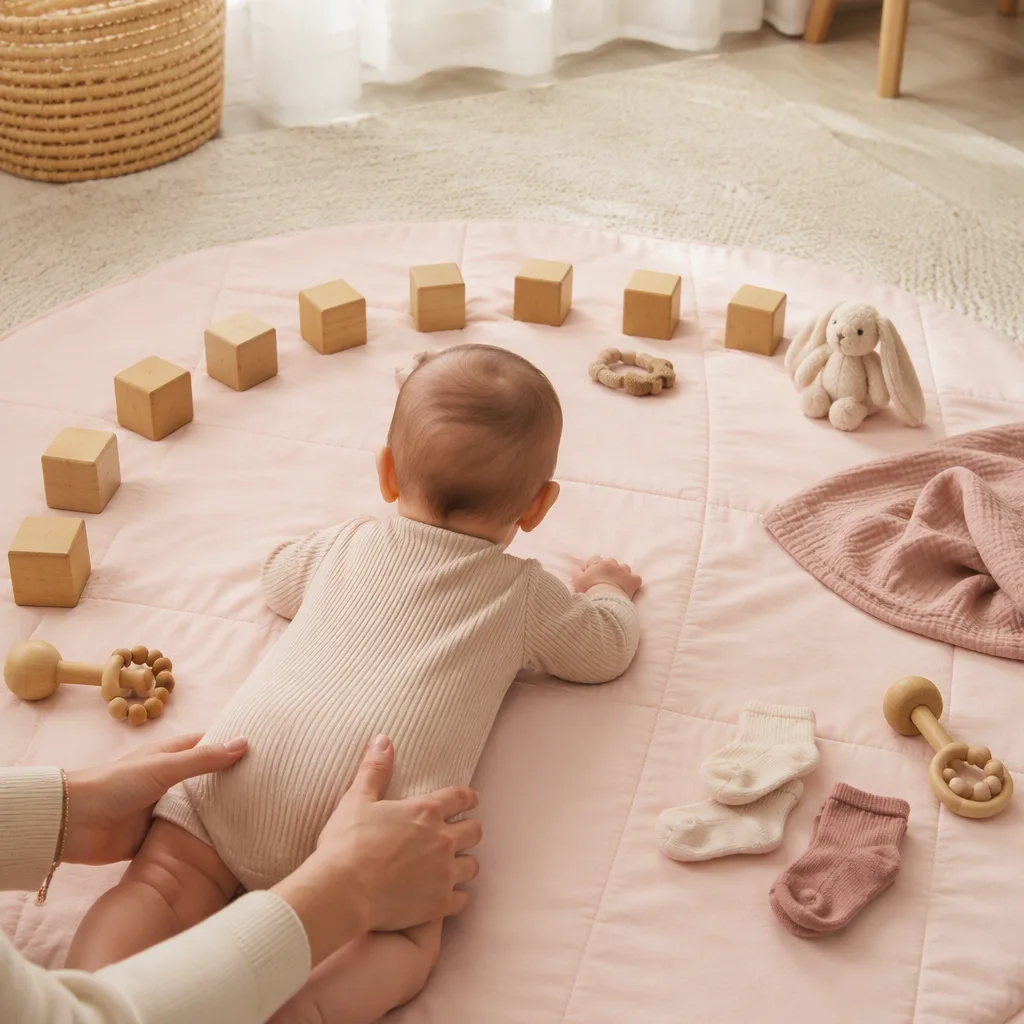
Baby milestone chart by month
Milestones are helpful guideposts, not strict deadlines. Babies grow on their own timelines, and if your baby was born early, it’s often fairer to look at milestones using corrected age rather than comparing by birth date alone.
| Age | Movement | Social and emotional | Communication and thinking |
|---|---|---|---|
| 1 month | Mostly curled up, with early newborn reflexes you may notice during feeding, startling, and grasping. See Newborn Reflexes Explained: What Parents Notice Early. | Calms with familiar touch and voices. | Begins learning your voice, face, and daily rhythms. |
| 2 months | May lift the head briefly during tummy time. A simple guide like Tummy Time by Age: Newborn to Crawling Guide can help. | Starts becoming more alert with you. | Watches faces and listens when you talk or sing. |
| 3 months | Holds the head steadier and moves arms and legs with more control. | Enjoys familiar people and routines. | Turns toward interesting sounds and faces. |
| 4 months | May push up more during tummy time and begin working toward rolling. More here: When Do Babies Roll Over? Milestones and Safe Practice. | Shows excitement during play. | Responds to your voice and playful back-and-forth. |
| 5 months | Reaches, grabs, and explores toys with hands. | Likes playful attention. | Studies toys, faces, and sounds. |
| 6 months | May pass a toy from hand to hand. | Enjoys games and familiar songs. | Begins connecting sounds, actions, and routines. |
| 7 months | Sits with more balance and may start moving toward toys. | Looks for you when you move away. | Explores cause and effect, like dropping a spoon. |
| 8 months | May rock, scoot, or get ready for crawling. See When Do Babies Start Crawling? Signs and Stages Guide. | May prefer familiar caregivers. | Looks for hidden or partly hidden things. |
| 9 months | Moves with more purpose, often reaching, pivoting, or pulling closer to objects. | Enjoys simple games. | Understands more daily words and gestures. |
| 10 months | May pull up or cruise with support. | Copies expressions and playful actions. | Points, looks, and gestures to show interest. |
| 11 months | Practices standing, stepping with help, and using fingers for small foods. | Seeks comfort from trusted adults. | Tries sounds with meaning. |
| 12 months | Many babies pull to stand, walk holding furniture, drink from a cup you hold, and pick up small bits of food with thumb and pointer finger. | Plays games with you, like pat-a-cake. | May wave “bye-bye,” call a parent “mama,” “dada,” or another special name, understand “no,” put a block in a cup, and look for a toy you hide under a blanket. |
If a skill disappears, your baby isn’t meeting one or more milestones, or your gut says something feels off, ask your pediatrician about developmental screening. You know your child best.
And if you need a tiny parenting brain break after all that tracking, name meanings can be a sweet reset. Here’s one to browse: Tanmay Suresh Upadhyay: meaning & origin.
1 to 3 months: waking up to the world
The first three months can feel quiet on the outside, but your baby is working hard. Tiny changes start to show up in everyday moments: a brief head lift during tummy time, hands that open a little more often, fingers finding their way to the mouth, and that sweet turn of the head when a familiar voice comes close.
Those early movements may look jerky at first. That’s normal to notice as a parent. One minute your baby’s arms fling out, the next they’re curled in tight. Over time, many of those motions begin to look smoother and more purposeful. If you’re curious about those early startles, stretches, and automatic movements, Newborn Reflexes Explained: What Parents Notice Early can help you make sense of what you’re seeing.
Socially, this is the stretch that melts people. You may start getting longer eye contact, especially during feeding or a diaper change, and then one day there it is: a real smile that feels like it was meant just for you.
A simple way to support development is short tummy time on your chest after a diaper change. Recline a bit, place baby belly-down against you, and talk softly. Even 30 seconds counts. Some babies relax right into it. Others protest like you’ve asked them to do push-ups before breakfast. Both babies are still learning.
If tummy time feels tricky, our Tummy Time by Age: Newborn to Crawling Guide has gentle ideas. These early head and body skills also build toward later movement, like rolling and crawling, which we cover in When Do Babies Roll Over? Milestones and Safe Practice and When Do Babies Start Crawling? Signs and Stages Guide.
4 to 6 months: rolling, reaching, and laughing
This is such a fun stretch. Your baby may start feeling less like a curled-up newborn and more like a tiny, busy person with opinions, sounds, and favorite toys.
Typical baby milestones from 4 to 6 months often include rolling one way, reaching for toys, laughing, babbling, and stronger head control. You might notice your baby pushing up during tummy time, tracking you across the room, or grabbing for your hair, spoon, or necklace with surprising focus. Those early automatic movements you saw in the newborn days begin to look more purposeful now, which is a sweet follow-up to the reflexes we talked about in Newborn Reflexes Explained: What Parents Notice Early.
Rolling can happen in either direction first. Some babies roll belly to back because gravity gives them a little help. Others shock everyone by going back to belly first, usually during floor play when they’re twisting toward a toy or your voice. If rolling is the big milestone on your mind, When Do Babies Roll Over? Milestones and Safe Practice walks through what practice can look like.
A simple game: place a soft rattle just to one side, close enough to see but not directly in their hand. Let your baby look, reach, turn, and maybe wobble a bit. Stay right there. This kind of side-reaching builds into the strength used later for pivoting, scooting, and the early stages covered in When Do Babies Start Crawling? Signs and Stages Guide. Short, happy sessions on the floor also pair nicely with Tummy Time by Age: Newborn to Crawling Guide.
Feeding readiness may start showing up too: interest in food, sitting with support, and good head control are signs families often watch for before solids.
One safety note: once baby shows signs of rolling, stop swaddling. Rolling and a wrapped body don’t mix safely.
And if you’re saving baby memories, even tiny details like favorite sounds or name notes, such as Tanmay Suresh Upadhyay: meaning & origin, can become part of the story.
7 to 9 months: sitting, scooting, and exploring
Around 7 to 9 months, babies often seem suddenly more “in the action.” They may sit without much support, reach for a toy, pass it from one hand to the other, and turn when they hear their name. You might also hear those sweet repeated sounds: “ba-ba,” “da-da,” “ma-ma.” They’re practicing, even when the sounds don’t clearly mean a person yet.
Movement can look very different from baby to baby. One baby crawls on hands and knees. Another does an army crawl, pulling forward with strong little arms. Some scoot on their bottoms, roll across the room, pivot in circles, or seem perfectly content to skip crawling for now. If you’ve been watching earlier movement skills build, our guide on when babies roll over and this tummy time by age guide can help connect the dots.
This is also a big age for wanting you close. Separation anxiety can show up in a very real, very loud way, like crying the second you leave the room to start dinner. It doesn’t mean you’ve done anything wrong. It means your baby knows you’re their safe person.
Now’s the time to make the floor safer. Lower the crib mattress before pulling up becomes a surprise. Cover outlets. Move coins, beads, older sibling toys, and any tiny mystery bits off the floor.
Try to offer more floor play than time in seats, jumpers, or other containers. Babies need space to wobble, reach, tip, push, and try again. That’s how balance and strength grow.
If crawling is on your mind, this crawling signs and stages guide may help. And if you enjoy baby-name meanings while tracking milestones, here’s Tanmay Suresh Upadhyay: meaning & origin.
10 to 12 months: pulling up, pointing, and first words
By 10 to 12 months, your baby may look suddenly busier. One minute they’re sitting with blocks, and the next they’re pulling up on the couch, cruising along the furniture, or trying to get into the snack cupboard with serious determination.
Near the end of the first year, many babies are practicing big and small movements at the same time. The CDC lists pulling up to stand, walking while holding on to furniture, picking up small bits of food with the thumb and pointer finger, and drinking from a cup while you hold it as common 1-year milestones. That tiny pincer grasp matters. It’s what helps your baby pick up soft finger foods, turn board book pages, and eventually manage more self-feeding.
You may also see more social communication now: waving “bye-bye,” clapping during games like pat-a-cake, pointing at interesting things, and copying sounds or simple rhythms. First words can show up around this age, often “mama,” “dada,” or another special name. But understanding usually runs ahead of talking. Your baby might pause when you say “no,” look for a hidden toy, or point before they can say the word.
Here’s the kind of everyday language moment that counts: your baby points at the dog, and you say, “Yes, that’s Nana’s dog. He says woof.” Simple. Warm. Repeated often.
Walking can bring out parent worry fast. Try to keep it calm. Some babies take steps before their first birthday, and many healthy babies walk later. Cruising is still real progress. If you’re thinking back through earlier movement stages, our guides on rolling over, tummy time, and crawling can help you see the bigger pattern, from those early reflexes in newborn days to this wobbly, exciting almost-toddler stage.
And if you’re also choosing names while tracking milestones, you might enjoy reading about Tanmay Suresh Upadhyay: meaning & origin.
Red flags to bring up with the pediatrician
First, a little reassurance: bringing up a concern early doesn’t mean something is wrong. It means you’re paying attention. And if your baby does need extra support, asking sooner can help you get that support in place sooner.
Mention any milestone concern that keeps tugging at you, especially if you notice patterns like these:
- No social smile by around 3 months
- Poor head control by around 4 months
- Not rolling or reaching by around 6 months
- Not sitting with help by around 9 months
- Not using gestures, like waving “bye-bye,” by around 12 months
Some concerns are worth calling about promptly. Tell your pediatrician if your baby loses a skill they once had, seems very stiff or very floppy, has ongoing feeding trouble, doesn’t respond to sound, or uses one side of the body much more than the other.
Your pediatrician may start with a simple exam and questions about what you’re seeing at home. They may check hearing or vision, ask developmental screening questions, or suggest an early intervention referral if more support would help. The CDC also recommends talking with your child’s doctor if your child is not meeting one or more milestones, has lost skills, or if you have other concerns.
If you’re trying to sort out what’s typical at different ages, these guides can help you compare what you’re noticing day to day: Newborn Reflexes Explained: What Parents Notice Early, Tummy Time by Age: Newborn to Crawling Guide, and When Do Babies Roll Over? Milestones and Safe Practice. Later on, When Do Babies Start Crawling? Signs and Stages Guide can be useful too.
And if you’re here while also choosing names, yes, parenting tabs multiply fast. You might even have Tanmay Suresh Upadhyay: meaning & origin open right beside the milestone chart.
How to support development without turning play into homework
You don’t need to run your baby’s day like a lesson plan. Most infant development milestones are supported through ordinary, repeated moments: dressing, feeding, cuddling, bath time, floor time, and the hundred tiny back-and-forths that happen in between.
Talk through what you’re already doing. “Now we’re putting on your blue socks.” “Here comes the spoon.” “Daddy is washing your hands.” The CDC suggests talking or singing to your baby during routines, and building on the sounds they try to make. If your baby says “ba,” you might say, “Ball. Yes, that’s your ball.”
Simple play counts, too. Try short bursts of tummy time, a board book with flaps, a song you’ve sung so many times you’re tired of it, or peekaboo behind a burp cloth. Safe floor play gives babies room to practice moving, reaching, looking, and figuring things out. If a toy is just out of reach, pause before handing it over. Let your baby try. That little stretch is work.
Repetition is the point.
Babies learn by doing the same small thing again and again: reaching for a rattle, turning toward your voice, patting a book, pulling up, dropping a spoon, laughing when you say “boo.” It can feel boring to us, but to them it’s practice.
If you’re watching early movement, you might like When Do Babies Roll Over? Milestones and Safe Practice, Tummy Time by Age: Newborn to Crawling Guide, and When Do Babies Start Crawling? Signs and Stages Guide. For the earliest body movements parents notice, Newborn Reflexes Explained: What Parents Notice Early can help.
And truly, you don’t need fancy toys, flashcards, or a packed schedule. A blanket on the floor, your voice, a safe spoon, a sturdy board book, and a baby who gets to try things again tomorrow are more than enough. If you’re in a naming mood during one of those quiet contact naps, Tanmay Suresh Upadhyay: meaning & origin is a gentle little read.
How to use a baby milestone chart without stressing yourself out
A baby milestone chart is a tool, not a report card.
You can bring it to well visits, tuck notes into the baby book, or pull it up when you notice something new, like your baby waving “bye-bye,” pulling up to stand, or picking up tiny bits of food with a thumb and pointer finger. The CDC describes milestones as skills most children, 75% or more, can do by a certain age, which is helpful context when you’re tracking progress.
Try looking for patterns over time instead of checking off every item on the exact month. Maybe your baby was slow to enjoy tummy time, then suddenly started pushing up, reaching, and trying to move. That story matters. If you want more context for early movement, these guides on newborn reflexes, rolling over, tummy time, and crawling signs can help you see how skills often build on each other.
Also, compare your baby to your baby. Not to a cousin, a neighbor’s child, or a polished social media clip. Timing can vary because of sleep, temperament, prematurity, illness, and simple practice opportunities. A baby who’s had fewer chances to play on the floor may need more time to work on movement skills.
And yes, baby books can include sweet extras too, from first foods to name notes like Tanmay Suresh Upadhyay: meaning & origin.
If you’re concerned, bring notes or a short video to the pediatrician. It’s a calm, useful way to show what you’re seeing.
Frequently Asked Questions
What are the major milestones in a baby's first year?
Major first year baby milestones often include smiling, rolling, sitting, babbling, crawling or scooting, pulling to stand, using gestures, and possibly saying first words.
Are baby milestones by month exact?
No. Baby milestones by month are general ranges. Many healthy babies reach skills a little earlier or later, especially if they were born early.
When should my baby roll over?
Many babies roll sometime around 4 to 6 months. Some roll one direction first, and some take longer while they build strength.
When do babies usually sit up?
Many babies sit with support around 5 to 6 months and sit more steadily without support around 7 to 9 months.
Is it normal if my baby skips crawling?
Yes, some babies skip classic hands-and-knees crawling. They may scoot, army crawl, roll, or move straight to pulling up and cruising.
When should I worry about missed infant development milestones?
Call your pediatrician if your baby loses a skill, seems very stiff or floppy, does not respond to sound, or is far outside expected ranges for several skills.
Should I use corrected age for milestone tracking?
Yes, if your baby was born early, ask your pediatrician about using corrected age when checking milestones during the first year and beyond.
Frequently asked questions
Are baby milestones the same for every baby?
Should I use corrected age for a premature baby?
When should I talk to the pediatrician about milestones?
What milestones do babies often reach around 12 months?
References
Sources
External research this article was grounded in.
Related reading
More from the journal → development
When Do Babies Laugh? Milestones and Play Ideas
Most babies laugh around 3 to 4 months. Learn what early giggles mean, what can encourage them, and when to check in with your pediatrician.
8 min readAug 3, 2026- development
When Do Babies Start Babbling? Sounds and Stages
Most babies start babbling around 4 to 6 months, then build toward ba-ba and da-da sounds as speech skills grow.
11 min readAug 3, 2026 - development
When Do Babies Roll Over? Timing, Practice, Safety
Rolling can look wobbly at first. Learn what early practice looks like, how tummy time helps, and what safety changes once baby starts to roll.
11 min readAug 3, 2026