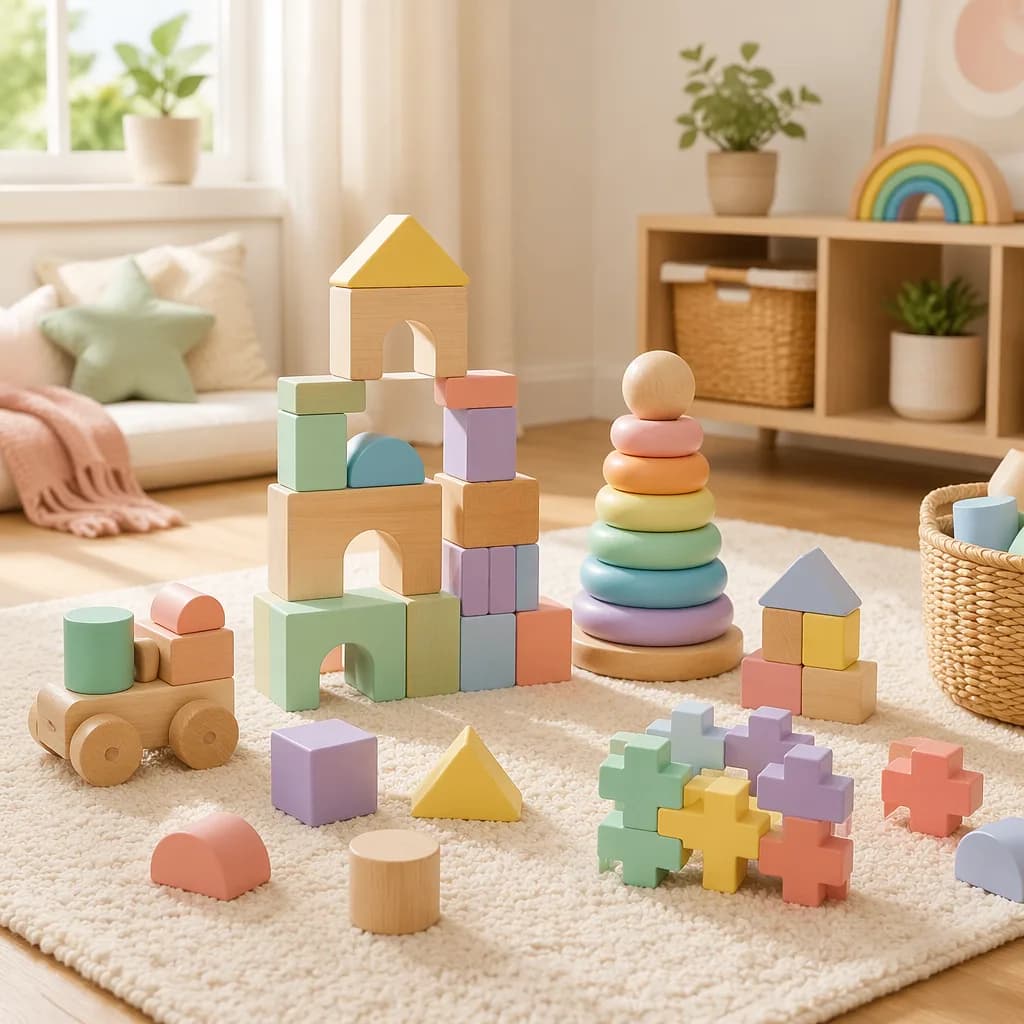
Building blocks and construction toys are simple pieces your baby can stack, connect, knock down, sort, and rebuild. That is their magic. They turn a quiet corner of your floor into a tiny work site, a tower town, or a pretend zoo.
For a 12- to 18-month-old, the joy may be very simple. Your baby picks up one block, drops it in a basket, then laughs when you build a tower to topple. Between 18 and 24 months, your little one may start lining pieces up, nesting them, or making short stacks. Around age 2 to 3, those stacks can become houses, roads, bridges, and birthday cakes. By 3 to 4, many children enjoy bigger plans, richer pretend play, and proud “Look what I made!” moments.
This toy category covers many styles. Some blocks are soft and chunky. Some are wooden, foam, cardboard, magnetic, or made to interlock. Some sets focus on open-ended building. Others add wheels, arches, people, animals, or simple themes. The best part is that your child can use them in fresh ways as they grow. You do not need a fancy setup. A basket of pieces, a clear patch of floor, and your gentle attention can bring lots of joy together.
Building play can support your baby’s hand skills in very real, easy-to-see ways. Your little one grasps, turns, balances, presses, pulls, and lines pieces up. These tiny actions often help fingers and hands get stronger. They also give your child practice using both hands together.
Blocks can also support thinking skills. Your baby learns that a wide base holds more pieces. A tall tower wobbles. A heavy piece may work better at the bottom. When a bridge falls, your child gets a gentle chance to try again. That is early problem solving, wrapped in play.
Language grows here too. You can talk about “up,” “down,” “more,” “big,” “small,” “red,” “under,” and “next to.” You can narrate your child’s plan without taking over. “You put the blue block on top.” “Your tower fell down.” “You are building a long road.” These simple words often help your baby connect language to action.
Construction toys can also support social and emotional growth. Your child may feel proud after finishing a tall stack. They may feel frustrated when it falls. With you nearby, they can practice patience, repair, and flexible thinking. Older toddlers and preschoolers may build together, trade pieces, copy your design, or invite a toy animal into their world.
Pretend play comes naturally too. A few blocks can become a bed, a train, a shop, or a rocket. Your little one learns that one object can stand for another. That kind of flexible play can support imagination, storytelling, and early planning.
Choose building blocks and construction toys that match your child’s current stage, while leaving room to grow. For younger babies and toddlers, look for larger pieces that are easy to grip. Lightweight blocks are helpful when your baby is still learning to stack and carry. Soft or rounded edges can feel gentler during busy floor play.
Open-ended sets are often a smart choice. Simple shapes invite more uses than very fixed designs. Cubes, rectangles, arches, ramps, cylinders, and flat pieces give your child more ways to experiment. A mix of sizes can keep play interesting as your little one grows.
Think about how the pieces connect. Some children love plain blocks that balance and fall. Others enjoy pieces that click, stick, or snap together. Magnetic or interlocking styles can support longer builds for older toddlers and preschoolers. For younger children, simpler pieces may lead to less frustration.
Look for textures, colors, and sounds that feel pleasant in your home. You might prefer calm natural tones, bright colors for sorting games, or washable materials for snack-time builders. Storage matters too. A sturdy bin or bag makes cleanup part of the play. Your child can drop, sort, carry, and pour pieces with you.
It also helps to choose a set that works with your space. Big blocks are wonderful for body movement and giant towers. Smaller tabletop sets can be lovely for focused play. If you have more than one child, a larger number of pieces can make sharing easier and give everyone room to create.
Choose age-suitable pieces and check them now and then for damage.
No published comparisons yet for this category.
