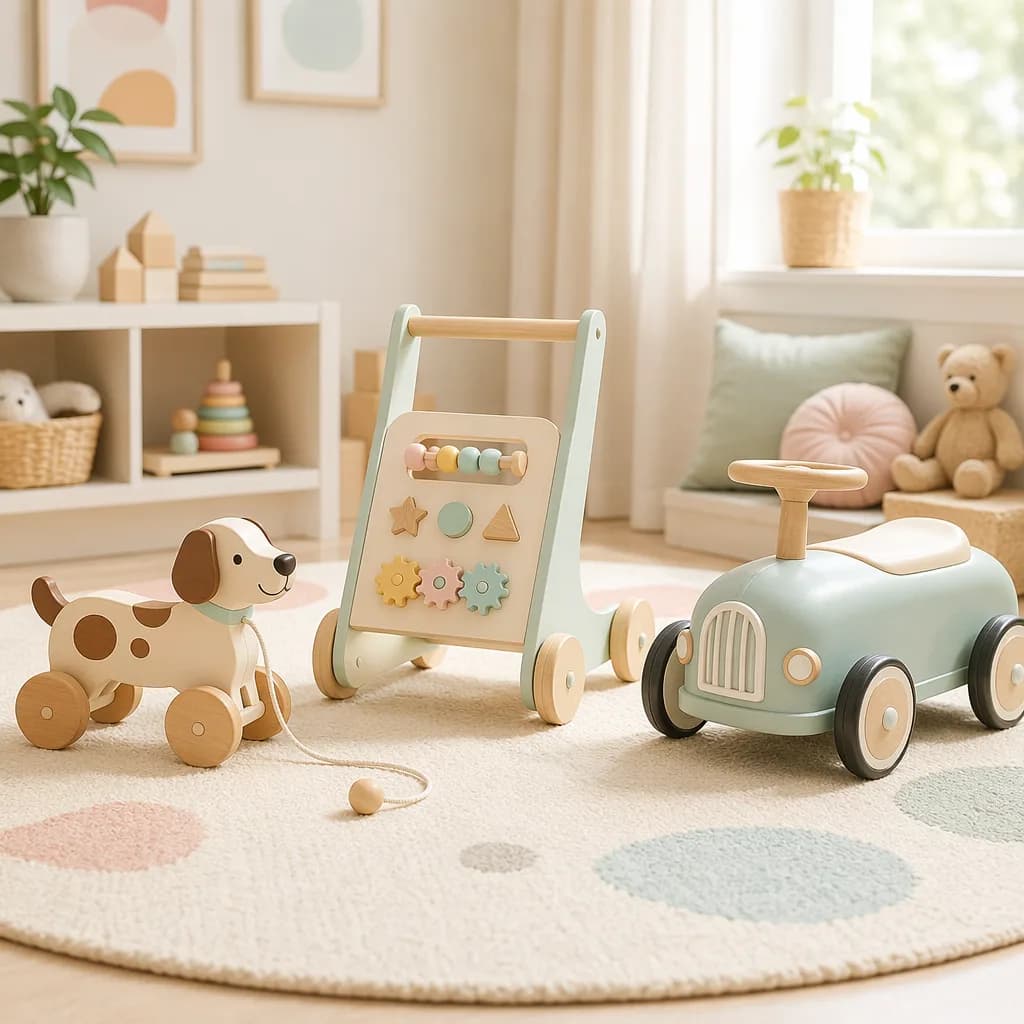
Push, pull and ride-on toys turn early movement into playful adventure for your baby.
These are the little movers your baby can push, drag, scoot on, or toddle behind. They include sturdy push toys, pull-along animals, and low ride-on toys. Each one invites your little one to make something happen with their body.
That is the magic. Your baby pushes, and the toy rolls away. Your toddler pulls a string, and a friendly shape follows behind. Your little one climbs on, scoots forward, and beams at you from across the room.
These toys often arrive during a busy, joyful stage. Your baby may be cruising along furniture. Your little one may be taking first steps. Or your toddler may want to carry, chase, park, and “drive” everything in sight.
Push, pull and ride-on toys give that energy a place to go. They make movement feel like play, not practice. They can turn your hallway into a road, your kitchen into a parade, and your living room into a tiny adventure trail.
They also grow nicely with your child. A younger baby may pat the wheels and push from sitting. Later, your little one may stand, steer, and toddle. An older toddler may load toys into a seat, pretend to deliver parcels, or give a teddy a ride.
These toys can support gross motor skills in very natural ways. When your baby pushes a toy, they use legs, feet, hips, and core muscles together. That whole-body work often helps with balance and body awareness.
Pull toys add a different challenge. Your baby needs to walk forward while thinking about what trails behind. Many babies enjoy looking back, turning, stopping, and starting again. That can support coordination and planning.
Ride-on toys invite your toddler to use both feet in rhythm. Scooting forward can build strength in legs and hips. Steering around a cushion or chair can support spatial awareness. Your little one learns, “Can I fit through there?” and “How do I turn?”
These toys can also support confidence. Your baby gets to choose a direction. Your toddler gets to chase you, bring a toy to you, or ride toward your open arms. Those moments feel big to your child. They say, “I can move. I can explore. I can come back to you.”
Language can grow here too. You can use simple words during play. “Push.” “Pull.” “Stop.” “Go.” “Fast.” “Slow.” Your baby hears words linked to real action. That often helps meaning click.
Pretend play may bloom around 18 to 24 months. Your little one might drive to the shops, walk a toy dog, or push blocks across the room. You can join gently. “Where are you going?” “Who is riding with you?” Together, you build stories from everyday joy.
Start with your baby’s stage. For 9 to 12 months, look for push toys with a broad base and easy-grip handle. A steady design can help your baby feel supported while cruising and standing.
For 12 to 18 months, many little ones enjoy pull toys with a short, easy-to-hold cord or handle. Simple wheels and friendly shapes work well. Your toddler can focus on walking, turning, and bringing the toy along.
For 18 to 24 months, ride-on toys become especially fun. Choose a low seat, wide wheels, and space for your toddler’s feet to reach the floor. A simple steering shape can invite big play without making the toy too busy.
Think about your home, too. Smooth wheels suit indoor floors. Chunkier wheels can handle rugs better. If you have a small space, a compact toy is easier to park and bring out each day.
Weight matters. A toy should feel sturdy enough to stay grounded, yet light enough for you to move. For push toys, check that the handle height suits your child’s body. Your baby should not need to reach too high.
Look for features that invite open play. A small storage seat, a shape sorter top, or a basket can add extra use. Simple sounds, gentle textures, and bright contrast can interest your baby. Too many effects can distract from movement, so simple often feels best.
Easy cleaning helps as well. Wheels gather dust. Handles get sticky. Smooth surfaces and washable parts make daily play easier for you.
Use these toys on clear, flat floor space while you stay close and share the fun.
No published comparisons yet for this category.
