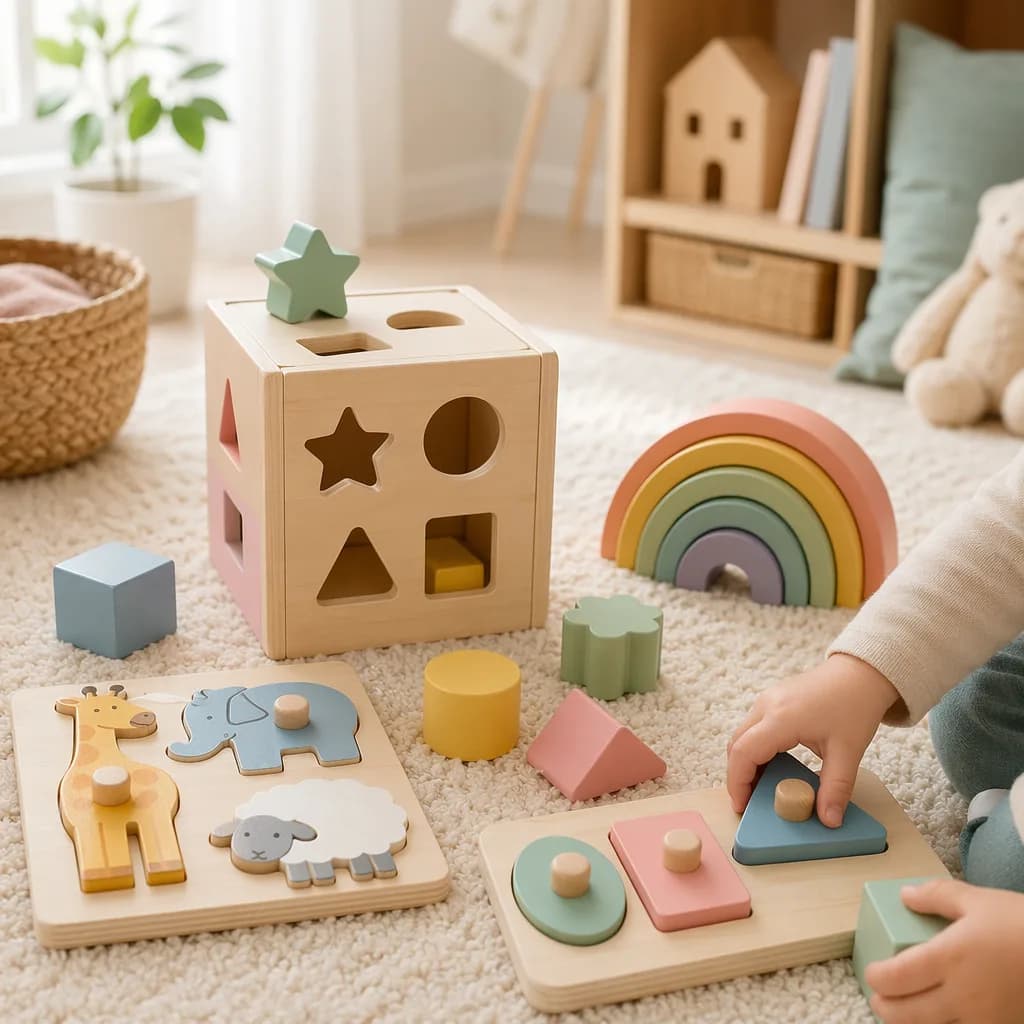
Shape sorters and puzzles turn simple fitting, posting, and matching into a joyful little problem your baby can solve with you.
Shape sorters and puzzles are classic playroom toys with a lovely, clear idea. Your little one picks up a piece, studies it, turns it, and tries to make it fit. Sometimes it drops in with a happy clunk. Sometimes it gets tried sideways first. That is part of the fun.
For younger toddlers, shape sorters often look like boxes, buckets, balls, or boards with holes. Your baby posts circles, squares, stars, and triangles into matching spaces. For older toddlers, puzzles may have chunky knobs, inset shapes, animals, vehicles, or simple scenes. By age two or three, many children enjoy puzzles with more pieces and a picture to complete.
The delight comes from the mix of mystery and success. You can almost see your baby thinking. Your child may clap after fitting one piece. They may hand it to you for help, then try again. That shared “we did it” moment brings real joy. It makes a quiet afternoon feel full of discovery.
These toys also grow nicely with your child. At 12 to 18 months, your baby may mostly bang, mouth, stack, dump, and post pieces. At 18 to 24 months, your toddler may start matching shapes with more purpose. From 2 to 3 years, your little one may notice colours, pictures, edges, and where each piece belongs.
Shape sorting and puzzle play can support many early skills at once. Your baby uses their hands, eyes, and mind together. They reach, grasp, rotate, push, and release. These small actions can help build fine motor control for later everyday tasks, like turning pages or using a spoon.
They also invite problem solving in a gentle way. Your little one learns that a piece may not fit on the first try. They turn it. They compare it. They test a new hole. This kind of trial and error often helps toddlers build patience and confidence.
You can support language as you play together. You might say, “Round circle,” “blue square,” or “the cat goes here.” Your baby hears words linked to real objects and actions. Over time, many toddlers begin to copy those words. They may point, name, or ask for “more.”
Shape sorters can also support early spatial thinking. Your child starts to notice size, shape, direction, and position. A triangle needs corners in the right place. A puzzle piece needs to be turned just so. These tiny discoveries can lay helpful groundwork for later building, drawing, and early maths play.
There is emotional growth here too. When your baby keeps trying, they practise staying with a challenge. When you smile, wait, and offer gentle support, your child feels safe to try. The toy becomes more than a task. It becomes a warm back-and-forth between you and your little one.
Choose pieces that suit your child’s stage right now. For 12 to 18 months, look for chunky pieces that are easy to grip. Simple shapes and clear openings make play more rewarding. A sorter with a removable lid can help your baby enjoy both posting and dumping.
For 18 to 24 months, you may want a little more variety. Look for bright, clear shapes, simple animals, or familiar objects. Knob puzzles can help your toddler lift and place pieces. Inset puzzles with obvious cut-outs make matching feel doable.
For 2 to 3 years, try puzzles with a few more pieces. Picture puzzles with sturdy parts can keep your child interested. Themes from daily life work well, like food, pets, vehicles, or bedtime. Your toddler may love naming each piece before placing it.
Good design matters. Look for smooth edges, sturdy materials, and pieces that feel comfortable in your hand. Clear contrast between the pieces and the base can help your baby see where things go. Pieces that stand up to dropping, chewing, and enthusiastic play are useful in real family life.
It also helps when the toy is open enough for more than one kind of play. Your child may sort by shape one day and colour the next. They may hide pieces in a basket, stack them, or use them in pretend play. That flexibility can keep the toy fresh for longer.
Keep small parts away from children who still mouth toys heavily.
No published comparisons yet for this category.
