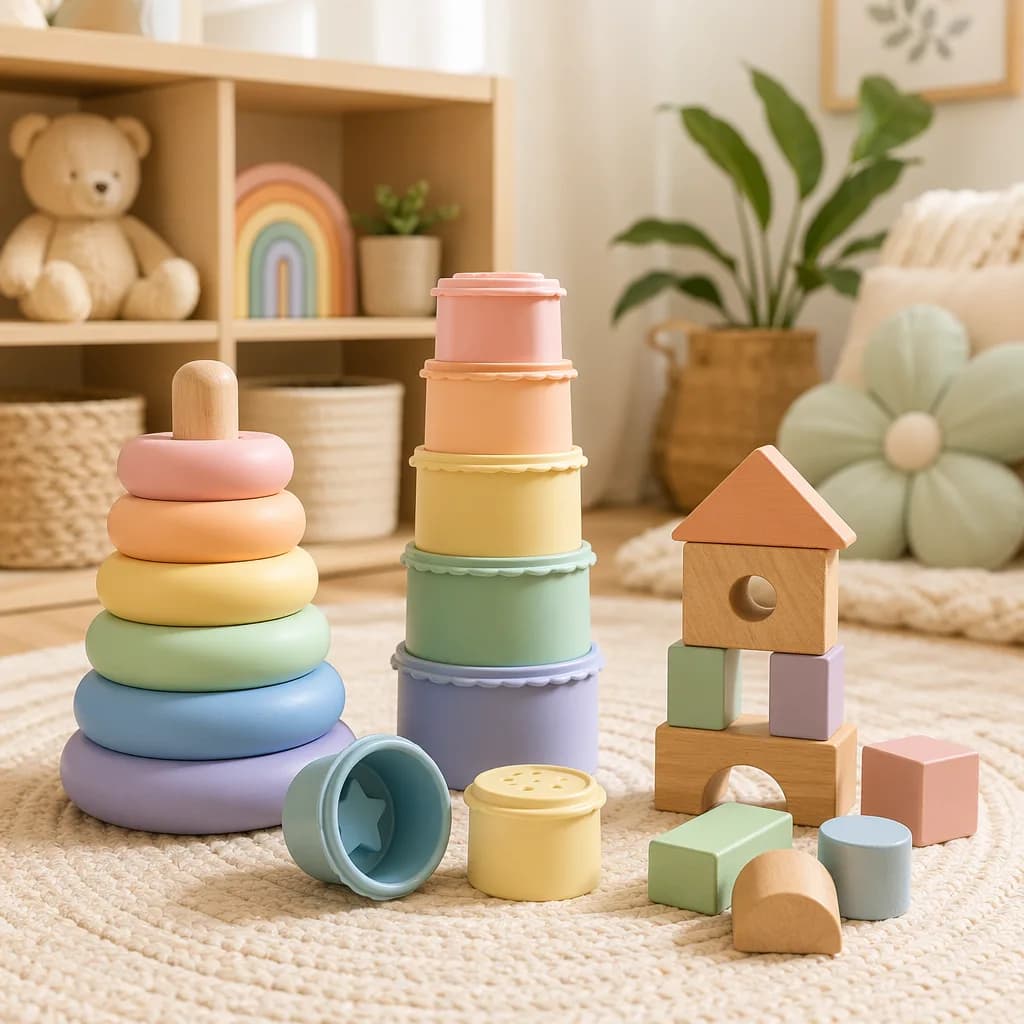
Stacking and nesting toys are simple playthings that fit together, pile up, tip over, and invite your baby to try again.
Stacking and nesting toys are usually cups, rings, blocks, or tubs in graduated sizes. Your baby can place one inside another. Your little one can also build a wobbly tower, knock it down, and beam at you with pride.
That is the lovely thing about this category. It turns basic actions into real discovery. Your baby grabs, bangs, mouths, drops, scoops, hides, and sorts. You sit nearby and see a tiny scientist at work.
Many parents love these toys because they grow with your baby. At 6 to 9 months, your baby may mostly explore the feel and sound. They may clap two cups together or chew the rim. Around 9 to 12 months, your little one may start dropping smaller pieces into bigger ones. By 12 to 18 months, you may see more careful stacking, nesting, pouring, and pretend play.
They also bring easy joy to your day. A tower falling over gets a giggle. A hidden cup feels like a surprise. A ring that lands in the right place earns a happy look back at you. The play is simple, but the connection feels big.
Stacking and nesting toys can support hand skills in very practical ways. Your baby reaches, grasps, releases, and adjusts. Those small moves often help build finger control for later feeding, drawing, and dressing.
They can also support hand-eye coordination. Your baby learns to aim a cup at a space. Your little one tries to place a ring on a post or balance a block on top. It may take many tries. That is part of the joy. You can watch your baby pause, think, and try a new angle.
These toys often help babies explore size and order. A big cup holds a little cup. A tiny ring does not fit over a wide shape. Your baby may not know the words yet, but the ideas start to feel familiar through play.
Cause and effect shows up again and again. If your baby pushes the tower, it falls. If your little one drops a block into a cup, it makes a sound. If you hide a small cup under a bigger one, your baby may search for it. These little moments can support early problem solving.
Language can grow here too. You can say, “in,” “out,” “up,” “down,” “big,” and “small.” You can count pieces as you stack. You can name colors, shapes, and actions. Your warm voice gives the play more meaning, and your baby gets to share the fun with you.
Choose stacking and nesting toys that match your baby’s stage right now. For 6 to 9 months, simple cups or soft rings are easy to grab. Light pieces work well for busy hands. Smooth edges feel comfortable during mouthing and banging.
For 9 to 12 months, look for pieces that nest clearly. Cups with different sizes make success easier to see. Rings with a sturdy base can invite repeated practice. Pieces that make a gentle sound when tapped can add interest.
For 12 to 18 months, you may enjoy sets with more challenge. Look for varied shapes, simple numbers, or textured surfaces. These can support sorting, counting, and pretend cooking or bath play. A toy that works in several ways tends to stay useful longer.
Think about easy cleanup too. Nesting cups save space in your basket. Larger pieces are easier to find under the sofa. Washable materials help when your baby takes play from the floor to the high chair.
Good stacking toys do not need lights or loud sounds. The best ones invite your baby to act. They leave room for your little one to lead. They also leave room for you to join in gently, cheer, and laugh together.
Pick pieces that are the right size for your baby’s age and play stage.
No published comparisons yet for this category.
