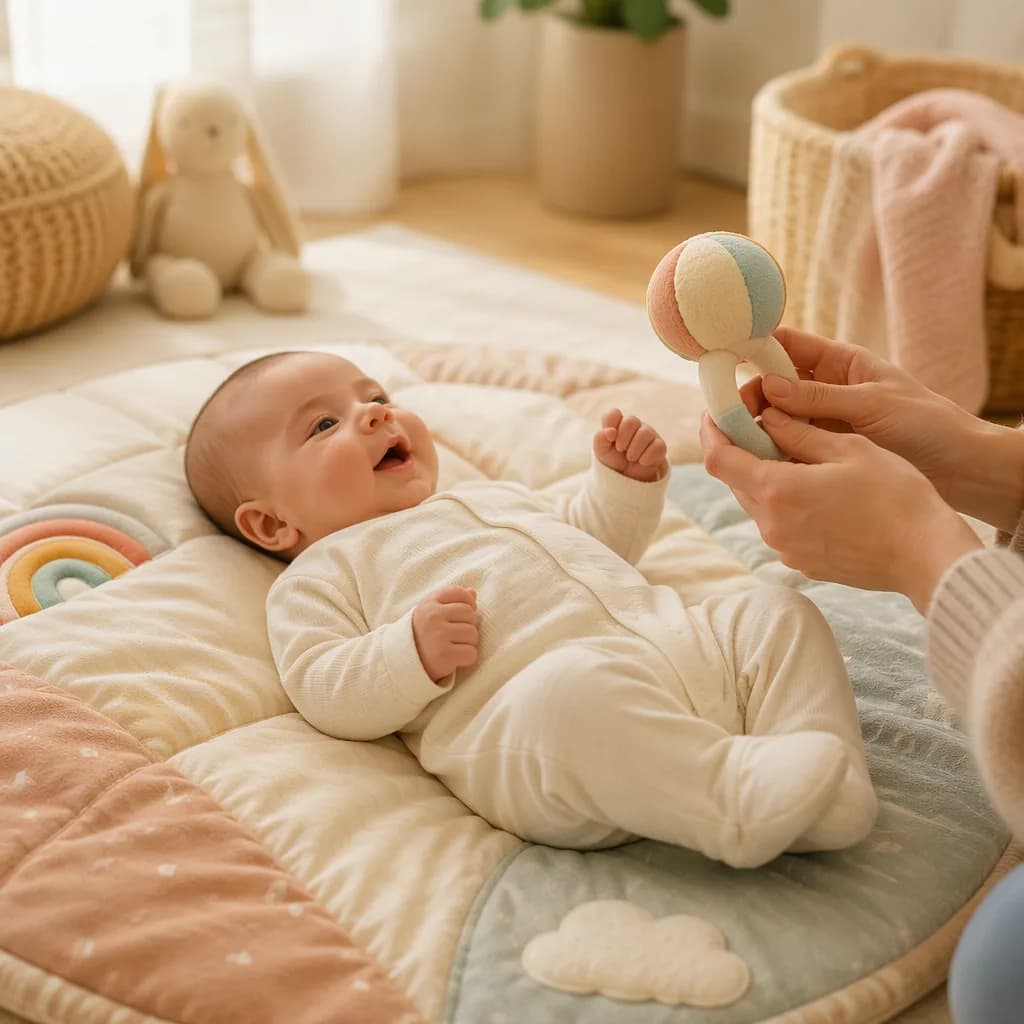
Your baby answers with little sounds before real words arrive, and those tiny coos, cries, fusses, and happy noises matter.
At 0-3 months, language starts in the soft back-and-forth between you and your baby. You lean close and say, “Hi, sweet baby.” Your baby may pause, look toward you, wiggle, or make a small sound. It might be a breathy coo. It might be a squeak. It might be a fussy little protest when they want a cuddle or feed.
This is early communication.
Your baby doesn’t need words yet to join you. They use sound, body movement, face, and quiet moments. You answer with your voice, your smile, and your gentle rhythm. Over time, your baby begins to learn that sounds can bring connection. A cry brings you near. A happy coo gets your warm face. A small noise can turn into a tiny “conversation” between the two of you.
These early voice moments can feel simple, but they are rich. You are showing your baby that communication has a pattern. One person acts, the other responds. Then it happens again. That loving turn-taking is one of the first roots of later language.
Language is a shared system for communicating meaning through spoken, signed, and written forms, according to Wikipedia, the free encyclopedia. Your baby is far from sentences, of course. Still, the earliest pieces begin now: listening, noticing your voice, reacting to sound, and using their own voice to show comfort or discomfort.
During birth to 3 months, many babies seem to know a parent’s voice and may quiet when crying, react to loud sounds, wake to loud voices or sounds, and make different pleasure and displeasure sounds, such as coos, cries, fusses, laughs, or giggles, according to Age-Appropriate Speech and Language Milestones. The same source notes that babies may make noise and smile when spoken to, and may respond to the sound of a rattle.
That means your baby is already linking sound with people and moments. Your familiar voice can become a steady cue. Your changing tone can add feeling. Your baby hears the rise and fall in your speech long before they understand the words.
In the first year, babies absorb language by watching, listening, and responding to your voice and facial expressions, according to 50 Best Toys for Language Development. For a 0-3 month baby, that often looks wonderfully ordinary. You talk while changing a diaper. You pause and wait. Your baby kicks, blinks, or makes a little noise. You answer as if it counts, because it does.
These moments may support early communication because they pair sound with closeness. Your baby hears language in a safe, loving setting. They also see your face move as you talk. The sound, expression, touch, and timing all work together.
Many babies this age make a small mix of sounds. You might hear soft coos during a calm diaper change. You may hear sharper cries when your baby feels hungry, tired, or uncomfortable. Some little ones make more sound after feeding or when they are lying on your chest. Others stay quieter and show interest through wide eyes, stillness, or body movement.
You may notice your baby reacts differently to your voice than to a sudden loud noise. A loud sound may startle them. Your voice may help them settle, especially when you speak in a soft, steady way. Age-Appropriate Speech and Language Milestones describes both reactions during birth to 3 months.
Some babies “answer” you with timing. You talk, then pause. Your baby moves their mouth, sighs, squeaks, or stares at you. Then you respond. It may not happen every time. It may last only a few seconds. Still, those little exchanges can feel like the first tiny chats.
You might also hear different cries. A hungry cry may sound different from a tired cry. A fussy sound may turn into a calmer coo once your baby feels close to you. Many parents learn these patterns slowly. You don’t need to decode each sound right away. Your warm response teaches your baby that their sounds reach someone who loves them.
Often around this stage, babies enjoy your face as much as your voice. They may watch your mouth, brighten when spoken to, or make a small noise when you smile and talk. 50 Best Toys for Language Development highlights the role of voice and facial expressions in early language learning during the first year.
If your baby doesn’t coo much yet, that can still fit within a broad range. Some little ones focus more on listening first. Others vocalize in short bursts. Look for the whole picture: reactions to sound, comfort with your voice, different cries or noises, and moments of shared attention.
- ). Keep them playful and non-medical; never prescribe therapy or medical action.If you have concerns about your baby’s hearing, sound reactions, or early communication, chat with your pediatrician.
