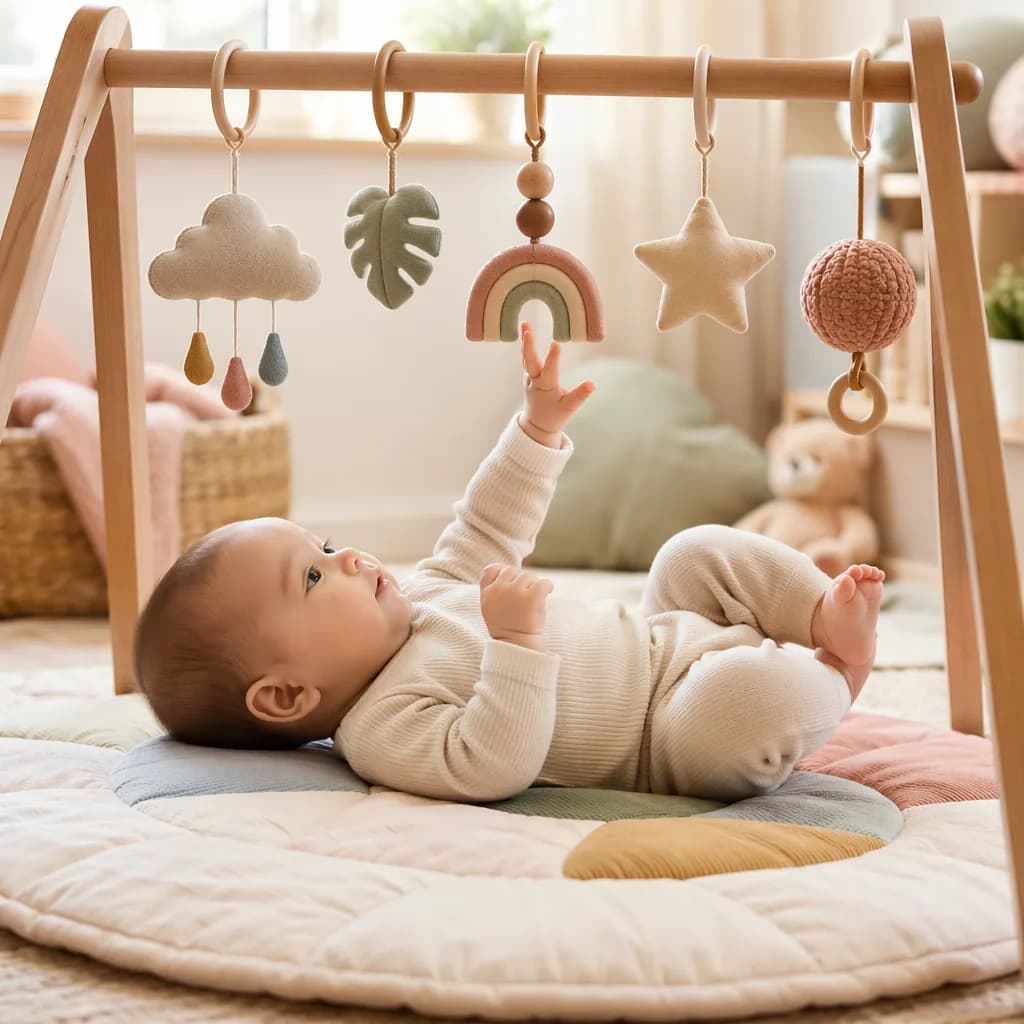
Baby cognitive development at 3 to 6 months shows up in curious looking, reaching, listening, and playful face watching. Your baby starts to connect what they see, hear, and feel. A rattle makes a sound. Your face brings comfort. A mirror offers a bright, fascinating “friend.” These tiny moments can feel simple. Yet they are rich learning for your little one.
Between 3 and 6 months, your baby often becomes a more eager explorer. You may see your baby stare at your face, then turn toward a sound. They may watch a toy swing above them. They may bring both hands toward the middle of the body. They may bat at a dangling toy, open their fingers, or hold a rattle for a short time.
Your baby’s world grows through repetition. You smile, and your baby watches. You shake a toy, and your baby listens. You pause, and your baby may wiggle, coo, or wait for the fun to start again. These back-and-forth moments build joyful learning together.
Mirrors can become especially fun. By 6 months, many babies like to look at themselves in a mirror, according to Milestones by 6 Months For Everyone. Your baby may not understand the reflection yet. Still, the face, movement, and light can invite focus, smiles, and gentle social play.
This stage is also full of “I know you” moments. By 6 months, many babies know familiar people, according to Milestones by 6 Months For Everyone. Your voice, your smell, and your face can help your baby feel safe enough to look, listen, and learn.
Your baby learns through the senses first. Seeing, hearing, touching, and moving all work together. Early play helps your baby connect a sight with a sound, or a movement with a feeling. Early Childhood Development Toys By Age says babies prepare for later developmental achievements through motor, sensory, and emotional experience.
Around this age, hands become more useful tools for learning. By 4 months, babies can bring their hands together in the middle and use their eyes to coordinate hand movement, according to Early Childhood Development Toys By Age. This matters because looking and reaching begin to team up. Your baby sees a toy, moves a hand, and starts to learn, “My body can make things happen.”
Focus also grows. Early Childhood Development Toys By Age notes that mirrors can improve focus on faces and objects about 8 to 12 inches away. That close range fits your loving face during cuddles, feeding, and floor play. Your baby gets many chances to study your eyes, mouth, and expressions.
The CDC describes developmental milestones as things most children, 75% or more, can do by a certain age, in Milestones by 6 Months For Everyone. So these skills typically emerge around this window, with each baby moving in their own pattern. The big picture is your baby’s growing curiosity. Your baby is learning that people, sounds, colors, and touch all carry meaning.
Many babies spend longer looking at faces now. Your baby may study your mouth while you talk. They may brighten when you come close. They may quiet when they hear your voice. Some little ones laugh during familiar games, and laughing appears as a 6-month milestone in Milestones by 6 Months For Everyone.
You may also notice more interest in objects. Your baby may track a colorful toy with their eyes. They may turn toward a musical mobile. They may stare at high-contrast pictures or baby faces in a book. Early Childhood Development Toys By Age links books with baby faces, animals, and high contrast to social and cognitive development.
Some babies love rattles. A rattle gives grip practice and tactile stimulation, according to Early Childhood Development Toys By Age. Your baby may hold it, mouth it, drop it, or look surprised when it makes noise. Each try gives your baby more information.
Many babies enjoy dangling toys on a play gym. Early Childhood Development Toys By Age says tripod gyms with dangling toys can enhance reach and grasp. Your baby may swipe with a whole arm at first. Later, they may aim more clearly. Some little ones reach often. Others mostly watch before they try.
Your baby may also take turns making sounds by 6 months, according to Milestones by 6 Months For Everyone. This can feel like a tiny conversation. You coo. Your baby coos back. You smile. Your baby wiggles. This gentle rhythm supports attention, memory, and connection.
- ). Keep them playful and non-medical; never prescribe therapy or medical action.If your baby seems to miss many 6-month milestones, you can chat with your pediatrician for gentle guidance.
