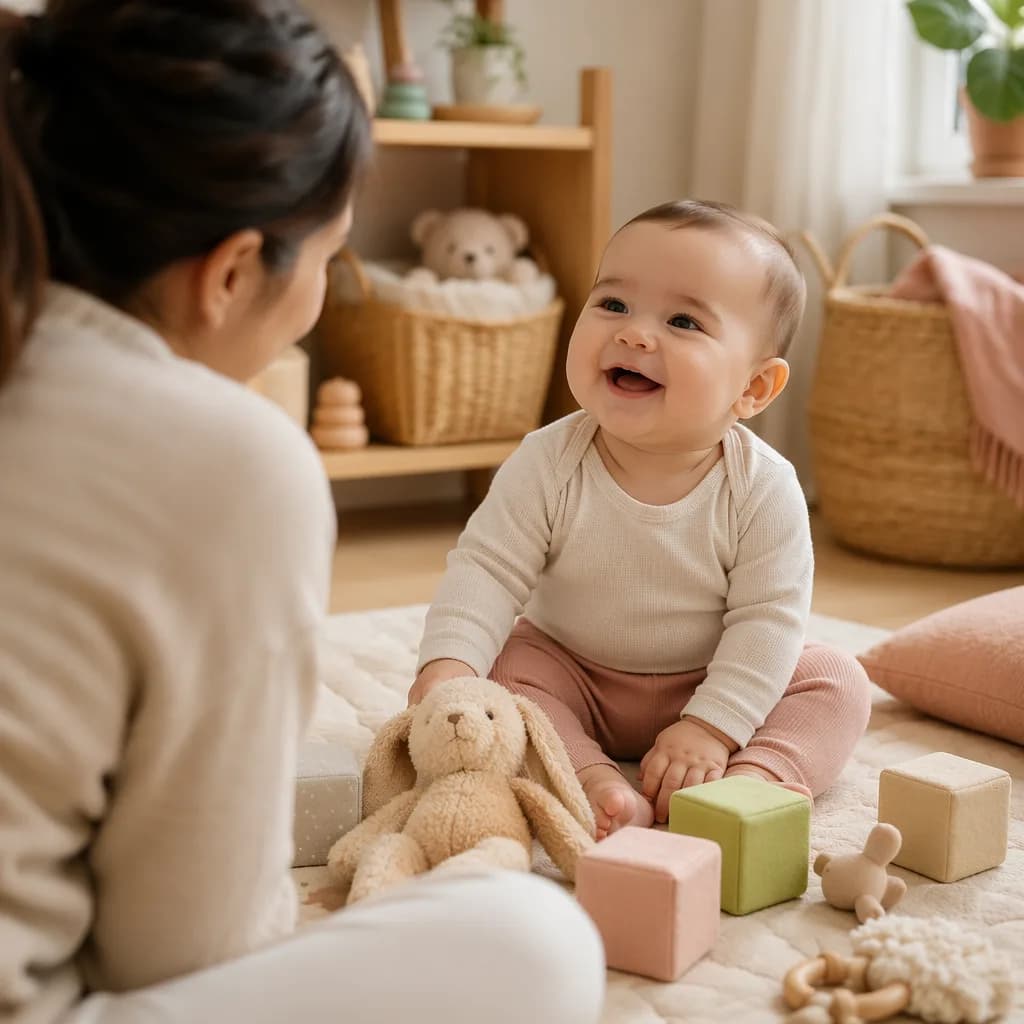
Your baby knows familiar faces, and this can make daily life feel sweeter, sillier, and more connected.
Around 6 to 9 months, many babies begin to show you that certain people feel known. Your baby may brighten when you walk into the room. They may kick, grin, laugh, or reach toward you. A grandparent who visits often may get a big smile. A new neighbor may get a long stare.
This is a beautiful social-emotional step. Your baby is not just seeing faces. Your baby is starting to connect faces with comfort, care, voices, routines, and love. You become part of their map of the world.
You might notice it during tiny moments. You lean over the crib in the morning, and your baby’s whole body seems to say, “There you are.” You pick them up after a nap, and they settle against your shoulder. You sing the same bath song, and their eyes lock onto your face.
These moments matter because your baby learns through warm back-and-forth time with you. A smile gets a smile. A laugh gets a laugh. A familiar voice helps your baby feel ready to look, listen, and join in.
By 6 months, the CDC says many babies know familiar people, like looking at themselves in a mirror, and laugh (CDC). These are social-emotional clues. Your baby is paying close attention to people, expressions, and repeated experiences.
Recognition grows from everyday patterns. Your baby hears your voice during feeding. They see your face during diaper changes. They feel your touch when you carry them. Over time, these repeated moments can help your baby link you with comfort and safety.
Your baby’s body skills may also support this new social awareness. In the 6 to 9 month period, St. Jude Children’s Research Hospital notes that babies may sit without support and get into a sitting position (St. Jude Children’s Research Hospital). Sitting gives your baby a fresh view of the room. From the floor, your baby can watch you make lunch, fold towels, or smile from across the carpet.
That wider view gives your baby more chances to study faces and voices. Your baby may turn toward you when you speak. They may look between you and another person, almost checking, “Do I know them?” This kind of watching can help build social memory.
The CDC also describes 6-month milestones as things most children, 75% or more, can do by that age (CDC). So this skill often starts before or around this window, then gets clearer with time. Some babies show it with big laughs and open arms. Others show it quietly, with steady eye contact or a calm body when you hold them.
Many babies show familiar-face recognition in bright, easy-to-read ways. Your baby may smile when you come close. They may laugh when you repeat a silly face. They may calm faster with you than with someone they don’t see often.
Some little ones act more thoughtful. Your baby may stare at a new person, then look back at you. They may take a few minutes to warm up. They may prefer your arms in a busy room, then relax once the room feels calmer.
Often around this age, mirror time becomes more fun too. Since the CDC notes that many babies like looking at themselves in a mirror by 6 months, your baby may grin at that interesting “other baby” in the glass (CDC). They may pat the mirror, laugh, or look from your real face to your reflected face.
Laughter can also become more social. Your baby may laugh because you laughed first. They may wait for you to repeat a funny sound. They may enjoy peekaboo, even if they don’t fully understand the trick yet. The joy is in your face coming back.
Some babies give different reactions to different familiar people. One parent may get excited kicking. A sibling may get a squeal. A regular caregiver may get a relaxed, sleepy snuggle. These differences can be your baby’s way of showing that each relationship has its own feel.
Your baby may also have quieter days. Tiredness, hunger, teething discomfort, or a busy setting can make social smiles less frequent. Look for patterns across many days, not one hard afternoon.
- ). Keep them playful and non-medical; never prescribe therapy or medical action.If your baby rarely responds to familiar voices, faces, smiles, or laughter across many days, you can chat with your pediatrician.
