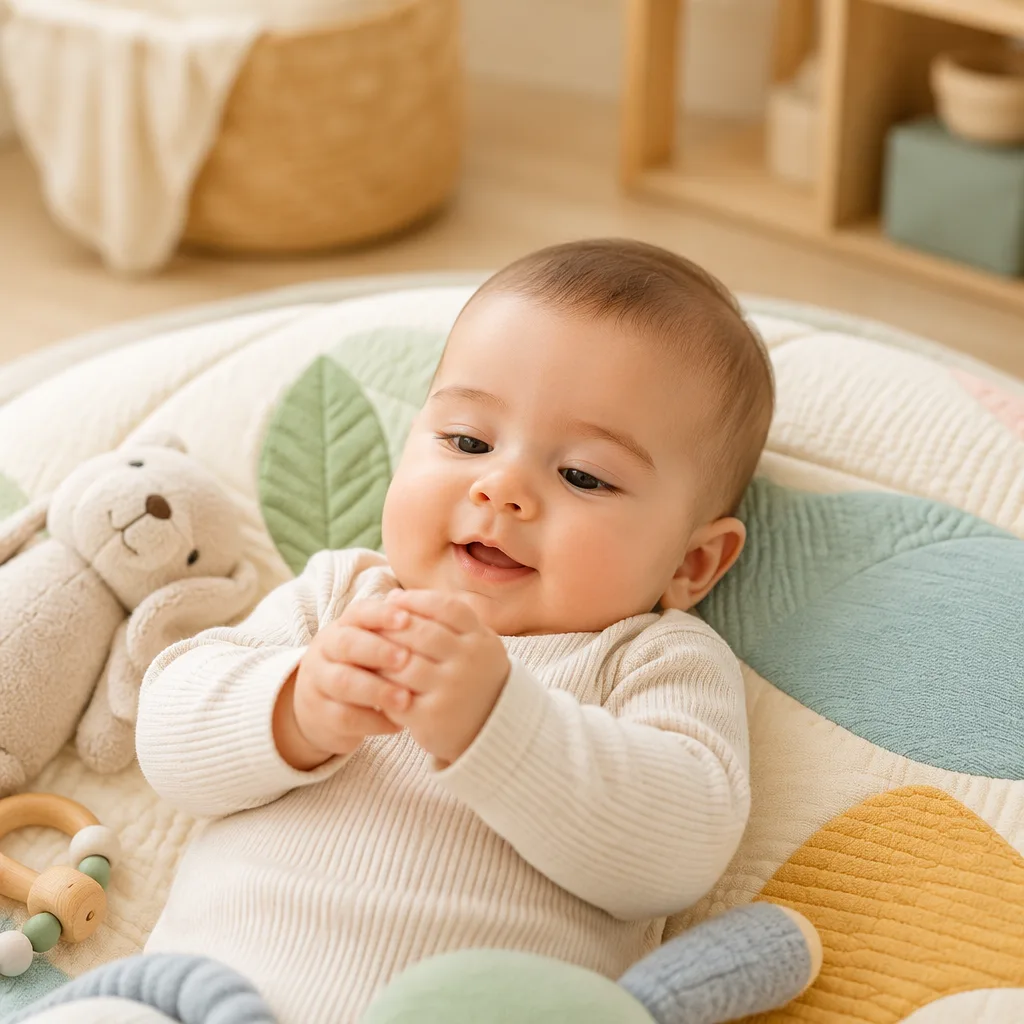
Bringing hands together with purpose is a sweet fine motor milestone that often appears between 3 and 6 months.
Your baby may start finding their own hands in a new way. One hand meets the other at the middle of the body. Fingers touch. Palms rub. Your baby may stare at this tiny hand meeting like it’s the best show in the house.
It can look simple. It matters a lot.
This middle-of-the-body play gives your baby a chance to connect looking, feeling, and moving. You might see your baby bring both hands to the chest during diaper changes. During a quiet cuddle, your baby may clasp their hands and hold them there for a few seconds. On a play mat, one hand may drift toward the other, then both hands may pat together in a soft, wobbly way.
This is different from a quick random swipe. Your baby is starting to use both sides of the body together. The movement may still look jerky. That’s fine. At this age, many babies are practicing control in little bursts.
You get a lovely window into your baby’s growing body map. Your baby is learning, “These hands are mine. I can bring them together. I can feel one hand with the other.” That discovery can bring real joy, for you and your baby.
Between 3 and 6 months, many babies gain better control of the muscles that guide the shoulders, arms, wrists, and hands. This helps your baby move their arms toward the center of the body, rather than keeping them mostly out to the sides. Fine motor growth at this stage often builds through small, repeated actions, much like a motor system depends on parts working together in a planned pattern (https://www.electricalvolt.com/types-of-electric-motors/).
Your baby’s vision and body sense are also working together more. When your baby sees a hand, feels it move, and then brings the other hand close, the brain gets helpful feedback. Over time, those little tries may support smoother movement.
There’s a gentle reason this milestone can feel so exciting. The center line of the body is becoming an easier place for your baby to find. Bringing hands together near the chest gives your baby a stable place to practice. It may support later skills, like reaching with more aim, passing a toy from one hand to the other, and exploring objects with two hands.
The word “motor” can mean movement powered by coordinated parts. In your baby, fine motor growth also depends on many parts working together: eyes, hands, arms, posture, attention, and touch. Sources about motor systems describe how movement depends on coordinated components and patterns of action, which gives a simple frame for understanding why small hand movements matter (https://www.theengineeringknowledge.com/what-is-motor-definition-types-working-principle-applications/; https://motortrade.com.ph/).
Your baby doesn’t need formal practice. Loving daily routines give plenty of chances. A clean onesie, your warm voice, a soft toy, and a few unhurried minutes can be enough.
Many babies begin by accidentally brushing one hand against the other. Then, over days or weeks, the movement may look more planned. Your baby may hold both hands together at the chest, open and close the fingers, or bring the hands toward the mouth.
Some little ones do this most during calm moments. Others show it during play, especially while lying on their back. You may notice your baby watching their hands closely, then trying to bring them together again.
Often around this age, the hands may still look fisted at times. Your baby may open the fingers, close them, and then curl them again. That shifting pattern can be part of early hand control. Some babies use one hand more in the moment, then switch later. Many babies are still quite wobbly with both hands.
Your baby may enjoy touching your fingers too. If you offer your clean finger near the middle of the chest, your baby may bring both hands toward it. The grasp may be brief. The effort still counts.
You might also see hand-to-hand play show up during feeding breaks, stroller time, or right after sleep. It may come and go. Tired babies may move less smoothly. Hungry babies may focus on comfort instead of play.
If you notice your baby uses one hand much less than the other, keeps one hand tightly closed most of the time, or seems very stiff or very floppy, you can chat with your pediatrician.
- ). Keep them playful and non-medical; never prescribe therapy or medical action.