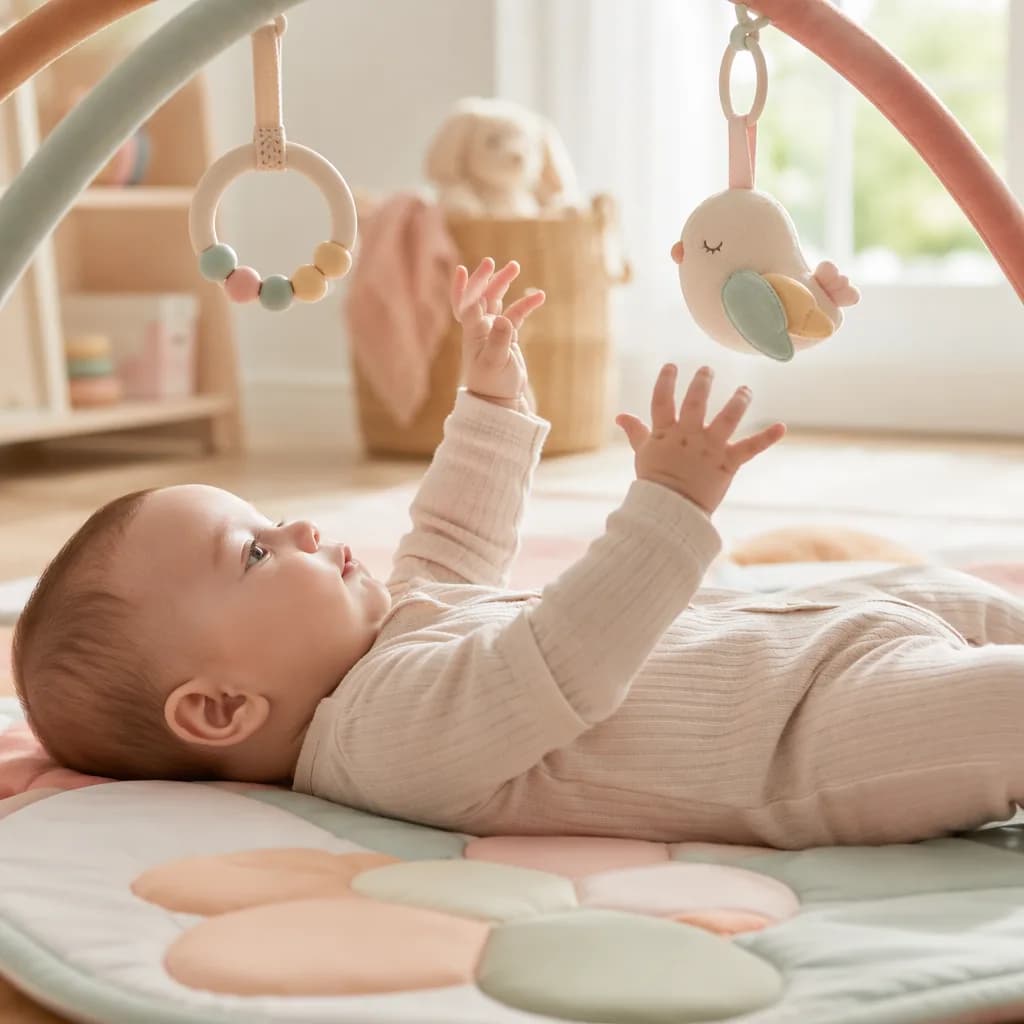
Early grasping with open hands is the gentle shift from tight newborn fists toward tiny moments of touch, hold, and release.
In these first months, your baby’s hands may start as curled little fists tucked near their chest. Then, during a calm feed or a diaper change, you may notice one hand soften. A thumb slips out. Fingers stretch. Your baby brushes your shirt, your finger, or the edge of a soft blanket.
It can look small. It matters.
This is early fine motor learning. Your baby isn’t yet reaching with clear aim like an older infant. At 0-3 months, many babies are still learning that their hands belong to them. They move, bump, grasp, and let go in simple ways. These tiny hand moments sit inside a bigger pattern of early learning through movement, touch, sounds, faces, and simple play, as described by Baby-Chick.
You might see your baby close their fingers around your finger for a few seconds. They may hold fabric by accident, then drop it. They may bring a hand near their mouth and suck on their knuckles. These moments can feel random, but your baby is getting gentle practice with touch, body awareness, and early hand use.
There is joy here. A tiny hand resting on your chest after a feed can be one of those quiet parent moments you remember.
Your baby’s nervous system and muscles are maturing quickly during the first year. VHTC describes infant milestones as observable skills and behaviors that show progressive maturation of the nervous system and muscular coordination. In plain parent language, your baby’s brain and body are learning to work together.
Fine motor skills start very simply. Before your baby can pick up a toy on purpose, they need many small building blocks. They need to notice touch. They need to open and close their fingers. They need to feel where their hands are. They need enough body control to bring a hand closer to the middle of the body.
Baby-Chick notes that babies from 0 to 3 months are learning through movement, touch, sounds, faces, and simple play. The same source also says a few simple options can encourage sensory exploration, body awareness, early grasping, and motor development. That fits this stage well. Your baby doesn’t need fancy gear. Your face, your voice, your finger, and a soft cloth can give plenty of gentle input.
Early hand opening also connects with whole-body movement. Your baby may wiggle arms and legs, turn toward your voice, or look briefly at a high-contrast image. Baby-Chick describes babies in this age range as beginning to notice high-contrast images, respond to voices, move arms and legs, and build early strength during tummy time. Those wider body experiences may support the hand skills you see during calm, close play.
Think of it like this: your baby is not practicing one skill in a neat little box. Touch, sight, sound, movement, and loving connection all overlap. You smile. Your baby quiets. Their hand opens against your shirt. Their fingers curl around yours. The learning is simple, warm, and real.
Many babies keep their hands fisted much of the time in the early weeks. You may see brief open-hand moments during sleep, after a bath, or while your baby feels relaxed in your arms.
Some little ones grasp your finger firmly when you touch their palm. Others hold for only a second. Both patterns can fit this early stage.
Often around these months, babies may wave their hands without clear aim. They may bat lightly against your chest during feeding. They may rub their cheek or mouth with a hand. Some babies bring both hands near the middle of the body for a moment, then lose that position again.
Your baby may seem more interested in your face than in a toy. That’s fine. Faces, voices, and touch are rich play at this age. Baby-Chick describes simple play, voices, movement, and touch as part of how babies learn from day one.
You may also notice that your baby’s hands change with mood. When they cry, startle, or feel tired, fists may tighten. When they settle, fingers may loosen. A calm cuddle after feeding can be a sweet time to notice these little changes.
There is a wide range here. Some babies seem busy with their hands early. Some take more time. Your baby’s daily rhythm, sleepiness, feeding, and temperament can all shape what you notice.
If your baby’s hands seem very stiff, rarely open, or one hand seems very different from the other, you can chat with your pediatrician.
- ). Keep them playful and non-medical; never prescribe therapy or medical action.These tiny hand moments may be easy to miss. Once you start watching, they can become a lovely part of your day together.
