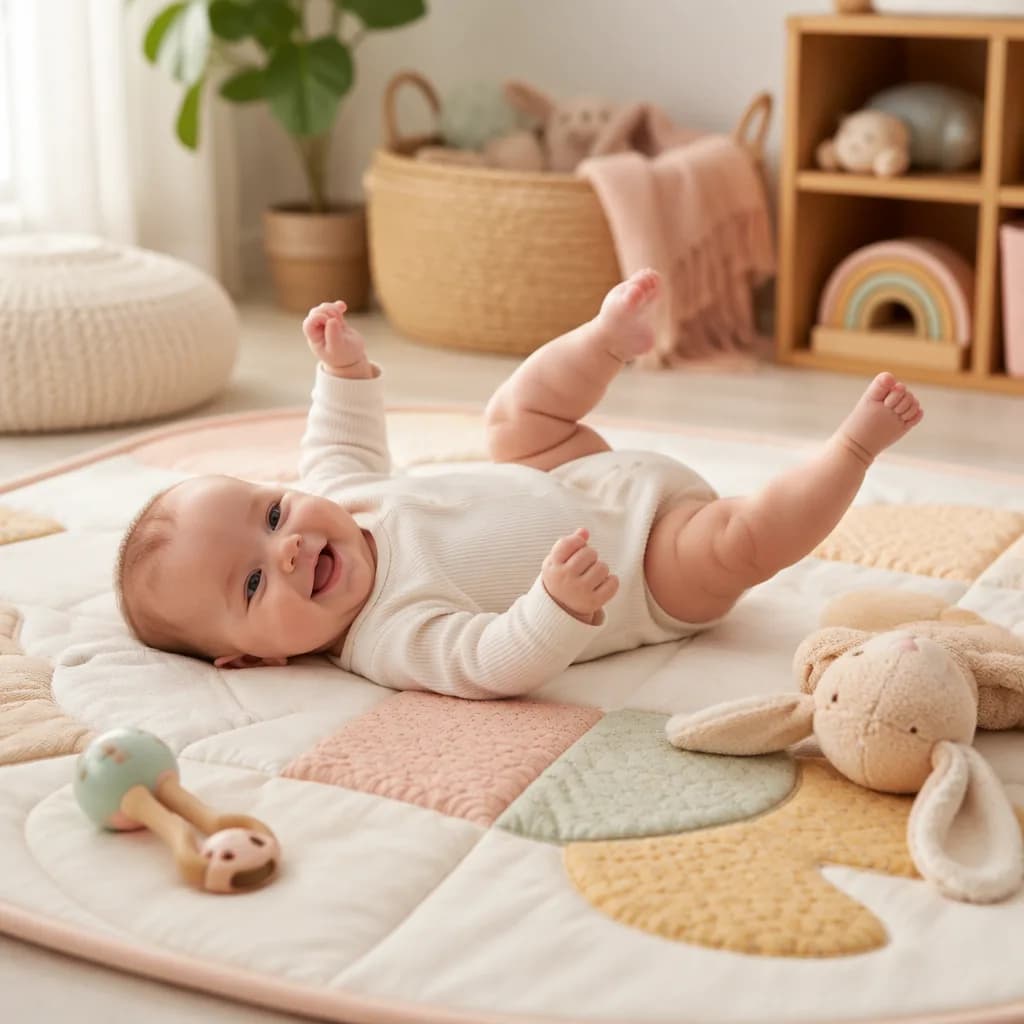
Excited arm and leg wiggles are those sweet whole-body kicks, waves, and little bursts your baby makes when something catches their attention.
You lean over the crib and say, “Hi, baby.” Suddenly, your baby’s arms pop up. Legs kick the mattress. Tiny feet pump like they’re pedaling an invisible bike. Their whole body seems to say, “I know you’re here!”
This is early gross motor development in a very baby-sized form. Your baby isn’t trying to crawl or roll yet. They’re learning that their body can move, respond, and show excitement. Those wiggles may look random. Still, they’re part of your baby’s growing body control.
You might notice it most during happy, familiar moments. A diaper change. Your face coming close. A soft song after feeding. The sound of your voice. Your baby may kick harder when you smile, then pause when you stop. It can feel like a tiny conversation, even before words arrive.
These movements matter because your baby is practicing big body patterns from the very beginning. Arms lift. Legs push. The trunk shifts. Shoulders and hips get tiny chances to work. It’s simple, but it’s real work for a new baby.
In the first 3 months, babies begin learning how to move their bodies and interact with others, according to 0 to 3 Month Baby - Motor Milestones to Look ForVideo. That mix matters. Movement and connection often show up together at this age. Your baby hears you, sees you, feels your touch, and their body answers with wiggles.
By 3 months, one motor milestone listed in 0 to 3 Month Baby - Motor Milestones to Look ForVideo is that a baby moves legs and arms off the surface when excited. That is the heart of this milestone. Your baby may lift both arms, kick both legs, or make uneven bursts that come and go. The movement may look wobbly because body control is still new.
The same source also notes that babies often work on tummy time skills by 3 months, including pushing up on arms and lifting and holding the head up. Those skills connect to the same growing strength. Your baby’s neck, shoulders, belly, hips, and back are slowly learning to join the team.
Parents often see age-based toys and play ideas grouped broadly, like the “Shop By Age 0-2” section on ToysRUs. For a young baby, though, the most useful “toy” is often you. Your face, voice, gentle touch, and steady floor time give your baby safe, simple chances to move.
Research suggests daily tummy time can help babies build core strength and meet early motor milestones, according to 0 to 3 Month Baby - Motor Milestones to Look ForVideo. For your baby, that may mean short, gentle practice while awake, calm, and watched. Even a minute or two can feel like a workout at first.
Many babies show excited arm and leg wiggles in short bursts. Your baby may kick fast for a few seconds, then rest. That pause is normal for a new body that tires quickly.
Some little ones wiggle most when they’re on their back. The firm surface gives their arms and legs room to move. You may see fists open and close too. By 3 months, babies may be able to move fists from closed to open and bring hands to mouth, according to 0 to 3 Month Baby - Motor Milestones to Look ForVideo.
Often around this age, movement looks uneven. One leg may kick more than the other. One arm may fly up while the other stays tucked. Your baby may startle, stretch, squirm, or make jerky little waves. Smooth control usually builds with time and practice.
You may also notice your baby moving more when excited by you. A bright voice might bring kicks. A familiar song might bring arm waves. A pause in your play may bring stillness. Then your smile starts it again. That back-and-forth can bring real joy to your day.
Some babies are quieter movers. They may watch your face more than they kick. Others seem to turn every diaper change into a dance party. Many babies shift between sleepy, calm, fussy, and lively states throughout the day.
If your parent gut feels concerned about your baby’s movement, you can chat with your pediatrician.
- ). Keep them playful and non-medical; never prescribe therapy or medical action.