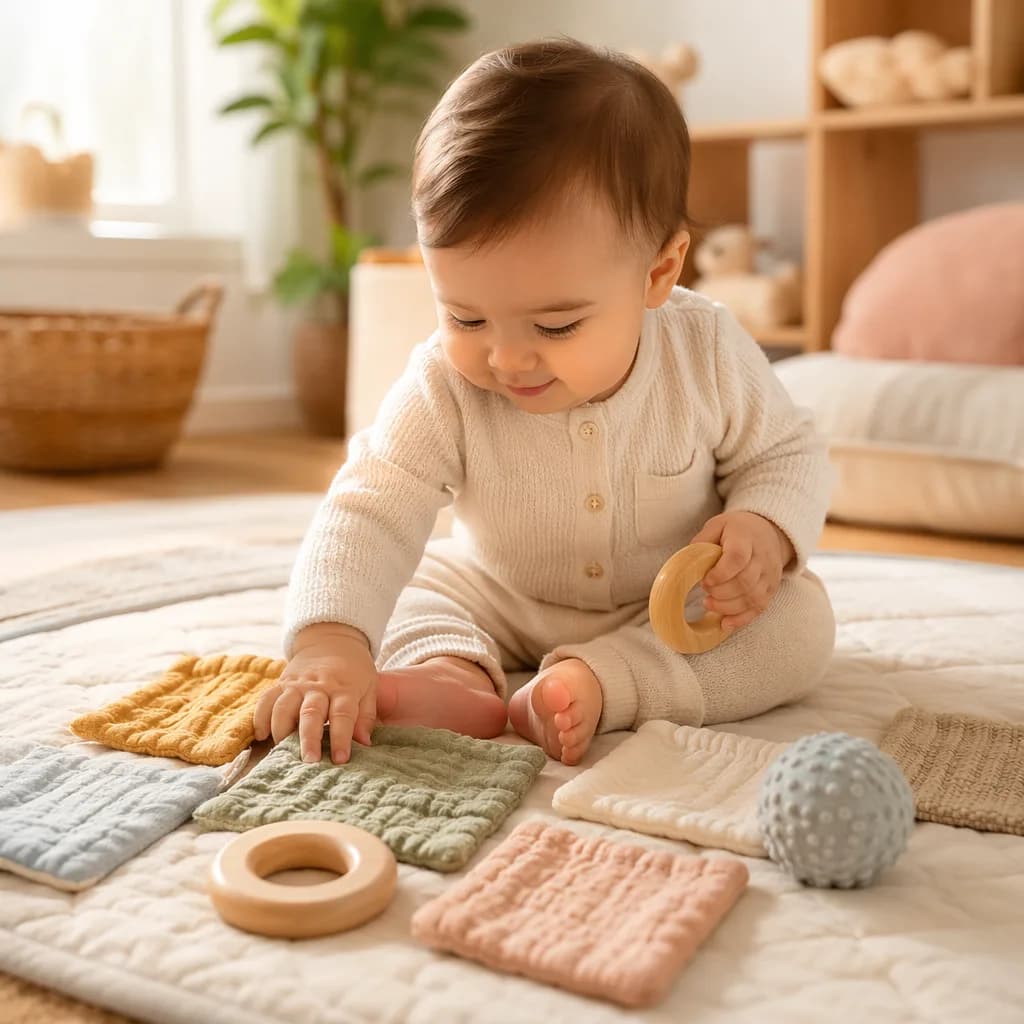
Exploring textures with busy hands is a sensory milestone you may see often between 12 and 18 months.
Your baby is becoming a tiny texture tester. A strawberry gets squeezed. A sock gets rubbed on a cheek. Sand may slip through your baby's fingers, then get patted flat with serious focus.
This kind of play can look simple. It matters, though. Your baby is learning how the world feels, sounds, moves, and changes. A wooden spoon feels hard. Yogurt feels cool and slippery. A stuffed bear feels soft. A bath cup feels smooth, then loud when it hits the tub.
You may notice your baby using both hands more during play. One hand may hold a block while the other taps it, turns it, or bangs it on the floor. Your little one may poke holes in play dough, crinkle paper, or press every button on a toy. These small moments bring your baby joy and give the brain useful information.
Mouth exploration may still show up, too. Many babies this age learn through hands and mouth together. You might offer a teether, a chunky board book, or a clean silicone cup and watch your baby compare each one. Smooth. Bumpy. Squishy. Heavy. Light.
It can be messy.
It can also be wonderful.
Around this age, your baby has more control over reaching, grasping, standing, walking, and shifting position. That means your baby can get to more objects and test them in more ways. The CDC describes how development shows up through how a child plays, learns, speaks, acts, and moves, and lists milestones that most children can do by 18 months in Milestones by 18 Months For Everyone. Sensory play sits right in that mix because your baby uses movement, touch, sight, sound, and curiosity together.
Research-based milestone guidance from Pathways.org describes earlier sensory growth as babies use both hands to explore toys, bring objects to their mouth, enjoy movement, and investigate shapes, sizes, and textures in toys and surroundings. By 12 to 18 months, many babies build on those earlier skills. Your baby may now explore with more purpose. They may squeeze, stack, drop, push, carry, and compare.
This sensory work also supports early problem solving. Your baby starts to notice that some things need a gentle touch, while others need more force. Pathways.org notes that babies experiment with the amount of force needed to pick up different objects during earlier infancy. That learning can keep growing now. A soft banana needs different hands than a chunky wooden block.
Toys and simple household objects can invite this kind of practice. BabyCenter notes toys for 12- to 18-month-olds often include shape sorters, musical toys, crayons, books, outdoor toys, and activity toys in Best toys for 12- to 18-month-olds for safe and skillful fun. Those playthings are popular for a reason. They give babies chances to feel, press, turn, tap, listen, and try again.
Your baby doesn't need fancy gear for this milestone. A basket with a clean washcloth, a rubber spatula, a wooden spoon, and a soft ball can be rich sensory work. You sit nearby. You name what you see. Your baby explores with love and support close at hand.
Many babies at 12 to 18 months love repeat testing. Your baby may drop the same spoon from the high chair again and again. The sound changes on carpet, tile, and the tray. That repetition helps your baby compare results.
Some little ones seek big input. They may stomp in puddles, press hard with crayons, hug pillows, or enjoy bouncing on your lap. Others prefer gentle textures. They may touch finger paint with one finger first, then pull back, then try again later.
Food textures can be part of this stage. Your baby may squish peas, smear oatmeal, or pick up tiny pieces with great care. Some babies enjoy sticky foods right away. Others need time before they accept gooey or lumpy feelings on their hands.
You might notice stronger likes and dislikes. Your baby may giggle at bubbles but frown at grass. They may love bath splashing but avoid wet sleeves. These preferences can shift with mood, hunger, sleep, and practice.
Many babies also start combining senses. Your baby may shake a container, listen, open it, touch what is inside, then shake it again. They are linking sound, sight, touch, and movement. It is busy work for a busy brain.
- ). Keep them playful and non-medical; never prescribe therapy or medical action.If your baby's sensory reactions worry you or daily routines feel very hard, you can chat with your pediatrician for guidance.
