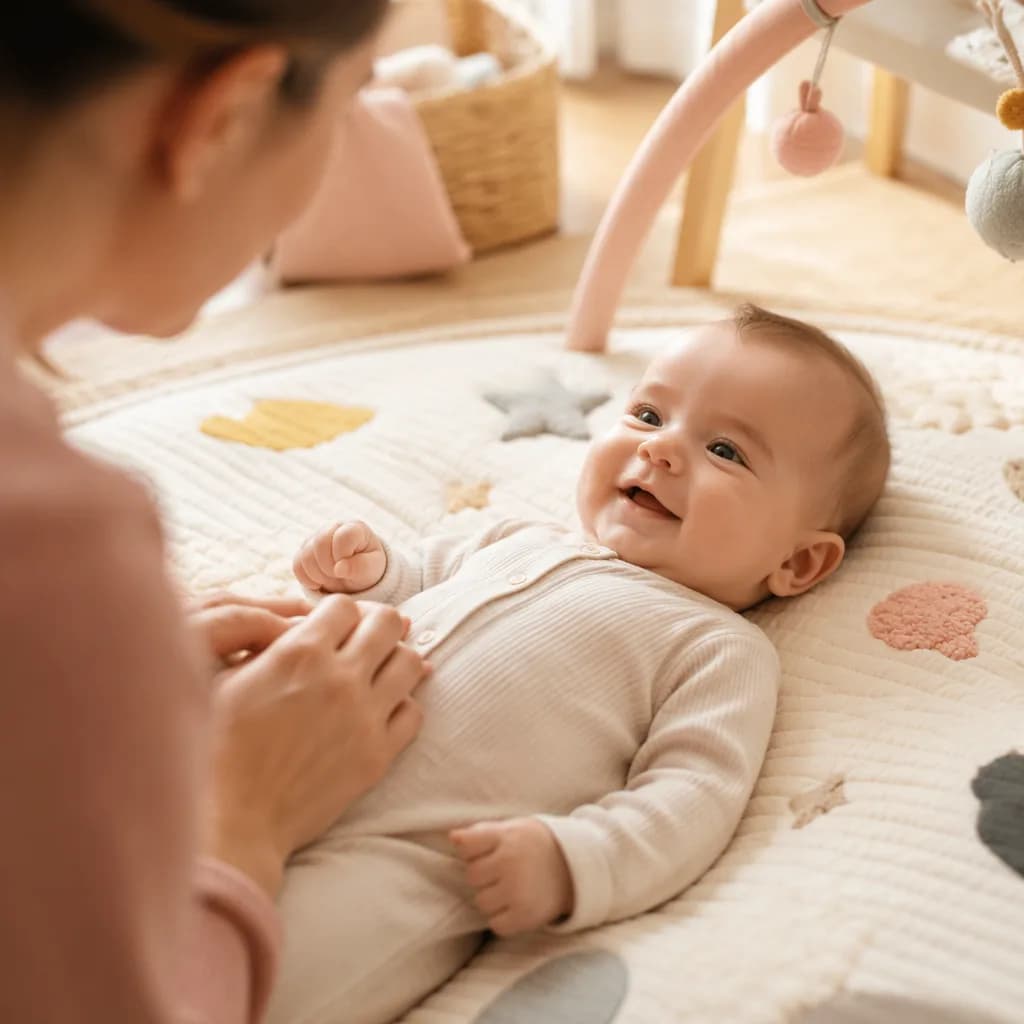
Early social connection with you begins in these first months through warm care, gentle play, and close face-to-face moments.
Your baby is just beginning life with you, and relationship is already part of the story. In the first months, your little one takes in a mix of sensory, motor, and emotional experience. These everyday experiences help babies prepare for later developmental achievements, according to UnityPoint Health.
This milestone may look simple from the outside. You hold your baby. You speak in a gentle voice. You offer a calm face. You share a soft rattle, a mirror, or a bright book. Your baby takes in pieces of that moment through sight, sound, touch, and closeness.
These small shared moments matter because early relationships help shape social-emotional growth. Virtual Lab School explains that emotional well-being in the early years has a powerful impact on social relationships. It also says early relationships with nurturing and responsive adults help infants and toddlers learn how to be in relationships.
So this stage is not about big performances. It is about tiny, loving patterns. You care for your baby. You notice your baby. You offer warmth again and again. Together, those moments can help lay a foundation for later skills like positive relationships, self-regulation, empathy, turn-taking, and sharing, as described by Virtual Lab School.
From 0 to 3 months, many babies prepare for new abilities through a blend of motor, sensory, and emotional experience. UnityPoint Health describes this early mix as part of how babies prepare for developmental achievements in the early months.
Your baby’s social-emotional world grows through care with you. Virtual Lab School says social-emotional development supports a young child’s sense of well-being. It also explains that important people in young children’s lives help lay the foundation for social-emotional skills.
Faces can be especially useful in this stage. UnityPoint Health notes that mirrors can improve focus on faces and objects when they sit about 8 to 12 inches away. It also says mirrors can stimulate social and language development. That makes simple face time with your baby feel meaningful, even when it lasts only a short while.
Sounds also fit this early stage. UnityPoint Health says musical mobiles can stimulate hearing and stimulate an infant to make sounds. Rattles can build grip and tactile stimulation. Books with baby faces, animals, and high contrast can support speech and language development, social development, and cognitive development, according to UnityPoint Health.
Your baby does not need fancy lessons. Your steady care gives your baby a gentle place to grow. Virtual Lab School highlights nurturing and responsive adults as central to early social-emotional learning. That means your everyday love, attention, and playful routines can help foster early connection.
Many babies in this age range enjoy short, simple social moments with you. Your baby may spend time looking at faces or objects placed close by, since UnityPoint Health describes face and object focus at about 8 to 12 inches when using mirrors.
Some little ones may seem drawn to bright, contrasting colors. UnityPoint Health recommends sensory toys with textures, sounds, and bright, contrasting colors for babies from 0 to 4 months. Your baby may also notice soft sounds from a mobile or rattle during calm play.
Many babies also explore through touch. A rattle can offer tactile stimulation, according to UnityPoint Health. A textured toy or soft book can give your baby another gentle way to take in the world with you nearby.
Often around these early months, your baby’s social world centers on caring adults. Virtual Lab School explains that infants and toddlers learn about relationships through early relationships with nurturing and responsive adults. So your little one’s milestone may appear during feeding, holding, changing, floor time, or quiet play.
Some babies may show interest in books with baby faces, animals, or high-contrast pictures. UnityPoint Health connects these books with speech and language development, social development, and cognitive development. You can keep it light. A few pages with your warm voice can be enough for a sweet shared moment.
- ). Keep them playful and non-medical; never prescribe therapy or medical action.If you feel concerned about your baby’s social-emotional development, you can chat with your pediatrician.
