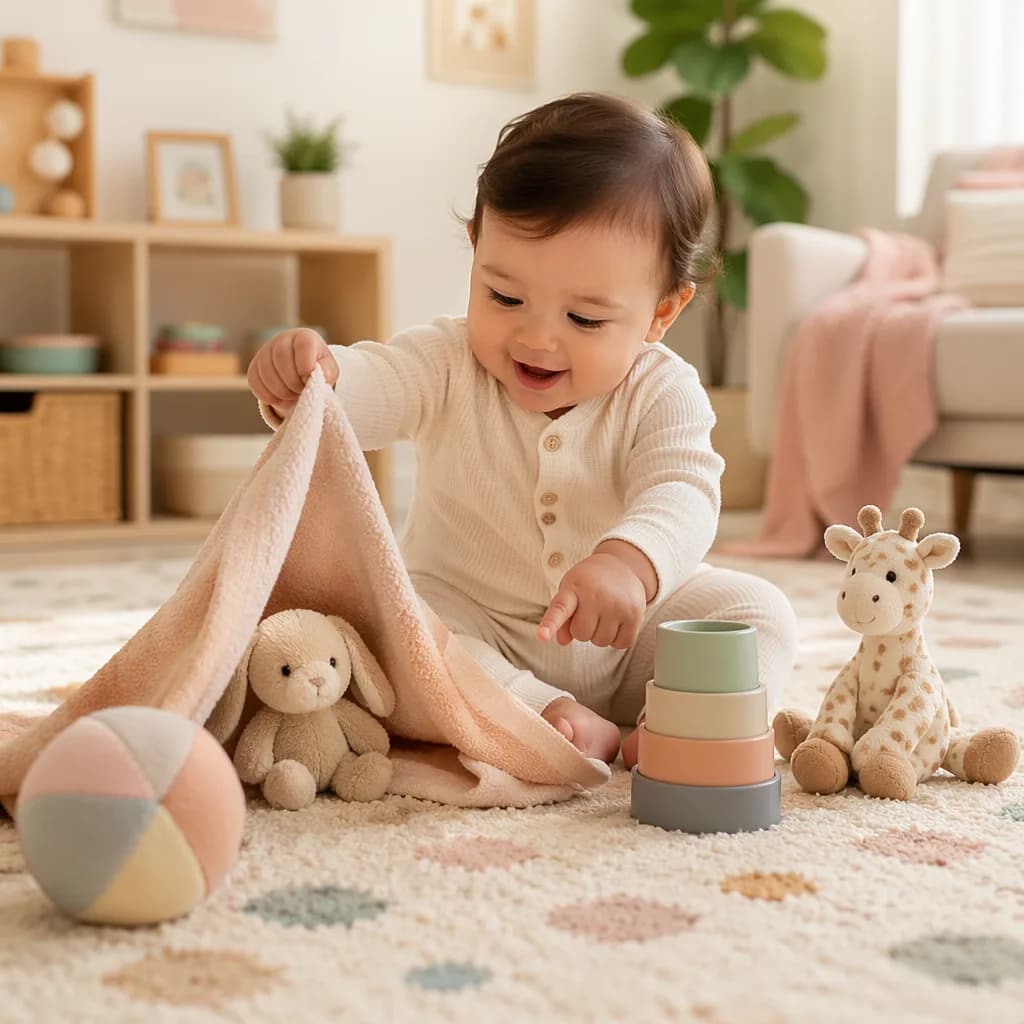
Finding hidden objects and naming simple things is a cognitive milestone many babies work on between 12 and 18 months.
Your baby is starting to make more sense of the small world around them. A cup is still a cup when it rolls under the chair. A teddy can be found when you ask for it. A toy under a blanket may be worth searching for.
At this age, play can look simple from the outside. But it’s full of thinking. Your baby may stack blocks and rings, push and pull toys, turn book pages, and use a crayon to make marks on paper. These are listed as common skills from 12 to 18 months by Nationwide Children's.
You may also see your baby play with toys more in their hands and less in their mouth. That gives them more chances to look, hold, turn, stack, and try again. Nationwide Children's describes this shift as one of the signs to look for in this age range.
Little moments count. You hide a ball under a cloth. Your baby lifts the cloth and beams. You ask, “Where’s your nose?” and your baby pats somewhere near the middle of their face. You say “bye-bye,” and your baby waves while trying the word too. Nationwide Children's notes that many children this age combine gestures with words, know body parts like eyes, nose, ears, and mouth, and look for hidden objects.
Between 12 and 18 months, many babies understand their surroundings more and get used to routines and object permanence, according to Good Play Guide. Object permanence means your baby can begin to understand that something still exists even when they can’t see it. That’s why hiding and finding games can be so joyful now.
This stage also brings more learning through play. Nationwide Children's lists stacking blocks and rings, pushing and pulling toys, finding hidden objects, and finding simple objects when asked as signs to look for from 12 to 18 months. These everyday actions give your baby practice with looking, remembering, matching words to objects, and using their hands with purpose.
By 18 months, how your child plays, learns, speaks, acts, and moves offers clues about development, according to CDC. The CDC also explains that developmental milestones are things most children, 75% or more, can do by a certain age. So these skills are useful guideposts, not a race.
Good Play Guide says hiding and finding games can be fun and may develop memory and concentration. It also notes that independent play starts to show more as children grow in confidence and ability. You might notice your baby staying with a toy a little longer, trying a stack again, or looking for a favorite object after you name it.
Books, songs, and visuals are helpful at this age too, according to Good Play Guide. Singing together encourages speech development, and Nationwide Children's notes that many children from 12 to 18 months babble, mimic simple words and sounds, and may use 8 to 10 words.
Many babies in this age range love repeated games. You may hide a block in the same spot five times, and your baby may still laugh each time they find it. Repetition can feel boring to you. For your baby, it can feel safe, clear, and exciting.
Some little ones may search eagerly for hidden objects. Others may need you to leave part of the toy showing. Both can fit this stage, since children reach milestones in many ways, including learning, moving, playing, and speaking, as Nationwide Children's explains.
Often around this time, your baby may find a simple object when you ask, such as a ball, teddy, or cup. Nationwide Children's names these examples directly. Your baby may also understand “No,” though that doesn’t mean they’ll stop every time. Understanding a word and managing an action are different skills.
You might see more pretend-like daily play with real objects, but keep your expectations gentle. The excerpts here support simple finding, stacking, pushing, pulling, book-page turning, mark-making, gestures with words, and naming or knowing body parts. Those are rich enough.
Some babies may be all about movement. They push a toy across the floor, carry an object while walking, or roll a ball forward. Nationwide Children's includes these as common skills in this age range. Other babies may sit with a book, flip pages, and point or babble. Both styles can show curiosity.
Many babies also begin to rely on routines. Good Play Guide says children from 12 to 18 months are getting used to routines. A familiar cleanup song, bedtime book, or goodbye wave can help your baby connect words, actions, and daily moments.
If you have concerns about your baby’s development, you can chat with your pediatrician and share what you’re seeing.
- ). Keep them playful and non-medical; never prescribe therapy or medical action.