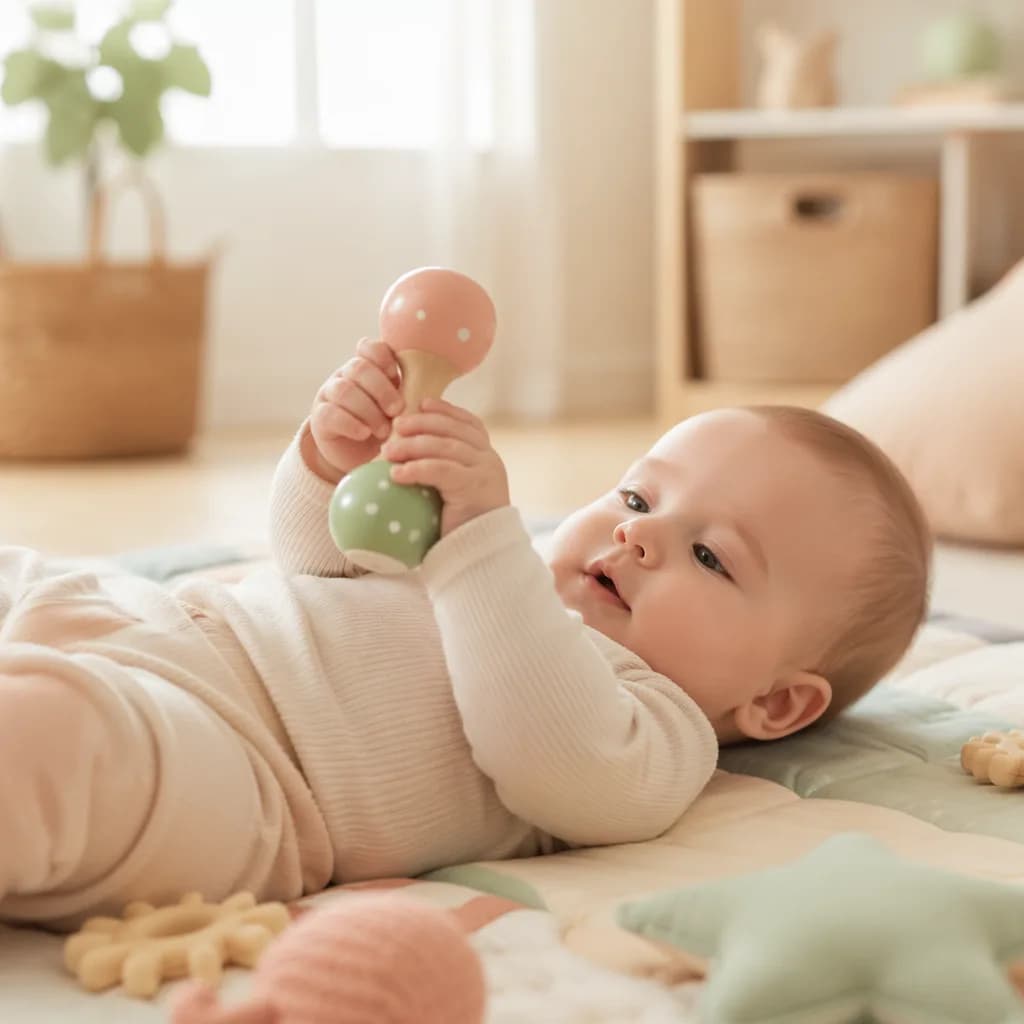
Grabbing and holding toys is a sweet fine motor milestone that often shows up between 3 and 6 months.
Your baby may spot a soft rattle, wave a busy little hand, and then manage to hold it for a moment. Maybe the toy bumps their cheek. Maybe it goes straight to their mouth. Maybe your baby looks surprised, as if their own hand just did something very clever.
It’s a small moment, but it can feel huge.
At this age, your baby’s hands are becoming more useful during play. They may open their fingers more, close them around a toy, and bring that toy closer to their face. You might see your baby clutch a fabric square during a diaper change, hold your finger while feeding, or grab at a crinkly toy on the floor.
This kind of play matters because hands are how your baby starts exploring the world up close. A toy has weight. A ring feels smooth. A soft book makes noise. Your baby learns through touch, sight, mouth, and movement all at once.
There’s joy here too. You hand over a rattle. Your baby holds it. You smile. Your baby watches you. That little back-and-forth can turn a simple toy into a shared moment between you and your baby.
Fine motor skills include using the hands and upper body for reaching, grasping, and handling objects, according to Fine motor skills: birth to 2 years. This same source explains that fine motor skills also connect with vision, often called hand-eye coordination. So when your baby looks at a toy and gets a hand near it, several skills are working together.
Around this age, your baby has had months of practice moving arms, bringing hands toward the mouth, and watching nearby faces and objects. Fine motor skills: birth to 2 years lists early skills such as bringing hands to the mouth, moving arms, and swinging arms at toys in the first months. Those early movements help set the stage for more purposeful grasping.
CDC's Developmental Milestones describes milestones as skills children reach in how they play, learn, speak, act, and move. That matters here because grabbing a toy isn’t just a hand skill. It sits right at the meeting point of play, learning, and movement.
By 3 to 6 months, many babies become more interested in objects they can see and touch. BabyCenter notes that toys for 3- to 6-month-olds often include rattles, sensory toys, tummy time toys, and easy-to-hold items. The details can vary from baby to baby, but the idea is simple: babies this age often enjoy safe objects they can look at, feel, mouth, and hold during close play with you.
Your baby doesn’t need fancy gear to practice. A clean cloth, a soft ring, or a light rattle can give your baby plenty to notice. The real magic is your baby’s growing ability to connect eyes, hands, and curiosity.
Many babies start with brief, wobbly holds. Your baby may grasp a toy for two seconds, drop it, and then seem annoyed that it disappeared. That’s part of the learning.
Some little ones hold best when the toy touches their palm first. Others wave both arms and catch the toy by chance. A few babies may stare hard, reach slowly, then close their fingers with great focus.
You may notice your baby uses both hands, but not in a neat way yet. One hand might grab while the other hand pats. Your baby may bring toys to the mouth because the mouth gives strong sensory feedback. That can be a normal part of exploring objects during baby play.
Many babies like toys with strong contrast, gentle sound, or easy shapes. A thin ring, soft rattle, or crinkly cloth can be easier to hold than a chunky block. Your baby may also enjoy holding your finger, your shirt, or a burp cloth. Real life counts.
Some days your baby may seem excited to practice. Other days, feeding, sleep, or a growth spurt may make play shorter. Skills can look different across the day. A calm, fed baby on a blanket may show you more than a tired baby in a noisy room.
You might also see your baby watch their own hands. That quiet hand study is lovely. Your baby is learning that those tiny fingers belong to them, and that hands can make things happen.
- ). Keep them playful and non-medical; never prescribe therapy or medical action.If your baby isn’t using their hands in ways you expect, you can chat with your pediatrician for gentle guidance.
