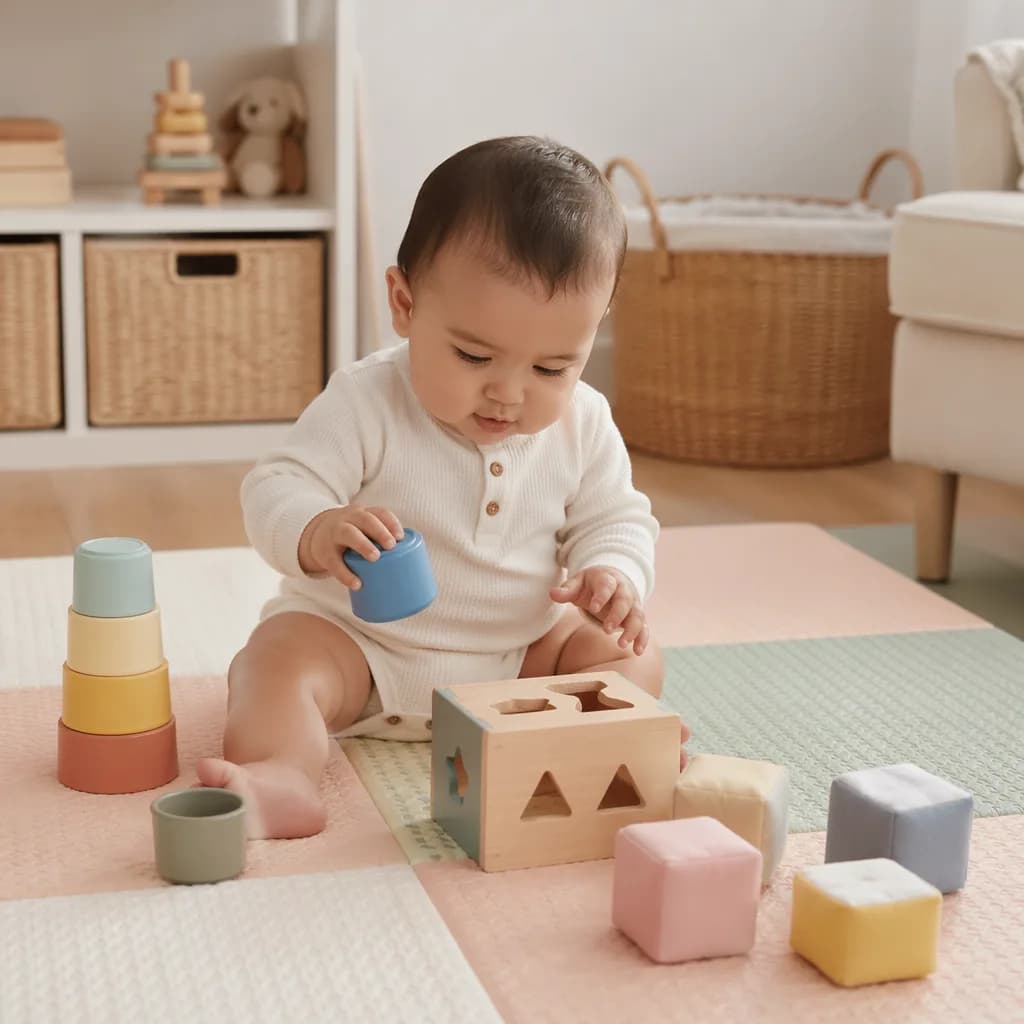
Learning through play at 9 months is your baby’s growing ability to explore, notice, remember, and make little choices during everyday moments.
At 9-12 months, play can start to feel more purposeful. Your baby may study a toy, turn it over, mouth it, bang it, and look back at you as if to say, “Did you see that?” That small pause matters. Your baby is taking in the world through touch, sound, sight, movement, and your loving face.
You might see your baby focus on a board book with bright pictures. Maybe your baby pats a photo of another baby’s face. Maybe a rattle gets a serious shake, then a grin. These are simple moments, but they’re rich ones. UnityPoint Health notes that books with baby faces, animals, and high contrast can support social and cognitive development, and that sensory toys with textures, sounds, and bright colors can be helpful developmental choices for babies (UnityPoint Health).
Your baby is also learning from you. Your voice, your smile, your gentle “you found it!” can turn a plain floor moment into a warm lesson. The CDC says how your child plays, learns, speaks, acts, and moves gives clues about development (Milestones by 9 Months For Everyone). So yes, that game with a spoon and a plastic bowl counts.
Around this age, many babies are gathering information in busy, whole-body ways. They look, listen, reach, grasp, and move as they learn. UnityPoint Health explains that early developmental gains grow from a mix of motor, sensory, and emotional experiences (UnityPoint Health). That means your baby’s thinking does not happen only during “learning time.” It happens while your baby squishes a soft block, hears a crinkle book, watches your eyebrows lift, or tries to grab a toy just out of reach.
The CDC describes developmental milestones as things most children, 75% or more, can do by a certain age (Milestones by 9 Months For Everyone). That helps frame this stage with calm. Milestones are useful guideposts, not a race. Your baby may show learning in a quiet way, like staring at a toy for a long time. Another baby may show it loudly, by squealing every time a cup falls from the high chair.
Your baby’s social world also shapes learning. The CDC lists several facial expressions by 9 months, such as happy, sad, angry, and surprised (Milestones by 9 Months For Everyone). When you mirror those expressions during play, your baby gets a tiny back-and-forth lesson. You smile, your baby smiles. You gasp, your baby looks again. Together, you’re building attention, memory, and shared joy in a very normal parent-baby way.
Many babies this age love cause-and-effect play. They shake something, hear a sound, then try it again. They drop a toy, watch where it lands, then wait for you. It can feel repetitive to you. For your baby, repetition can help make the world feel more predictable.
Some little ones study faces more than toys. They may watch your mouth while you talk, then look at your eyes. UnityPoint Health notes that mirrors can improve focus on faces and objects and can stimulate social and language development (UnityPoint Health). A safe baby mirror on the floor can give your baby a lot to notice, especially with you nearby naming what you see.
Many babies also enjoy books in their own wiggly way. Your baby may chew the corner, slap the page, or close the book fast. That still counts as early book play. UnityPoint Health links books with baby faces, animals, and high contrast to speech and language development, social development, and cognitive development (UnityPoint Health). You don’t need to finish the story. One picture, one sound, and one cuddle can be plenty.
You may also notice your baby’s reactions to new people. The CDC says babies by 9 months may be shy, clingy, or fearful around strangers (Milestones by 9 Months For Everyone). This can affect play too. Your baby may explore freely at home, then freeze at a busy family gathering. That shift can make sense. Your baby is learning who feels familiar and safe.
- ). Keep them playful and non-medical; never prescribe therapy or medical action.If you feel worried about how your baby plays, learns, or connects with you, chat with your pediatrician.
