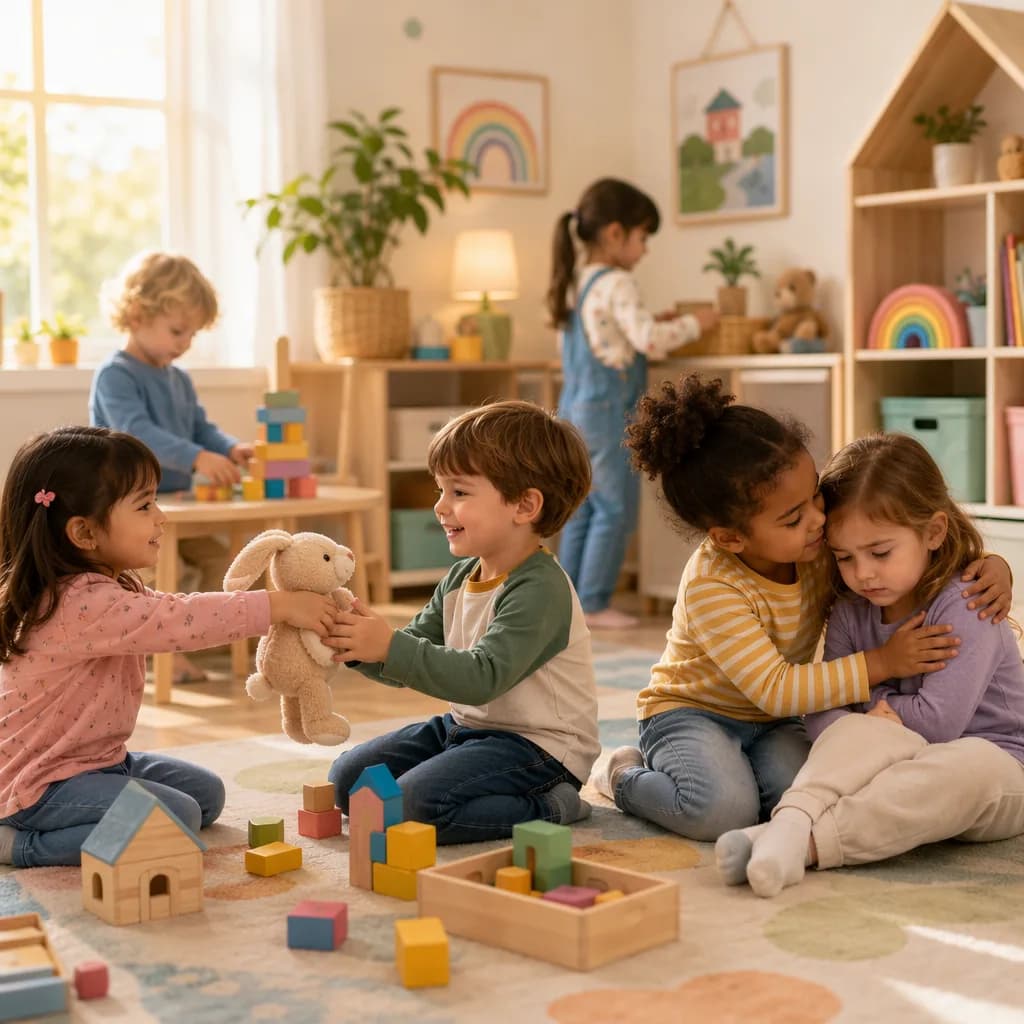
Playing with friends with growing care is a social-emotional milestone where your child starts to enjoy shared play, notice feelings, and take part in simple group plans.
At 4 to 5 years old, your child may look across the playground and choose a friend on purpose. Not just the nearest child. A real play partner.
You might hear, “Let’s be firefighters,” or “You be the baby dragon.” Then, a few minutes later, someone changes the plan. Your child may protest, bargain, laugh, or try again. This is the sweet, messy work of friendship.
This milestone often shows up in pretend play. Your child may assign roles, follow a shared story, and check if another child still wants to play. They may say, “Are you mad?” or “You can have this one.” Those tiny moments matter. Your child is learning that other people have ideas, feelings, and wishes too.
You may also see pride. Your child may tell you, “I helped Mateo build the zoo,” or “We made a rule.” That kind of talk shows your child is starting to see themselves as part of a group. It can bring real joy to your day.
It can also be loud.
Four- and five-year-olds still need your calm support. A shared game can fall apart over one red block. A turn can feel too long. A friend’s “no” can sting. Still, these little bumps give your child chances to practice care, words, waiting, and repair.
This age is rich for learning about feelings and relationships. All About Young Children: Information for Families on Children's Early Development names social-emotional development for children ages 48 months to 60 months as learning about “feelings and relationships.” That fits what you see at home, preschool, and the park. Your child is not just playing near others. They are often learning how to play with others.
Shared play also gives your child a live practice space. They hear another child’s idea. They compare it with their own. They may agree, refuse, copy, lead, or comfort. Each little exchange can help your child build social understanding.
The word “social” matters here. Wikipedia, the free encyclopedia describes social media as platforms that enable “communal activity” and help people “connect and build networks.” Your child’s play is not online, of course. But the basic social idea is familiar. People connect through shared activity. For your 4- or 5-year-old, that shared activity may be a block castle, a pretend restaurant, or a muddy “soup” made with leaves.
At this age, many children also grow more interested in belonging. They may care who sat beside them. They may remember who wanted the blue truck yesterday. They may make simple rules for a game and feel upset when those rules change. All of this can be part of learning how relationships work, as described in the 48 months to 60 months social-emotional section from All About Young Children: Information for Families on Children's Early Development.
Your role still matters deeply. You help your child name feelings, slow down, and try again. A gentle sentence like, “You wanted the shovel, and Sam is using it,” can give your child words when big feelings crowd in.
Many children around 4 to 5 years enjoy longer pretend games with friends. The play may have roles, rules, and lots of changes. One child might start as the vet, then become the dog, then become the teacher of all the dogs.
Some little ones love group play right away. They run toward friends and join the action quickly. Others watch first. Your child may stand nearby, copy a small action, then join when the play feels safer. That can still be social learning.
You may notice your child trying new friendship words. They might say, “Can I play?” or “I don’t like that.” They may also use words that feel sharp, like “You’re not my friend.” Often, those words mean, “I’m hurt,” or “I don’t know how to fix this yet.”
Many children this age can show real kindness. Your child may bring a toy to a crying friend or pat someone’s back. They may also grab, shout, or storm away when play gets hard. Both can live in the same child on the same morning.
Some little ones prefer one close friend. Others enjoy a busy group. Some move between solo play and friend play. Your child’s mood, sleep, hunger, and setting can all shape what you see.
You might also notice early fairness talk. “That’s not fair” may become a common phrase. Your child may care about turns, teams, and who got more crackers. This can be tiring for you, but it shows growing attention to other people and shared rules.
If your child seems very distressed by peer play, loses skills, or you feel worried, you can chat with your pediatrician.
- ). Keep them playful and non-medical; never prescribe therapy or medical action.These small moments add up. Your child learns care through practice, patience, and your steady love.
