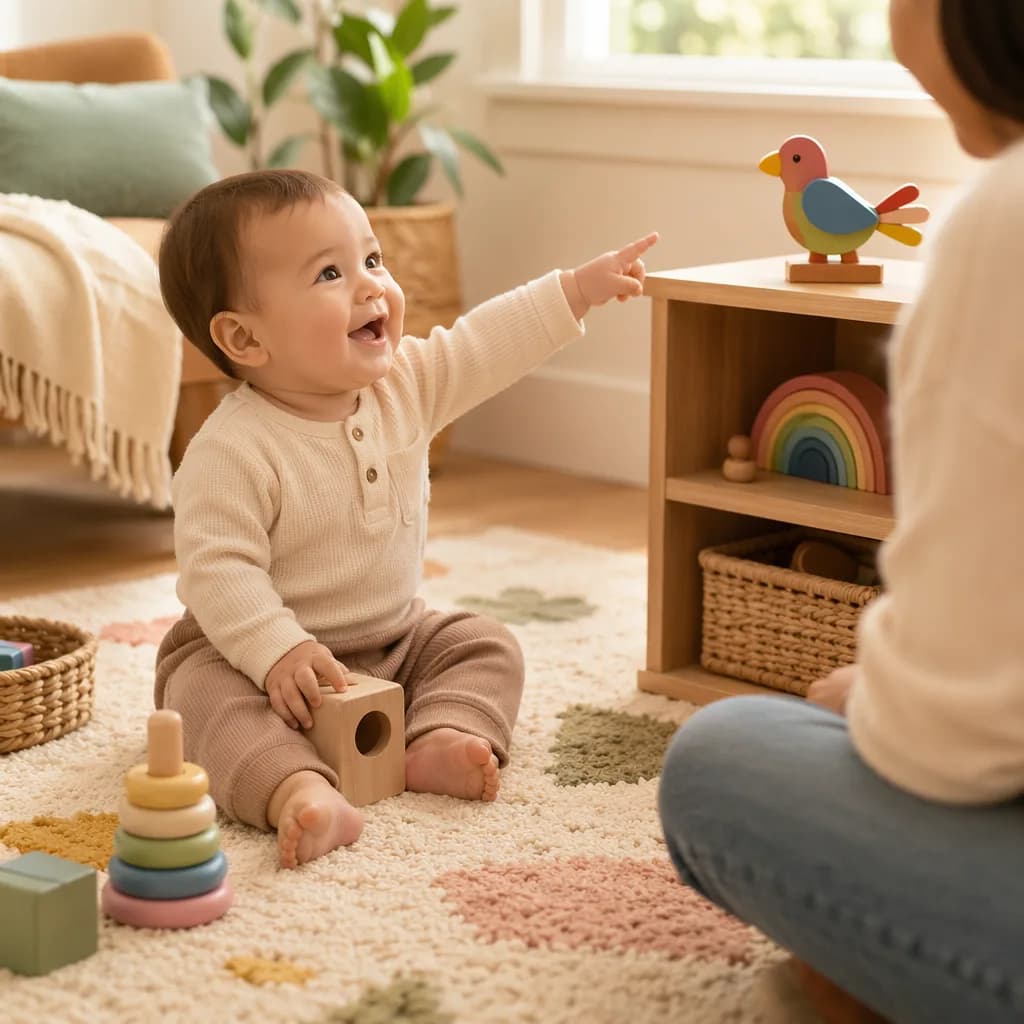
Pointing to share something interesting is a sweet social-emotional milestone where your baby uses a tiny finger to pull you into their world.
You’re walking past the window, and your baby suddenly freezes. A dog trots by. Your baby points, looks at the dog, then looks back at you with wide eyes.
That little point says a lot.
It may mean, “Do you see that too?” or “Wow, look!” Your baby isn’t only asking for help. They’re sharing joy with you. They’re inviting you into the moment.
Around 12-18 months, many babies start using gestures in a more social way. By 18 months, the CDC lists “points to show you something interesting” as a social and emotional milestone that most children can do. That matters because your baby is learning that you have thoughts, attention, and feelings too. Your baby can now pull your attention toward something and enjoy the shared reaction.
This can feel small in the middle of a busy day. But it’s big. Your baby is building connection with you, one point at a time.
This milestone typically emerges around this age because your baby’s social awareness is growing. Your baby is learning, “I can notice something, and I can help you notice it too.” The CDC describes milestones as clues in how your child plays, learns, speaks, acts, and moves. Pointing to share something interesting sits right in that mix, because it blends attention, action, and connection.
The CDC also notes that by 18 months, many children move away from you but look back to make sure you’re close by. That checking-in is related to the same warm skill: your baby wants freedom, but they still use you as a safe social base. A point across the room works in a similar way. Your baby reaches outward, then brings you along.
The Learn the Signs. Act Early. materials explain that milestone checklists can help you notice what your child does over time. For this stage, the checklist idea is useful because your baby may show this skill in quick, ordinary flashes. A finger toward a bird. A look back at you after hearing a truck. A delighted squeal when you say, “Yes, I see the kitty!”
Research-based milestone guidance from the CDC uses “most children” to mean 75% or more by a certain age. So this skill may not appear in the exact same week for every baby. Still, when your baby points to share, they’re practicing a powerful kind of back-and-forth attention with you.
Many babies start with whole-hand reaching before a clear finger point. Your baby may stretch an arm toward the ceiling fan, then glance at you. Later, that broad reach may turn into one little pointed finger.
Some little ones point with their whole hand, their thumb, or even their eyes first. Your baby may stare at the garbage truck, then look at you, then bounce with excitement. That can still be a social bid. They’re trying to share the moment with you.
Often around this age, your baby’s pointing may come with sound. They might say “uh!” or “dat!” while pointing at a balloon in the store. They may not have the word yet. The gesture still carries meaning.
You might also see your baby point more at favorite things. Animals are common. Lights, airplanes, older siblings, shoes, and snacks can all become headline news. One day your baby may point to a squirrel like it’s the most amazing thing either of you has ever seen.
Some babies point mostly at home, where they feel relaxed. Others save their best pointing for walks, stores, or the park. Some little ones prefer bringing you an object instead. They may toddle over with a sock, hold it up, and wait for your face to light up.
Your response helps the moment grow. If your baby points at a bird and you say, “You saw a bird! It’s hopping,” you’re feeding the social loop. Your baby points, you answer, and together you make meaning.
- ). Keep them playful and non-medical; never prescribe therapy or medical action.If you’re worried that your baby rarely shares interest with looks, gestures, or sounds by 18 months, you can chat with your pediatrician.
