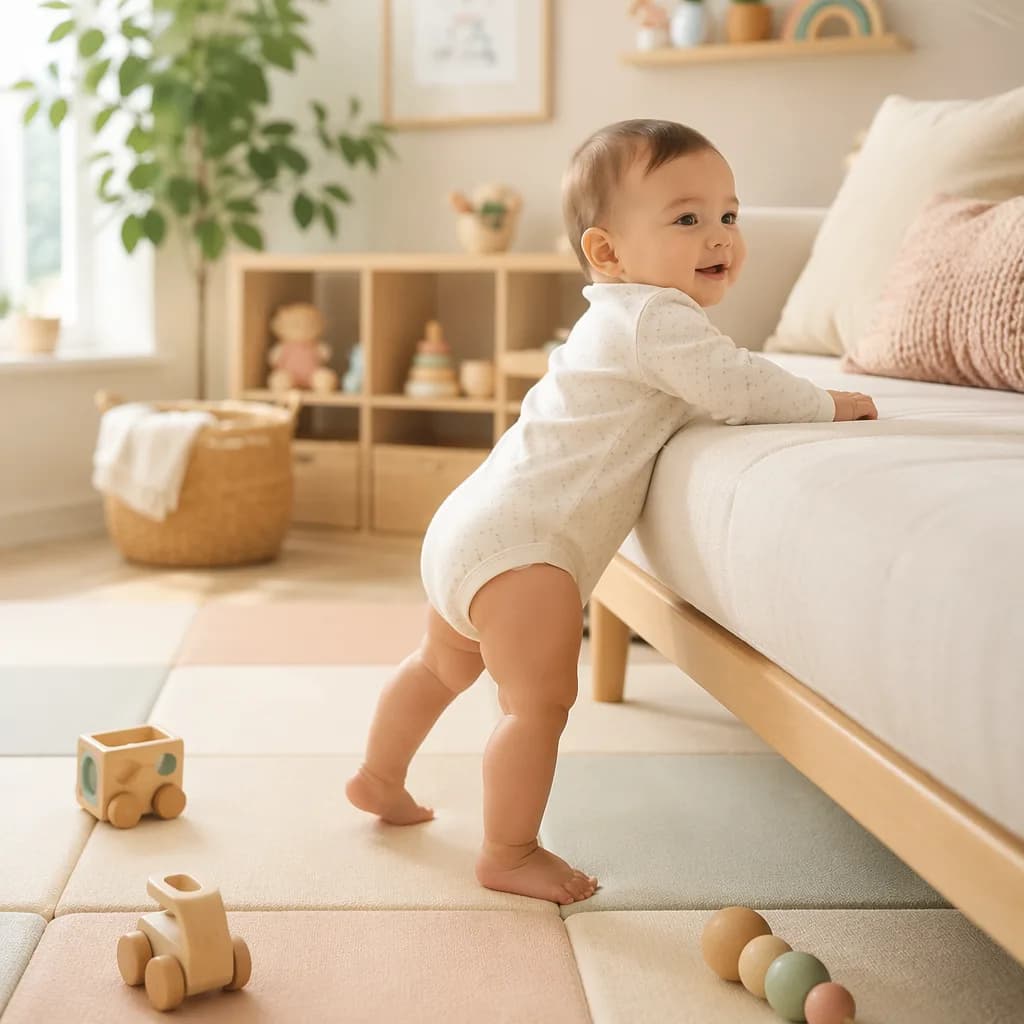
Pulling up and cruising is the stage when your baby starts using furniture, your hands, and their own growing strength to get upright and move sideways.
One day, your baby is sitting near the couch. The next, you turn around and see two small hands gripping the cushion, knees wobbling, face beaming with pride.
This stage can feel huge. Your baby is learning that the room has levels. The floor is still home base, but now the coffee table, sofa, low shelf, and your lap all look like places to explore.
You may see your little one pull to stand, bounce on bent knees, or shuffle sideways while holding on. That sideways step is often called cruising. It’s a big motor-gross moment because your baby uses large muscles in the legs, hips, belly, back, and shoulders. Children’s Hospital of Richmond at VCU explains that gross motor skills use the large muscles, while fine motor skills use smaller muscles.
There’s joy in it. There’s effort too.
Your baby may grunt, squeal, flop down, try again, and look right at you for a smile. That look matters. You’re part of the milestone. Your calm face, soft clap, and gentle “You did it” help your baby feel safe enough to practice again.
Around 9-12 months, many babies want to move with more purpose. They’re not just watching the room anymore. They’re trying to get into it.
The CDC says that how your child plays, learns, speaks, acts, and moves offers clues about development, and its 9-month milestone guidance focuses on what most babies can do by that age (CDC). That matters here because pulling up and cruising are part of a bigger pattern. Your baby’s movement, play, and curiosity are all working together.
Your baby also needs lots of practice. Children’s Hospital of Richmond at VCU notes that babies and toddlers need plenty of playtime and practice to build motor control. Even though that excerpt focuses on fine motor skills, it also explains the key difference: gross motor skills involve large muscles. Pulling up asks those large muscles to coordinate in a new way.
This is why your baby may repeat the same move over and over. Stand. Plop. Stand. Plop. It’s not random. Research suggests repeated playful movement may support coordination, balance, and body awareness.
BabyCenter’s toy guidance for 9- to 12-month-olds includes active play items, such as a tunnel climber, and a sit-to-stand walker among toys considered for this age range (BabyCenter). You don’t need special gear for your baby to benefit from active play. The useful idea is simple: babies this age often enjoy chances to move, shift weight, crawl, stand with support, and explore safely with you close by.
Many babies start by pulling up on your body. Your pant leg, your knees, or your shirt may become the first “furniture.” It’s sweet and a little inconvenient.
Some little ones pull up but seem unsure how to get back down. They may cry for help from a standing position. Over time, many babies learn to bend their knees, squat, or lower themselves with more control.
You might notice one side looks stronger at first. Your baby may lead with the same leg each time. They may cruise only to one side for a while. Often, babies choose the easiest route before they try a harder one.
Some babies love standing but don’t cruise much yet. Others move sideways along the couch before they can stand for long. Some little ones prefer crawling, scooting, or rolling to reach what they want. The CDC reminds parents that milestone checklists are not a substitute for standardized developmental screening tools, so they’re best used as a helpful snapshot, not a strict script (CDC).
Your baby may also mix movement with big feelings. They might laugh after a successful stand, then fuss when a toy rolls just out of reach. That’s normal learning energy. Their body is working hard. Their brain is too.
And yes, your home may suddenly look different to you. The low plant, the basket of wipes, the shiny remote, and the dog bowl all become thrilling targets. Your baby’s new height brings new curiosity.
- ). Keep them playful and non-medical; never prescribe therapy or medical action.If your baby isn’t showing interest in bearing weight, moving in some way, or using both sides of the body, you can chat with your pediatrician.
