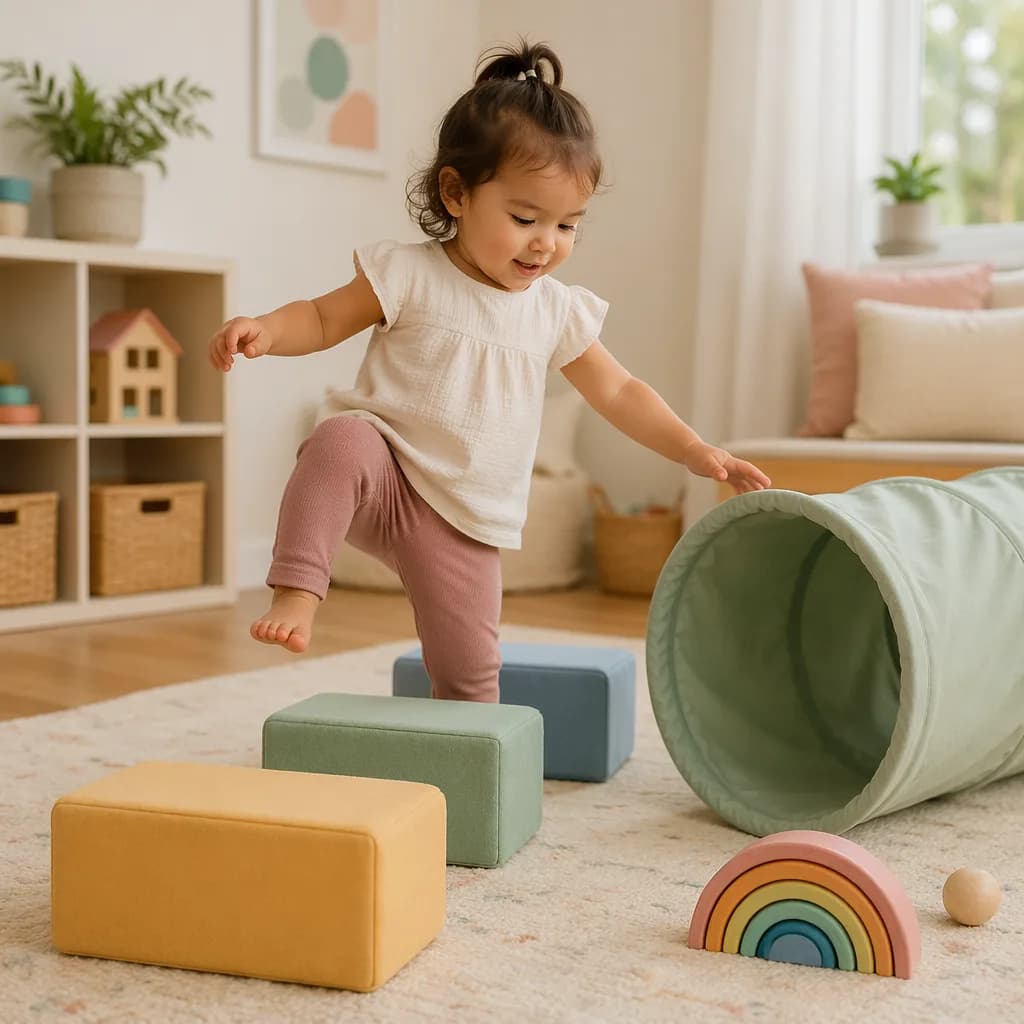
Big toddler moves between 24 and 36 months can look like running, jumping, stairs, ball play, and the first joyful tries at pedaling.
Your toddler may seem suddenly more ready for the whole playground. One minute your baby is walking beside you. The next, your little one is running toward the slide, stopping at the edge of the mulch, then turning back with a proud grin.
This stage can bring a lot of busy, happy movement. Child and Family Development lists several gross motor skills for toddlers 24-36 months, including walking backward, running with more speed, avoiding or stopping at obstacles, jumping forward, jumping down from a 16-inch step, walking on tiptoes for a few steps, and beginning to hop on one foot (Child and Family Development).
You may also see new stair confidence. Child and Family Development notes that toddlers in this age range may walk up stairs with one foot on each step without a railing, and may walk down stairs with one or both feet on each step without a railing (Child and Family Development). In real life, that might look like your toddler proudly saying, “I do it,” while you stay close and calm.
Ball play can become more fun too. Your toddler may catch a large 12-inch ball, then work toward a smaller 8-inch ball. Your little one may throw a tennis ball overhand or underhand 8-10 feet forward (Child and Family Development). These are the moments that turn a rolled-up pair of socks into a living room game.
At 24-36 months, many movement milestones show up together because toddlers get more chances to move in daily life. The St. Jude Children’s Research Hospital resource for 24 to 36 months lists movement and physical development skills such as running easily, pedaling a tricycle, and walking up and down stairs with one foot on each step (St. Jude Children’s Research Hospital).
Child and Family Development describes a similar set of 24-36 month gross motor milestones. Their list includes running with greater speed, stopping or avoiding obstacles, riding a tricycle, beginning to pedal a tricycle, standing on one foot for 3 seconds by imitation, and beginning to hop on one foot (Child and Family Development).
These sources give you a helpful picture of what often appears around this age. Your toddler is not just “getting bigger.” Your child is trying more whole-body skills in ordinary places: the sidewalk, the park, the stairs, the yard, and the kitchen floor while you make lunch.
Pedaling can be a favorite example. St. Jude Children’s Research Hospital lists pedaling a tricycle as a 24-36 month movement skill (St. Jude Children’s Research Hospital). Child and Family Development also includes riding a tricycle and beginning to pedal a tricycle in this age window (Child and Family Development). For you, that may look like tiny feet pressing, pausing, pressing again, and then cheering together when the wheels move.
Many toddlers in this age range love movement, but the mix can vary. Your baby may run often, yet still prefer two feet on each stair. Another child may try stairs all day, but feel less interested in catching a ball.
Some little ones walk backward for fun. Others use it during play, like backing up a toy truck or stepping away from bubbles. Child and Family Development includes walking backward among 24-36 month gross motor milestones (Child and Family Development).
Jumping may show up in small, funny ways. Your toddler may jump forward a short distance, jump down from a low step, or bend knees with great drama before both feet leave the floor. Child and Family Development notes jumping down from a 16-inch high step and jumping 18-24 inches forward in this age range (Child and Family Development).
You might notice tiptoe walking for a few steps during pretend play. Your little one may say, “Quiet mouse,” then cross the rug on tiptoes. Child and Family Development lists walking on tiptoes a few steps as a 24-36 month skill (Child and Family Development).
Ball play can feel delightfully uneven. One throw flies forward. The next drops behind your toddler’s feet. Some little ones catch a large ball against their body. Child and Family Development describes catching a large 12-inch ball, with progress toward a smaller 8-inch ball, and throwing a tennis ball overhand or underhand 8-10 feet forward (Child and Family Development).
Tricycle time may be full of starts and stops. Many toddlers enjoy sitting on a tricycle, pushing with feet, or trying the pedals. St. Jude Children’s Research Hospital and Child and Family Development both include pedaling a tricycle around 24-36 months (St. Jude Children’s Research Hospital; Child and Family Development).
If your child loses skills they had already mastered, or you feel concerned about movement, you can chat with your pediatrician.
- ). Keep them playful and non-medical; never prescribe therapy or medical action.