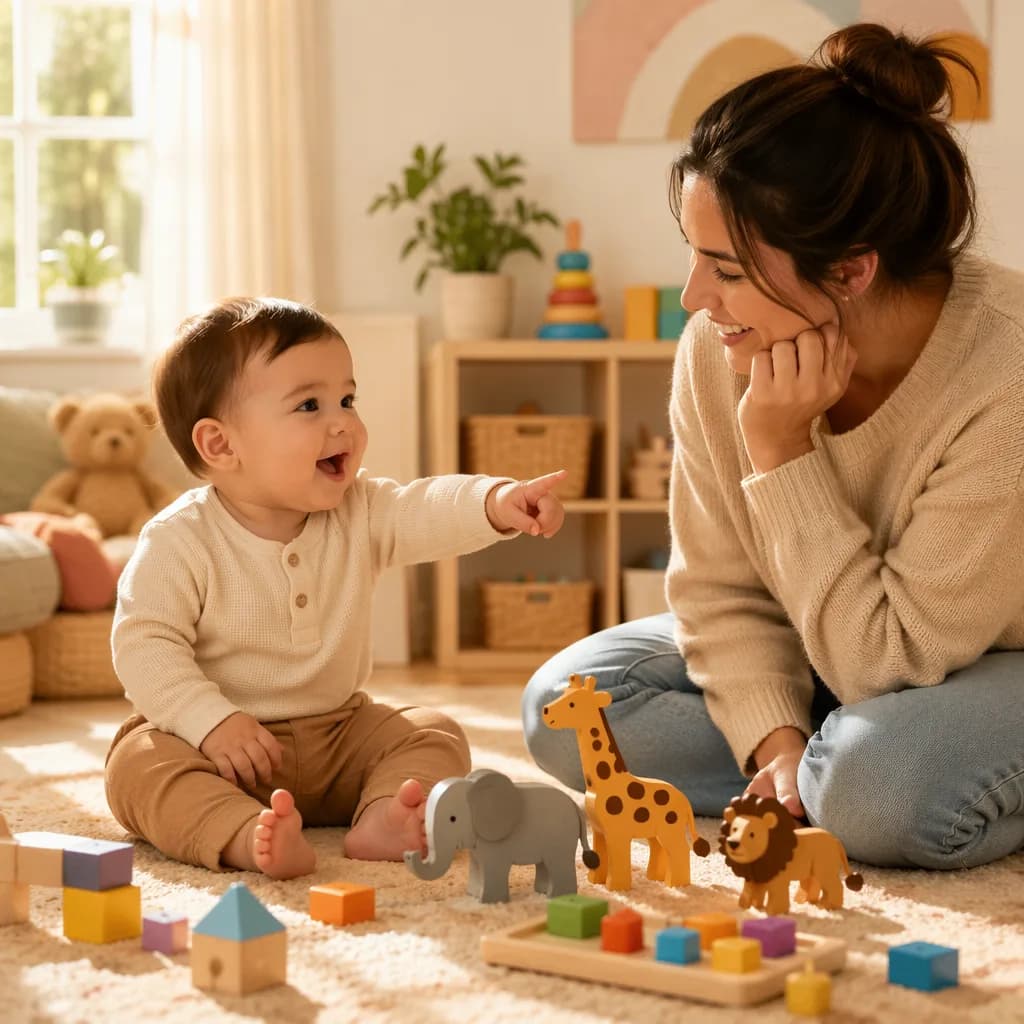
Toddler first phrases and word bursts are a sweet language milestone, when your baby starts using more words and may begin putting two or three together.
Around 18 to 24 months, your baby’s words can start to feel more useful and more personal. You may hear “more milk,” “mama up,” or “bye car” at the exact moment your toddler wants you to understand.
It’s a lovely shift.
Before this stage, your baby may have used one word with a big gesture. Now those words may begin linking together. A snack request turns into “more banana.” A goodbye becomes “daddy go.” A favorite book page brings “woof woof dog.” These little phrases matter because language lets your baby share meaning with you, ask for help, and bring you into their thoughts.
You may also notice your toddler copying your words with proud, wobbly sounds. “Water” may sound like “wa-wa.” “Elephant” may become “eh-eh.” That still counts as communication. Your baby is practicing how words work, and your warm response gives those attempts a reason to keep growing.
Language is a structured system for sharing meaning, using vocabulary and grammar in spoken, signed, and written forms, according to Wikipedia, the free encyclopedia. At this age, your toddler is starting to use that system in a more flexible way. They are not just naming things. They are beginning to combine ideas.
The American Speech-Language-Hearing Association describes communication milestones for 19 to 24 months as part of hearing, speech, and language development. It also notes that each child develops uniquely, even within the same family. That helps explain why one baby may say many clear words, while another uses fewer words plus gestures, signs, or sound effects.
By this age range, understanding often grows before speech sounds polished. speechandlanguage.org.uk says that by two years, children usually understand at least 200 words, understand more simple questions and instructions, copy sounds and words a lot, say 50 or more single words, and start to put short sentences together with two to three words. Those short phrases can include everyday gems like “more juice” or “bye nanny,” which are small but powerful steps.
The CDC also frames milestones as clues about how your child plays, learns, speaks, acts, and moves. Its 18-month guidance says developmental milestones are things most children, 75% or more, can do by a certain age. That wording matters. It leaves room for your real baby, with their own timing, temperament, and home language mix.
Many babies in the 18 to 24 month range use a growing mix of words, sounds, gestures, and facial expressions. Your toddler might point to the fridge and say “cheese.” They might bring you a shoe and say “go.” They might shout “mine” with their whole body.
Often around this age, toddlers understand more than they can say. You may ask, “Where’s your nose?” and your baby points right to it. You may say, “Give teddy a kiss,” and they do it with a grin. speechandlanguage.org.uk describes this growing understanding of simple questions, instructions, and action words during 18 to 24 months.
Some little ones use many single words before they combine them. Others may start with a few favorite phrases that carry a lot of meaning. “No bed” can mean “I’m tired, but I don’t want to stop playing.” “Mama car” might mean “I saw your car,” “I want to go in the car,” or “Mama left in the car.” Context helps you read the message.
Pronunciation can still sound very toddler-like. Many words may be unclear to people outside your family. You may understand “ba” means ball, bottle, or bath based on where your baby is standing. That’s common in this stage, since speech sounds are still developing while vocabulary grows.
You may also hear questions begin to pop up. “What’s that?” can become the soundtrack of a walk. Your baby may ask it for a truck, a leaf, and the same dog five times. This repeated asking is not just noise. It may support learning, because your toddler gets a clear word paired with something they care about.
Pretend play can join the language party too. Your toddler may feed teddy, make a cow say “moo,” or put a doll to sleep. speechandlanguage.org.uk includes pretend play, animal sounds, and trying new things in its 18 to 24 month guide. These playful moments give your baby words for actions, feelings, and little stories.
- ). Keep them playful and non-medical; never prescribe therapy or medical action.If your child misses many milestones in this age range, you can chat with your pediatrician about what you’re seeing and hearing.
