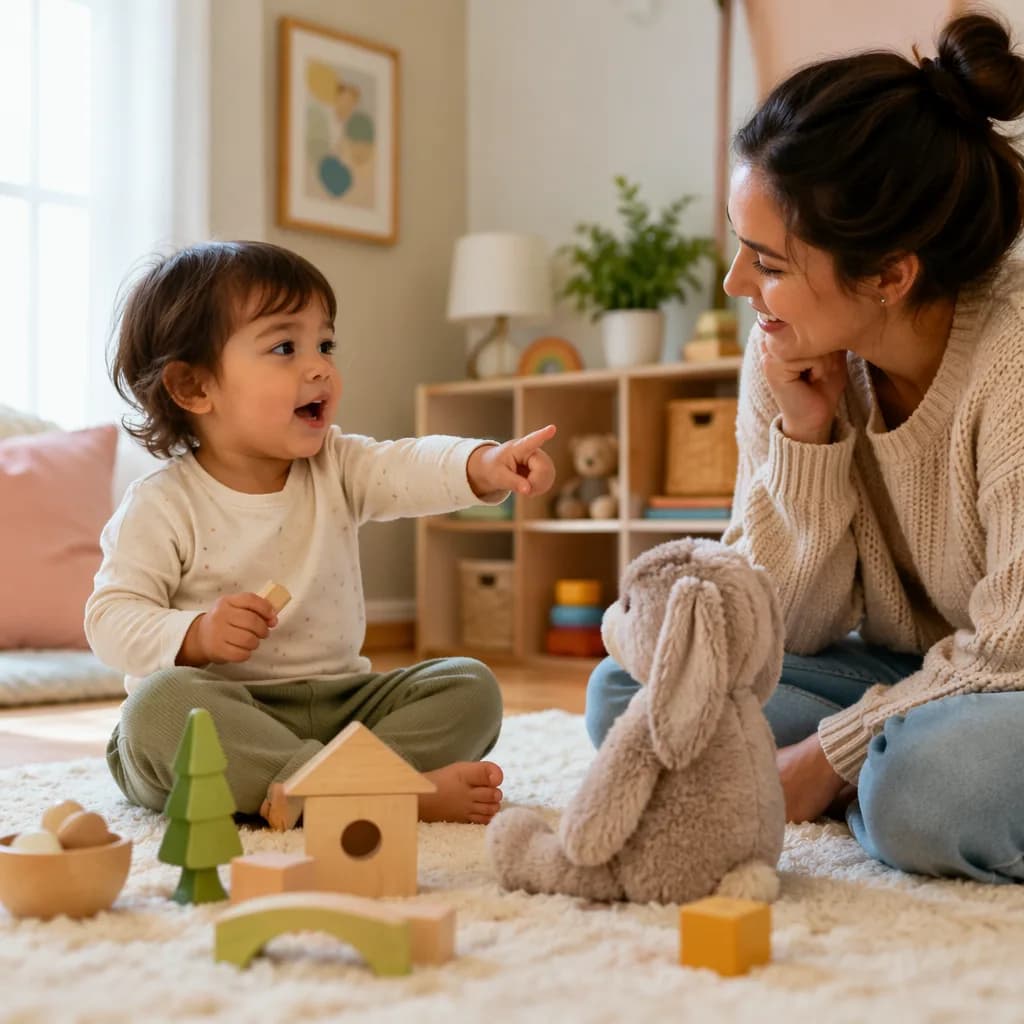
Your toddler starts using bigger language between 24 and 36 months, and it can make daily life feel more connected.
Your baby may start sounding more like a tiny storyteller now. One minute, you hear, “More milk.” A few months later, you may hear, “I want more milk, please.” That small change can feel huge.
Language gives your toddler a way to share meaning with you. It can happen through spoken words, signed words, gestures, pictures, and later writing. Wikipedia, the free encyclopedia describes language as a structured system of communication made from grammar and vocabulary. That simple idea shows up in your kitchen every day.
You might see your child point to the door and say, “Daddy work.” You understand the message. Then you add warmth: “Yes, Daddy went to work. He’ll come home after snack.” Your toddler hears words, order, meaning, and love all at once.
This stage can bring joy. It can also bring loud feelings. Your little one may have a big idea but only a few words to carry it. You may see frustration at the shoe rack, at bedtime, or in the grocery cart. Still, each try matters. Your baby is learning that words can move a moment forward.
Language works because people agree that sounds, signs, or symbols carry meaning. Wikipedia, the free encyclopedia notes that human language relies on social convention. That matters at home. When you and your toddler both understand that “up” means “pick me up,” your child can ask for comfort in a clear way.
Language also has grammar and vocabulary, according to Wikipedia, the free encyclopedia. Vocabulary gives your baby the words. Grammar helps your toddler put those words together so the message makes sense. You may hear early word order in simple phrases like “Mama sit,” “doggie eat,” or “go park.”
Research-style descriptions of language also point to something lovely: people can talk about things that are not right in front of them. Wikipedia, the free encyclopedia calls this displacement. For your toddler, that may look like talking about Grandma after a visit, asking for a toy left in the car, or saying “rain later” after hearing you mention the weather.
Language can also create new sentences. Wikipedia, the free encyclopedia calls this productivity. In real life, that means your child can mix familiar words in fresh ways. “Big truck sleeping” may mean the garbage truck parked outside. It’s not adult grammar yet, but it shows your toddler is trying to build meaning.
Your child also grows up inside a family culture. Wikipedia, the free encyclopedia notes that human languages vary across cultures and time. Google Translate shows this everyday reality too, with many listed languages such as English, Spanish, Arabic, French, Amharic, Armenian, and Bengali. If your home uses more than one language, your toddler may hear different words for the same loving routines.
Many babies at this age try more two-word and three-word messages. Some little ones use speech. Some use signs, gestures, or a mix. Since language can be spoken or signed, as Wikipedia, the free encyclopedia explains, your toddler’s communication may look different from another child’s and still carry rich meaning.
You may notice your child naming favorite people, foods, toys, and places. Your baby may ask for help with one clear word, then add another: “Help shoe.” “Open box.” “Mama read.” These short messages can carry a lot.
Some little ones repeat favorite lines from books or songs. Others practice social words during daily routines, like “hi,” “bye,” “no,” “mine,” and “thank you.” You may hear your toddler talk during pretend play too. A stuffed bear may “eat,” “sleep,” or “cry.” That kind of play can give language a gentle job.
Pronunciation may still sound soft or surprising. You might be the only one who understands “wa-wa” for water or “ba” for bus. That shared family code can be sweet. You can answer with the full word without making it a test: “Yes, water. Here’s your water.”
Your toddler may also talk about people or things that are absent. “Nana house.” “Blue car gone.” “Park tomorrow.” Because human language can refer to events and ideas that are not present, this kind of talk fits the larger pattern described by Wikipedia, the free encyclopedia.
If you’re worried that your toddler rarely tries to communicate in any form, you can chat with your pediatrician.
- ). Keep them playful and non-medical; never prescribe therapy or medical action.