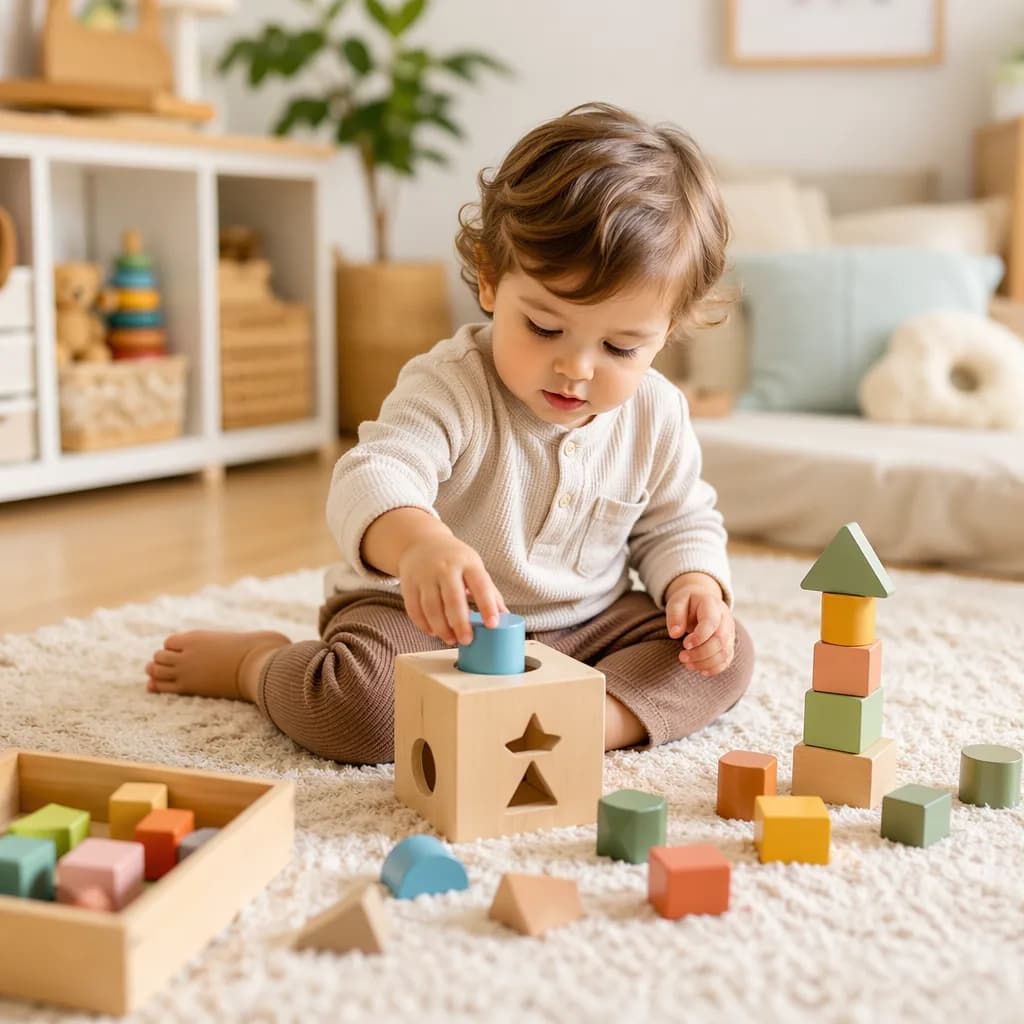
Toddler thinking takes a leap between 24 and 36 months, as your child starts using words, memory, and simple problem solving in busy everyday moments.
This is the age when your toddler’s mind can feel wonderfully visible. You may see your baby line up toy animals, call one the “mama,” and tuck another under a blanket. A block becomes a phone. A mixing bowl becomes a hat. Your child may remember that shoes go on before a walk, then bring you one tiny sneaker with a proud grin.
These moments are small, but they matter. Your toddler is learning how things connect. Words connect to objects. Steps connect to routines. Pretend play connects to real life. You get to watch your child’s thinking grow right in front of you.
At 2 to 3 years, many children can follow instructions with 2 or 3 steps, name most familiar objects, and understand location words like “in,” “on,” and “under,” according to 24 to 36 Months. That means your child may hear, “Put the bear in the basket, then bring me the book,” and actually try it. Maybe not with perfect focus. Maybe with a detour to hug the bear first. Still, the thinking is there.
Your toddler may also start using words like “I,” “me,” “we,” and “you,” and may carry on a short conversation using 2 to 3 sentences, as described in 24 to 36 Months. That language growth can support memory, planning, and pretend play. A child who says, “I make soup. You eat,” is practicing ideas, roles, and order.
Around this age, your toddler’s learning gets more organized. The CDC's Developmental Milestones describes milestones as skills in how children play, learn, speak, act, and move. Cognitive growth does not sit by itself. It shows up while your child talks, plays, copies you, and moves through the day.
Language gives your child a powerful thinking tool. When your toddler can name familiar objects, understand “in,” “on,” and “under,” and follow 2 or 3 step directions, they can hold more information in mind, as noted in 24 to 36 Months. That may support early planning. For example, your child hears, “Get your cup and sit at the table,” then uses memory and attention to do both parts.
Pretend play also grows because your child has more stored experiences to use. Your toddler has watched you stir oatmeal, feed the dog, wipe a spill, and answer the phone. Now those memories come out in play. A spoon becomes a tool for feeding a doll. A cardboard box becomes a car. This kind of play often shows your child sorting out how the world works.
Fine motor and visual thinking may join in too. 24 to 36 Months notes that children at this stage can copy a circle, string multiple 1-inch beads, and enjoy activities such as coloring, large puzzles, and musical toys. Those activities ask your child to notice shape, order, space, and cause and effect. Your baby shakes a tambourine, hears a sound, pauses, then shakes again. That is learning with the whole body.
Many babies this age want to do things “myself.” Your child may try to solve a simple puzzle by turning one piece again and again. You may want to step in, but a few quiet seconds can let your toddler test an idea. Then you can gently help: “Turn it. Try this side.”
Some little ones show their thinking through pretend play. Your toddler may put a toy cow to bed, then whisper, “Night night.” Another child may prefer cars, blocks, water play, or dumping socks out of a basket. These are all rich thinking moments.
You may notice your child sorting items in their own way. Big rocks go in one pile. Tiny cars go in another. Blue blocks may get gathered, then suddenly the rule changes and every block becomes “food.” Toddler logic can look funny from the outside, but your child is practicing categories and flexible thinking.
Often around this stage, directions become easier when they fit a familiar routine. “Put your pajamas in the basket and pick a book” may work better at bedtime than a brand-new task in a noisy room. Attention is still young. Your toddler may understand you, then get distracted by a crumb, a dog bark, or a very interesting sock.
Some children talk through problems. You may hear, “No fit. Try again.” Others stay quiet and use their hands. Both can show growing thought. If your child seems to lose skills they once used, or you feel concerned about your child’s learning, you can chat with your pediatrician.
- ). Keep them playful and non-medical; never prescribe therapy or medical action.