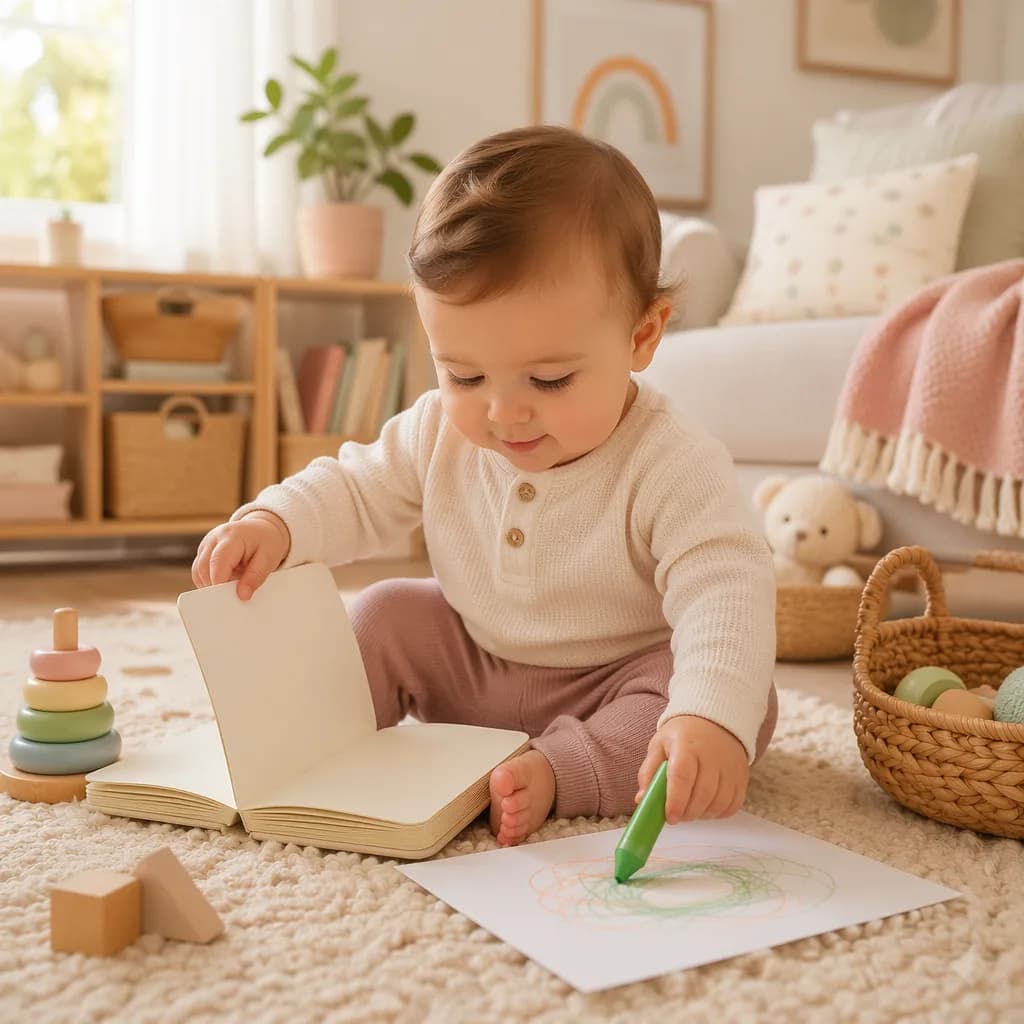
Turning book pages and making marks is a sweet 12-18 month fine motor milestone that turns everyday play into real practice for your baby's hands, eyes, and growing independence.
You hand your baby a chunky board book. Instead of chewing the corner first, your baby pats the page, pinches at the edge, and flips it over. Maybe two pages go at once. Maybe the book lands upside down. Still, something lovely is happening.
Your baby is learning that small hand movements can change what they see.
At the table, you tape down a piece of paper and offer a thick crayon. Your little one grabs it in a fist and drags it across the page. The mark may be a dot, a short line, or one bold streak. Your baby looks surprised. Then proud. Then they may do it again.
These small moments matter because fine motor skills involve reaching, grasping, and manipulating objects with the hands, along with hand-eye coordination, according to Fine motor skills: birth to 2 years. A page turn or crayon mark may look simple to you. For your baby, it asks the eyes, fingers, wrist, arm, and attention to work together.
This stage can bring real joy. Your baby may sit in your lap, turn pages while you name pictures, and enjoy the rhythm of the same book again and again. They may scribble for ten seconds, then hand you the crayon, then ask for it back. Short bursts count.
Around 12-18 months, many babies begin using their hands with more purpose during play. Developmental milestones 12 to 18 months lists turning book pages and using a crayon to mark on paper among motor skills for this age range. It also notes that children may stack blocks and rings, push and pull toys, and play with toys more in their hands and less in their mouth.
That shift matters. Your baby has spent months exploring objects by mouthing, banging, dropping, and shaking. Now, those same curious hands can start doing more precise work. A book page asks for grasping, lifting, and releasing. A crayon asks for holding, pressing, and moving across paper.
Fine motor skills: birth to 2 years describes fine motor development as the use of hands and upper extremities, plus visual motor skills, often called hand-eye coordination. So when your baby aims for the edge of a page, or watches a crayon leave color behind, their eyes and hands are practicing together.
Milestones by 18 Months also reminds parents that milestones are things most children, 75% or more, can do by a certain age. That helps keep this stage in perspective. Your baby may show these skills in their own timing and style. The big idea is progress in how your baby uses hands during shared play.
There is also a thinking piece here. Developmental milestones 12 to 18 months says children in this age range may look for hidden objects, understand simple words like "No," find familiar objects when asked, and combine gestures with words. While those are not fine motor skills by themselves, they show how play, language, and movement often grow side by side. Your baby turns a page, you say "dog," and your baby points, pats, or babbles. The whole moment becomes rich.
Many babies at 12-18 months turn board book pages with their whole hand. Some little ones grab a thick page from the top. Others pinch from the side. Your baby may skip pages, turn backward, or close the book with a happy smack.
You may notice your baby wants control. They may turn the page before you finish reading. They may go back to the same picture five times. This is common toddler learning. Repetition helps your baby connect action with result.
With crayons, many babies use a full-fist grasp. They may hold the crayon near the middle or top. The marks may be light at first, then darker as your baby learns to press. Some little ones make quick taps. Others sweep the whole arm across the paper.
Attention can be brief. A few marks may be plenty. Your baby may scribble, then climb down, then come back when you start drawing a circle or saying, "Your turn." That stop-start pattern can fit this age well.
Some babies prefer books over crayons. Some love stacking rings, pushing toys, or carrying objects while walking, all skills listed for this age range in Developmental milestones 12 to 18 months. Fine motor growth does not need to look like a quiet craft table. It can happen on the floor, in your lap, or beside the toy basket.
You might also see your baby use both hands together. One hand may steady the book while the other turns the page. One hand may hold the paper while the other moves the crayon. This kind of two-hand play can help support more controlled hand use.
If your baby seems to lose skills they once used, or you feel worried about their hand use, you can chat with your pediatrician.
- ). Keep them playful and non-medical; never prescribe therapy or medical action.