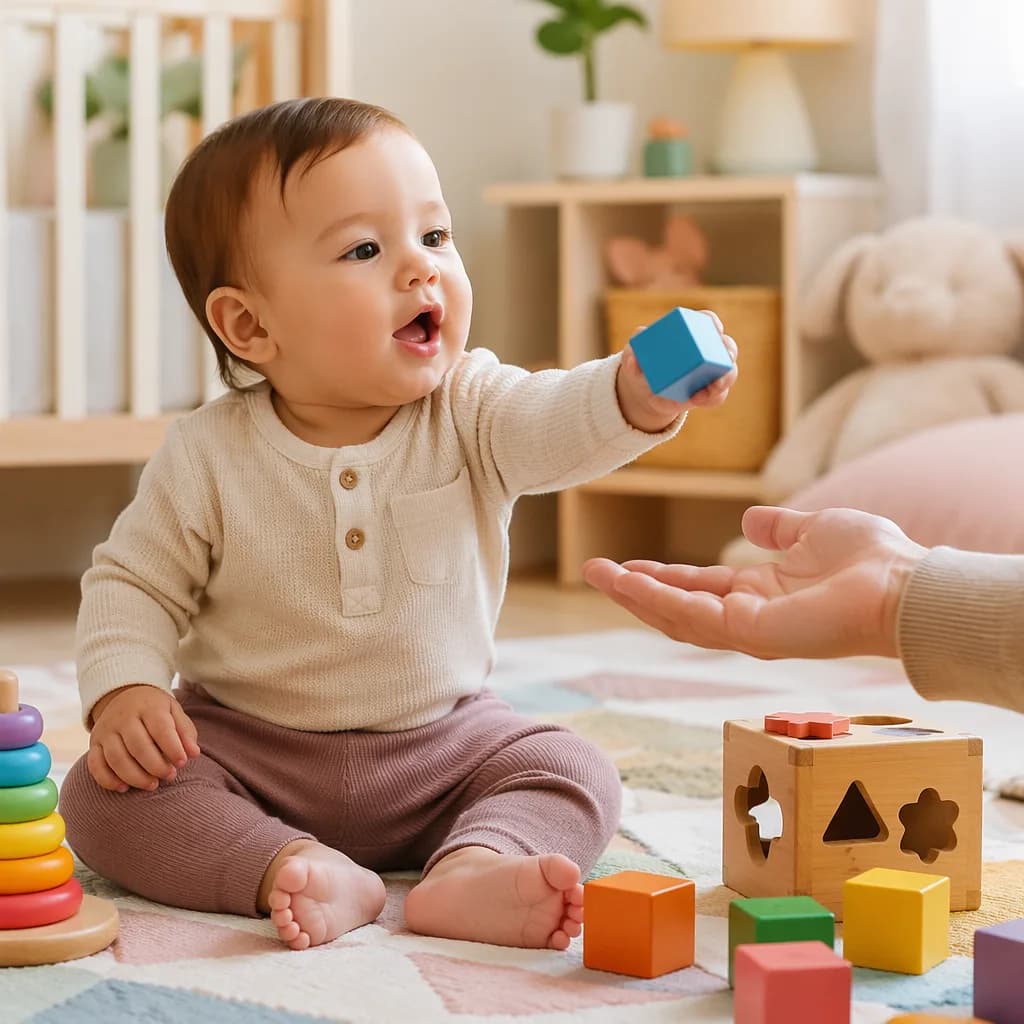
Using first words to ask and share is one of the sweetest language milestones between 12 and 18 months.
Your baby may start using a small handful of words with real purpose. A word might ask for something. It might name a favorite person. It might pull you into a shared moment.
You hear “mama” from the crib. You hear “up” beside your knees. You hear “ball” when your baby spots one under the sofa. These first words can feel tiny, but they carry a lot of meaning.
At this age, language often looks bigger than speech alone. Your baby may point, look at you, make a sound, then wait. That whole little exchange says, “Do you see what I see?” The CDC describes pointing to show something interesting as a common milestone by 18 months, and that pointing often sits right beside early words and sounds (Milestones by 18 Months For Everyone).
This is why a single word at snack time can feel so joyful. Your baby is learning that sounds, signs, looks, and gestures can move a conversation forward. You say, “More banana?” Your baby says “mo,” reaches, and smiles. You answer. Together, you’ve built a real back-and-forth.
Between 12 and 18 months, many babies become more intentional communicators. They don’t just make noise for fun, though they still love that too. They begin using sounds and words to send a message to you.
The CDC explains that how a child plays, learns, speaks, acts, and moves gives clues about development, and that most children reach certain milestones by a given age (Milestones by 18 Months For Everyone). For language, that means your baby’s words fit into a wider picture. Pointing, looking back at you, copying sounds, and trying new words all work together.
Language itself is a structured system for communication. It helps people convey meaning through spoken and signed forms, and it depends on shared social meaning (Language). That sounds formal, but you see it in your kitchen every day. Your baby says “wa-wa,” and you understand it means water. You respond with the cup. Over time, your baby learns, “This sound works with my parent.”
Memory also plays a lovely role. Your baby hears you say “shoes” every morning. Then one day, they toddle over, pat a sneaker, and say “shoo.” The word may sound soft or unfinished. Still, it shows your baby is connecting a sound, an object, and a shared routine.
Your warm response matters because language grows inside relationships. A baby learns words through repeated, meaningful moments with you. Bath words. Snack words. Dog words. Bedtime words. The words that matter most often come from the life you already share.
Many babies around this stage use a few clear words. Some little ones use word-like sounds that only your family understands at first. “Ba” might mean bottle, ball, or the family dog, depending on the moment.
You may notice your baby understands more than they can say. You ask, “Where’s your shoe?” and your baby looks toward the door. You say, “Give it to Daddy,” and your baby carries the toy across the room. Understanding often grows quietly before spoken words pour out.
Some little ones prefer gestures while words are still coming. They may point, reach, nod, shake their head, wave, or hand you an object. The CDC includes pointing to show something interesting as a common 18-month milestone, which reminds you that communication is more than spoken words (Milestones by 18 Months For Everyone).
Words may also come and go for a bit. Your baby might say “duck” all weekend, then skip it for several days. That can happen as attention shifts to walking, climbing, or a new routine. Many babies practice one skill hard, then circle back to another.
Pronunciation will likely sound very babyish. That’s expected in this stage. “Nana” for banana, “da” for dog, or “buh” for book can still count as meaningful communication when your baby uses it on purpose.
You may also hear lots of jargon. This is that adorable stream of speech-like sounds with rhythm and feeling. Your baby may point at the window and deliver a serious little speech. You might not understand the words, but your baby is practicing the music of conversation.
If your baby seems to lose words or doesn’t use gestures like pointing by 18 months, you can chat with your pediatrician.
- ). Keep them playful and non-medical; never prescribe therapy or medical action.