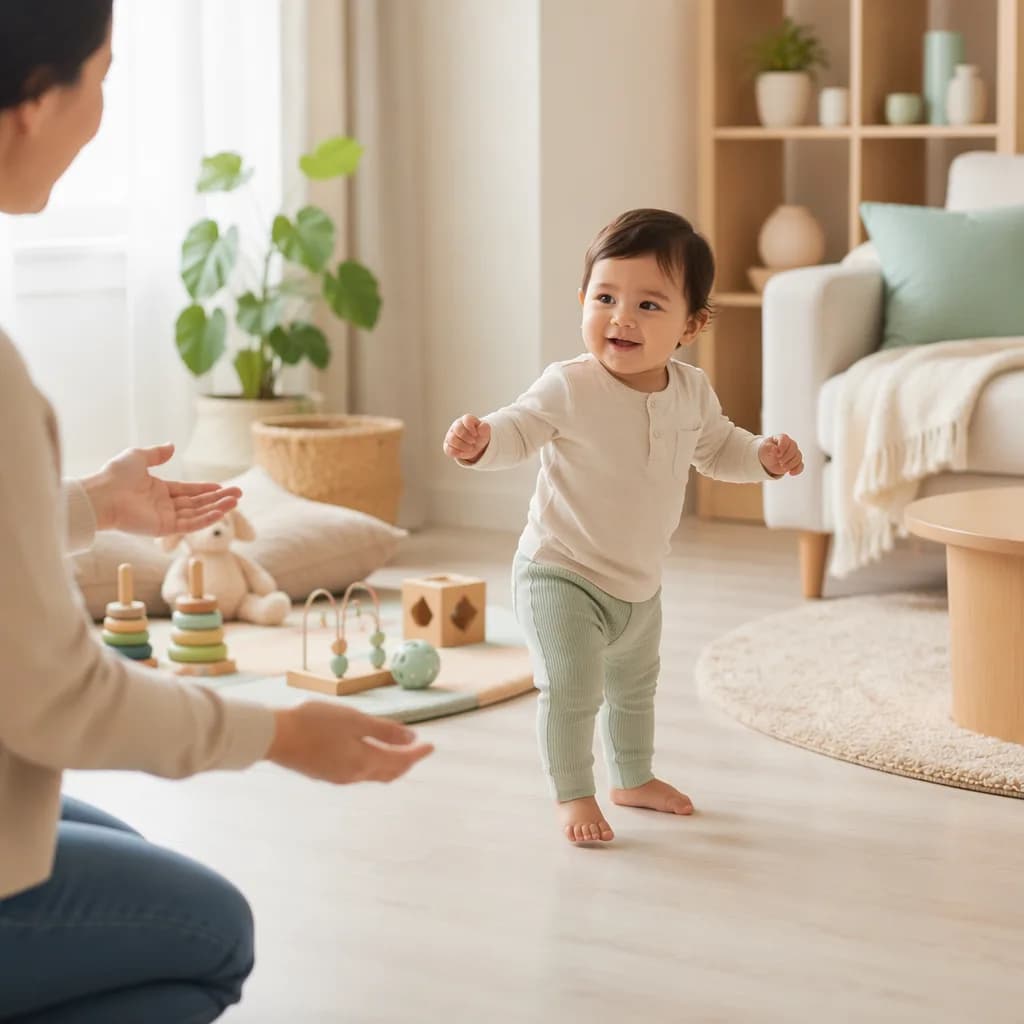
Walking off and checking back is a sweet 12-18 month milestone where your baby uses new movement skills while still keeping you in sight.
You may see it in the park first.
Your toddler toddles three steps away from you, stops near a leaf, then turns their head to find your face. Maybe they grin. Maybe they point. Maybe they hurry back and press into your knees before trying again.
This tiny loop matters. Your baby is practicing independence with you as their safe base. They want to move, explore, and test what their body can do. They also want to know you’re close.
By 18 months, many children move away from you but look to make sure you are close by, according to Milestones by 18 Months For Everyone. That picture captures this age so well. Your little one is not just walking. They are walking with connection.
You might notice this during simple routines. Your baby may wander toward the laundry basket, then glance back. They may step toward a slide, then reach for your hand. They may carry a toy across the room, look at you, and wait for your smile.
It can feel small. It’s big.
Around 12-18 months, many babies gain more control over the large muscles in their legs, hips, belly, and back. Gross motor skills use the large muscles of the body, while fine motor skills use smaller muscles, as Fine motor skills: birth to 2 years explains. That growing body control helps your baby stand, shift weight, turn, squat, and move away from you for short bursts.
At the same time, your baby is learning how movement fits with sight, balance, and attention. Fine motor skills: birth to 2 years notes that visual-motor skills help coordinate the hands, legs, and the rest of the body. For your toddler, that may look like stepping around a cushion, reaching for the couch, then turning to check where you are.
This milestone also has an emotional side. Milestones by 18 Months For Everyone lists “moves away from you, but looks to make sure you are close by” as something most children can do by 18 months. So your baby’s backward glance is part body skill, part trust, and part social connection.
Your calm face helps. Your smile says, “I see you. You’re safe with me.” That support can give your little one the courage to try one more step, one more turn, or one more wobbly trip across the rug.
Many babies in this age range move in short, uneven bursts. They may walk a few steps, drop to a crawl, pull up, and start again. Some little ones love open space. Others prefer cruising along furniture while they watch you closely.
Often around this stage, your baby’s movement looks a bit like a game of “away and back.” They may head toward a toy bin, then return to your lap. They may test a hallway, then call for you. They may climb onto a low cushion and look proud before asking for help down.
Some toddlers seem bold in familiar rooms but clingy in busy places. That can make sense. A quiet living room feels different from a loud playground. Your baby may need more touch, more eye contact, or your hand in a new space.
You may also see your little one combine movement with social gestures. They might point to show you something interesting, which Milestones by 18 Months For Everyone includes among common 18-month milestones. A toddler who spots a dog, steps away, points, and then checks your face is doing a lot at once.
Everyday practice helps your baby learn. Fine motor skills: birth to 2 years says babies and toddlers need plenty of playtime and practice to build motor control. For this gross motor stage, that practice can be simple. Floor time. Safe walking space. A patient grown-up nearby.
If you feel worried about your baby’s movement, or your child loses a skill they had, chat with your pediatrician.
- ). Keep them playful and non-medical; never prescribe therapy or medical action.