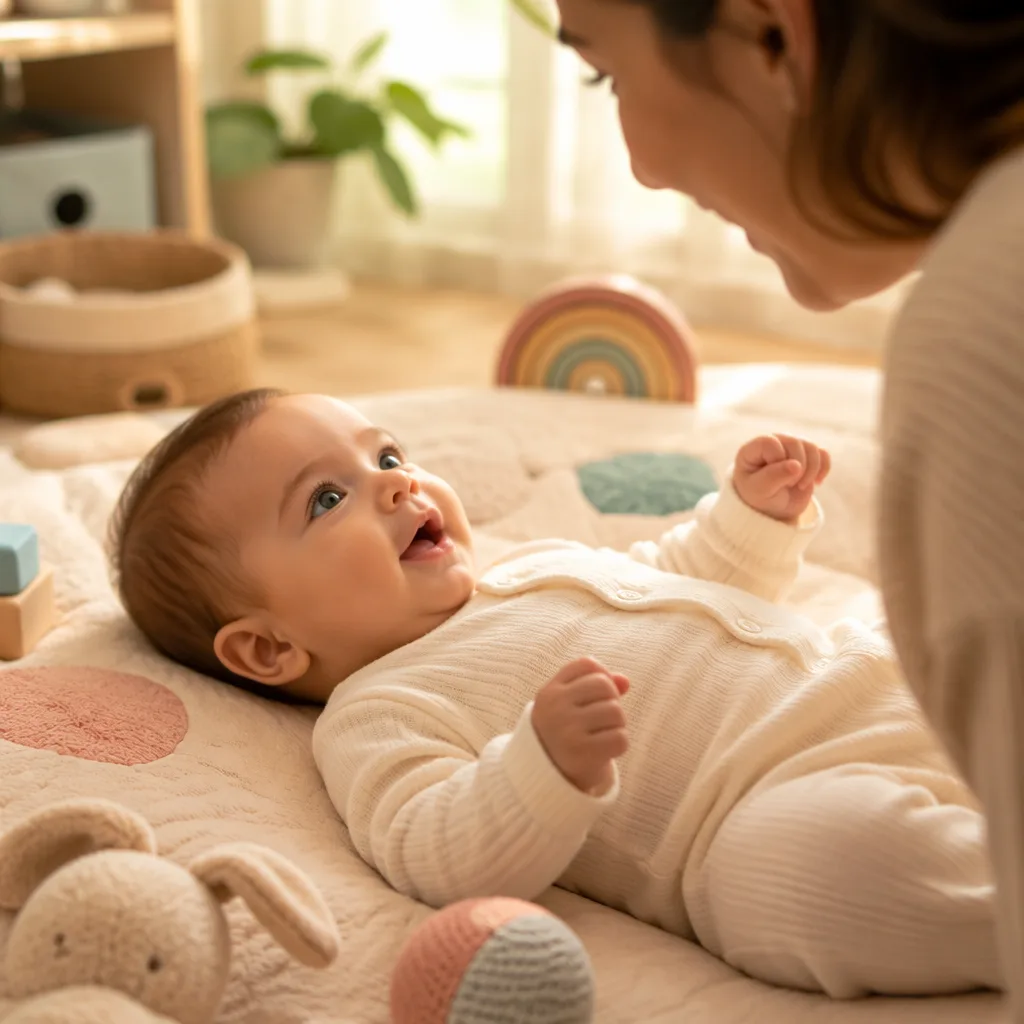
Watching your face for language is a tender 3-6 month milestone where your baby studies your mouth, eyes, and expression while you talk.
You may see it during the smallest moments. You lean over the changing table and say, “Fresh diaper!” Your baby goes still for a second. Those bright eyes land on your face. Maybe your baby kicks, opens their mouth, or gives you a soft little sound back.
This is language growing in a very baby way.
At this age, language is not about words yet. It is about your baby learning that faces, voices, sounds, and shared attention carry meaning. Your baby hears the lift in your voice when you sound excited. Your baby sees your smile when you pause. Your baby starts to connect your warm face with comfort, play, and connection.
These tiny moments matter because language is social. Your baby learns with you, not from a flashcard. A slow song during a cuddle, a silly face after bath time, or your gentle “Hi, sweet baby” after a nap can all become little language lessons.
Language is a structured system for communication, and people use it to convey meaning in spoken and signed forms, according to Wikipedia, the free encyclopedia. Your baby is not using grammar or vocabulary yet, but your baby is already soaking in the building blocks. Voice, rhythm, facial expression, and back-and-forth attention all help your baby begin to understand that communication connects people.
Between 3 and 6 months, many babies become more alert during face-to-face time. They may look longer at your mouth while you speak. They may brighten when your voice rises and softens. They may settle when you use a familiar song. These are early signs that your baby is listening, watching, and linking your voice with your loving presence.
Everyday Language Co describes the first year as a time when babies absorb language by watching, listening, and responding to your voice and facial expressions. That fits this stage so well. Your baby’s brain gets repeated, loving practice each time you talk during care routines. “Arms up,” “Here comes your shirt,” and “You found my nose” are simple phrases, but they give your baby sound, meaning, and connection together.
Toys can help, but you are the main event. Everyday Language Co notes that toys can help language development by encouraging communication, building vocabulary, and nurturing social interactions. For a 3-6 month baby, that might mean you hold up a soft book, name one picture, and wait for your baby to look back at you. The language learning lives in the shared moment.
Many babies at this age watch your face with new focus. Your baby may stare at your lips when you talk slowly. Some little ones look from your eyes to your mouth, then back again. Others seem most interested when you use a sing-song voice.
You may notice your baby gets quiet when you speak. This can look like deep listening. Your baby may stop moving for a few seconds, then kick or smile after you pause. Some babies answer with a coo, squeal, or breathy little sound. Others answer with their whole body.
Around this stage, many babies enjoy repetition. If you say “boo” in the same playful voice each time, your baby may start to expect it. Your baby may smile before you even finish. That little moment shows your baby is beginning to notice patterns in sound and social play.
Some babies love face-to-face chats. Some prefer short bursts, especially when tired or hungry. Your baby may look away when the moment feels too much. That can be a healthy pause. You can soften your voice, wait, and invite your baby back with a gentle smile.
You might also see your baby respond differently to familiar voices. Your voice may bring calm. A sibling’s silly voice may bring wide eyes. A repeated lullaby may help your baby relax into your arms. These everyday responses can support early communication because your baby is pairing sound with feeling, routine, and relationship.
- ). Keep them playful and non-medical; never prescribe therapy or medical action.Chat with your pediatrician if your baby seems unusually unresponsive to voices, faces, or familiar sounds.
