
Postpartum Hair Loss: What's Normal and What Helps
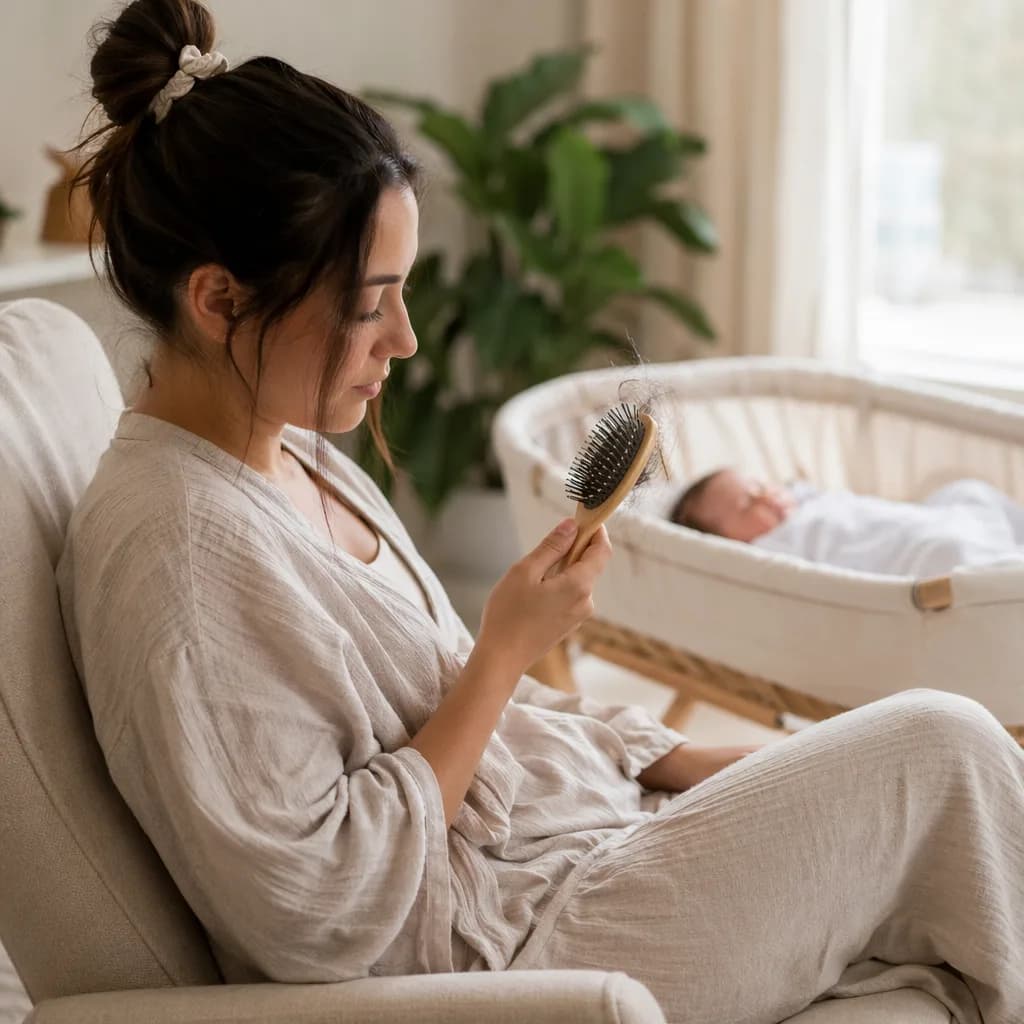
What postpartum hair loss usually looks like
Postpartum hair loss is usually shedding, not permanent hair loss. The medical name is telogen effluvium, and it happens because hormone changes after birth push more hairs into the resting phase of the hair growth cycle. A few months later, those hairs shed.
Most parents notice it in very ordinary places: extra hair in the shower drain, more strands on the pillow, a brush that seems full after one pass, or little wisps gathering around the hairline. Some people see hair come out in clumps, which can feel alarming even when it’s within the expected postpartum pattern.
Many parents first notice heavier shedding around 2 to 4 months after birth, with Cleveland Clinic noting it commonly shows up about three months postpartum. It can last up to six months, and for most people, hair regains its usual fullness by the time their baby turns one.
Still, “normal” doesn’t always feel fine.
When you’re already tired, healing, and maybe tracking feeds, naps, skin flare-ups, and appointments, a handful of hair can hit hard. Maybe you’re reading about Baby Eczema Basics: Triggers, Care, and Doctor Tips at 2 a.m., bookmarking Teething Symptoms: Signs, Remedies, and Soothing Tips for later, or checking the Baby Vaccine Schedule First Year: Month-by-Month Guide, and then you look down and see hair all over your shirt.
It’s tender. Of course it is.
If you’re naming a new baby, saving sweet options like Rami: meaning & origin or Aurora: meaning & origin, and also wondering why your hairline looks different in photos, you’re not being vain. You’re noticing your body changing after a huge physical event.
Why hair loss after pregnancy happens
Postpartum hair loss can feel shocking because it often shows up after the newborn haze has already begun. You might be three months in, finally getting a rhythm with feeds, naps, teething symptoms, or the baby vaccine schedule, and then suddenly there’s hair all over the shower floor.
The basic reason is hormones.
During pregnancy, higher estrogen levels keep more hairs in the active growing phase. That’s why some people notice thicker, fuller hair in the last trimester. After birth, estrogen levels drop. Those extra hairs then move into the resting phase around the same time, and a few months later they shed together.
It’s not that you’re doing something wrong. It’s also not usually about how you’re feeding your baby. The research points to the normal estrogen shift after pregnancy and birth, not breastfeeding by itself, as the reason for this kind of shedding.
This type of hair loss is called telogen effluvium. It’s common, temporary, and for most people, hair fullness returns by the time their baby turns one.
Still, hair loss doesn’t happen in a vacuum. Life after birth can be a lot on the body. Stress, not getting enough calories, major illness, low iron, or thyroid changes can also be part of the picture for some parents. Cleveland Clinic notes that if shedding continues for more than six months, it’s a good idea to talk with your healthcare provider because another condition, such as iron deficiency or thyroid disease, could be involved.
So while you’re checking a rash with baby eczema basics or saving names like Rami and Aurora, know this: the hair in your brush is usually part of a normal postpartum reset.
How long postpartum shedding tends to last
Postpartum hair shedding usually starts a few months after birth, often around the 3 to 4 month mark. For many parents, that’s when it feels most noticeable: more hair in the shower drain, more strands on your shirt, and a brush that suddenly looks alarming.
The reassuring part: this is usually temporary. Cleveland Clinic notes that postpartum shedding should last less than six months, and hair often regains its fullness by the time your baby turns one. So a realistic window is improvement somewhere between 6 and 12 months postpartum, even if it doesn’t feel quick while you’re living through it.
Regrowth can look a little funny at first. You might see short, wispy hairs sticking up around your temples or along your hairline, especially when you pull your hair back. Those little sprouts can be annoying, but they’re often a sign that new hair is coming in.
Hair density can take time to feel familiar again. Even after shedding slows, your ponytail may not feel quite like it did before pregnancy right away. Every birth and body is different, so timing can vary.
And because postpartum life rarely brings just one thing at a time, you may be tracking hair shedding while also reading about teething symptoms, skin changes like baby eczema, or the first-year vaccine schedule. One step at a time is enough.
Gentle hair care that can reduce breakage
Postpartum hair loss comes from hormone changes after birth, and you can’t prevent it completely. Still, gentle hair care can help reduce extra breakage while the shedding runs its course.
Start with how you detangle. Use a wide-tooth comb or a soft brush, and begin at the ends of your hair. Work upward in small sections instead of dragging from the roots down. It takes a little longer, but it’s kinder to fragile strands and helps avoid that awful tugging feeling at the scalp.
A very real, very doable example: keep a wide-tooth comb in the shower. After shampooing, apply conditioner, let it sit for a minute, then gently comb through the ends before rinsing. If the baby is fussing in the bouncer and you only have three minutes, just do the bottom few inches. That still counts.
Try to skip styles that pull tightly at the temples or crown. Tight ponytails, slick buns, heavy extensions, and tight braids can add tension to hair that’s already shedding more than usual. Loose scrunchies and claw clips are easier on your scalp than tight elastics, especially for the everyday “I need my hair out of my face” moments.
Heat can be another stressor. If your hair feels fragile, use lower heat settings on blow dryers and styling tools, and give your hair a break from frequent chemical treatments when you can. Wet hair can be more prone to snapping, so avoid harsh brushing right after a shower. Blot with a towel, add conditioner or a gentle detangling product if you use one, then comb slowly.
This is one of those small self-care habits that fits into real postpartum life, right alongside checking a rash with Baby Eczema Basics: Triggers, Care, and Doctor Tips or saving Teething Symptoms: Signs, Remedies, and Soothing Tips for later. You’re not being vain. You’re taking care of yourself in a season that asks a lot of your body.
Simple styling tips for thin spots and baby hairs
Postpartum shedding can make hair feel different for a while, especially around the hairline or temples. Since this kind of hair loss is usually temporary, the goal isn’t to “fix” you. It’s just to help you feel a little more like yourself on the mornings when the brush, shower drain, or pillowcase feels discouraging.
If long hair suddenly looks stringy, a trim can help. Soft layers, face-framing pieces, or a shorter cut can make hair look fuller and feel easier to manage. A shoulder-length cut, for example, may hold shape better than long hair that’s getting weighed down.
For thin spots near the part or hairline, try switching your part to the side for a bit. A soft headband or scarf can also help on days when baby hairs are sticking straight up. Tinted root powders can be useful as a temporary helper if you already like using them, but you don’t have to cover anything. Hair shedding after birth is common, and you’re allowed to just let it be.
Busy morning idea: make a loose low bun, pull out a few face-framing pieces, and add a soft headband. Done in two minutes, baby on your hip, coffee still warm if you’re lucky.
Be gentle with styling, too. Avoid tight ponytails and tight braids, which can pull on the hair and add tension. Lower heat settings on dryers or styling tools can help prevent extra damage.
And if this is one of those weeks where you’re also reading about teething symptoms, checking baby eczema basics, or sorting through the first-year vaccine schedule, keep the hair routine simple. You’ve got enough tabs open.
Food, supplements, and what actually supports regrowth
Postpartum hair loss is usually temporary, and for most people, hair starts returning to its usual fullness by baby’s first birthday. Still, it makes sense to support your body while it’s doing all that repair work after birth, especially when you’re feeding a baby, sleeping in short stretches, and trying to remember where you put your coffee.
A simple place to start is regular meals with enough overall food. Think easy, filling options: eggs with toast, Greek yogurt with cereal, lentil soup, salmon with rice, tofu stir-fry, beans in a tortilla, leafy greens tucked into pasta, or fortified cereal when that’s all you can manage. These are practical foods to keep in rotation if you’re trying to cover basics like protein, iron, zinc, vitamin D, and enough calories.
Supplements are where it’s worth slowing down.
Before taking high-dose vitamins or minerals, ask your clinician, especially if you’re breastfeeding. The Cleveland Clinic guidance is simple: talk with your provider about vitamins to supplement your diet. That includes continuing a prenatal vitamin. Some parents are told to keep taking one for a while, but it’s best to do that because your healthcare provider recommends it, not because a bottle on the internet promises thicker hair.
Biotin is another one to be careful with. It’s often marketed for hair, but it’s not a magic fix for typical postpartum shedding, and it’s mainly useful if someone is actually deficient. It can also interfere with some lab tests, so if you’re getting bloodwork for things like thyroid concerns or iron levels, mention any biotin supplement you’re taking.
And while you’re checking in on your own recovery, it’s normal for baby questions to pile up too. One day it’s hair in the shower, the next it’s a rash, sore gums, or shots on the calendar. Keep trusted guides handy, like Baby Eczema Basics: Triggers, Care, and Doctor Tips, Teething Symptoms: Signs, Remedies, and Soothing Tips, and the Baby Vaccine Schedule First Year: Month-by-Month Guide. Small answers help on long days.
When new mom hair loss needs a medical check
Most postpartum hair loss is temporary. It often shows up a few months after birth, and the shedding should usually settle within six months. For many people, hair feels full again by baby’s first birthday.
Still, you know your body. If something feels off, getting checked isn’t overreacting. It’s reassurance.
Call your OB-GYN, primary care clinician, dermatologist, or midwife if you notice:
- Shedding that continues past 12 months postpartum
- Bald patches or obvious thinning in one area
- Scalp pain, redness, scaling, or irritation
- Sudden, severe hair loss that feels very different from normal shedding
- Hair loss that continues beyond six months, especially if it’s worrying you
It also helps to mention whole-body symptoms, even if they seem unrelated. Tell your clinician if you’re having a racing heart, feeling unusually cold, getting dizzy, dealing with heavy periods, or feeling extreme fatigue. Cleveland Clinic notes that ongoing hair loss can sometimes be linked with another condition, such as iron deficiency or thyroid disease, so those details can help your provider decide what to check.
A visit may be simple. Your clinician may ask when the shedding started, how much hair you’re seeing on your brush or shower floor, and whether anything else has changed since birth. If your scalp looks irritated, a dermatologist can take a closer look.
And yes, it’s completely reasonable to bring it up during another baby-related appointment season, when you’re already tracking things like teething symptoms, skin changes such as baby eczema, or the first-year vaccine schedule. Your recovery matters too.
What to expect as your hair grows back
Regrowth can look a little funny at first. You might notice tiny hairs sticking straight up around your hairline, temples, or along your part, especially when you pull your hair back or catch yourself in bright bathroom light. Those short pieces can be a good sign: new hair is coming in as the shedding settles.
The awkward stage is real, though. Some days your hair may feel wispy at the front, fluffy in odd spots, or harder to smooth than it used to be. That can happen when short new hairs are mixed in with longer strands, so the overall texture may temporarily feel different even if your hair is simply growing back in uneven lengths.
Gentle styling helps. Try a softer part, a loose headband, a light conditioner, or a shorter cut if that feels easier with a baby on your hip. Avoid tight ponytails and braids, since tension can add stress to hair that’s already shedding. Lower heat settings are kinder too.
Postpartum recovery comes with a lot of small surprises, from your own hairline to baby skin changes like the ones we cover in Baby Eczema Basics: Triggers, Care, and Doctor Tips. And if you’re tracking baby milestones alongside your own healing, our Baby Vaccine Schedule First Year: Month-by-Month Guide can help.
Most postpartum hair loss improves with time. For many people, fullness returns by baby’s first birthday.
Frequently Asked Questions
Is postpartum hair loss normal?
Yes. Postpartum hair loss is common and is usually temporary shedding caused by hormone changes after birth.
When does postpartum hair loss start?
It often starts around 2 to 4 months after giving birth, though some parents notice it a little earlier or later.
How long does hair loss after pregnancy last?
Postpartum shedding often improves by 6 to 12 months after birth. Regrowth can take longer to feel full.
Does breastfeeding cause postpartum shedding?
Breastfeeding itself is not usually the cause. The main trigger is the normal hormone shift after pregnancy.
Can I prevent new mom hair loss?
You usually can’t prevent the hormone-related shedding, but gentle brushing, loose hairstyles, and good nutrition can help reduce breakage.
When should I worry about postpartum hair loss?
Call a clinician if you have bald patches, scalp irritation, shedding that lasts past 12 months, or symptoms like extreme fatigue or dizziness.
Frequently asked questions
When does postpartum hair loss usually start?
How long does postpartum hair shedding last?
Is postpartum hair loss caused by breastfeeding?
What can help with postpartum hair loss?
When should I call my doctor about postpartum hair loss?
References
Sources
External research this article was grounded in.
- Postpartum Hair Loss: Causes, Treatment & What to Expectmy.clevelandclinic.org
- Postpartum period - Wikipediaen.wikipedia.org
- Postpartum Hair Loss: Causes & Prevention | (EN)hiro-clinic.or.jp
- 8 Tips to Relieve Postpartum Hair Loss: A Guide for Momsgentlenursery.com
- Hair loss in new moms: Dermatologist tipsaad.org
Related reading
More from the journal → health
When to Call the Pediatrician: Baby Warning Signs Now
A calm, clear guide to baby warning signs, including fever, breathing trouble, dehydration, poor feeding, and when to call the pediatrician now.
13 min readJun 26, 2026 health
When Do Babies Start Teething? Signs and Relief
Most babies start teething around 6 months, but earlier or later can be normal. Learn the signs, timeline, and safe ways to soothe sore gums.
13 min readJun 17, 2026- health
Baby Fever: When to Call the Doctor and Track
Baby fever can feel scary fast. Learn what counts as a fever, when to call the doctor by age, and what details to track before you call.
10 min readJun 17, 2026