
When Do Babies Start Talking? Age-by-Age Milestones
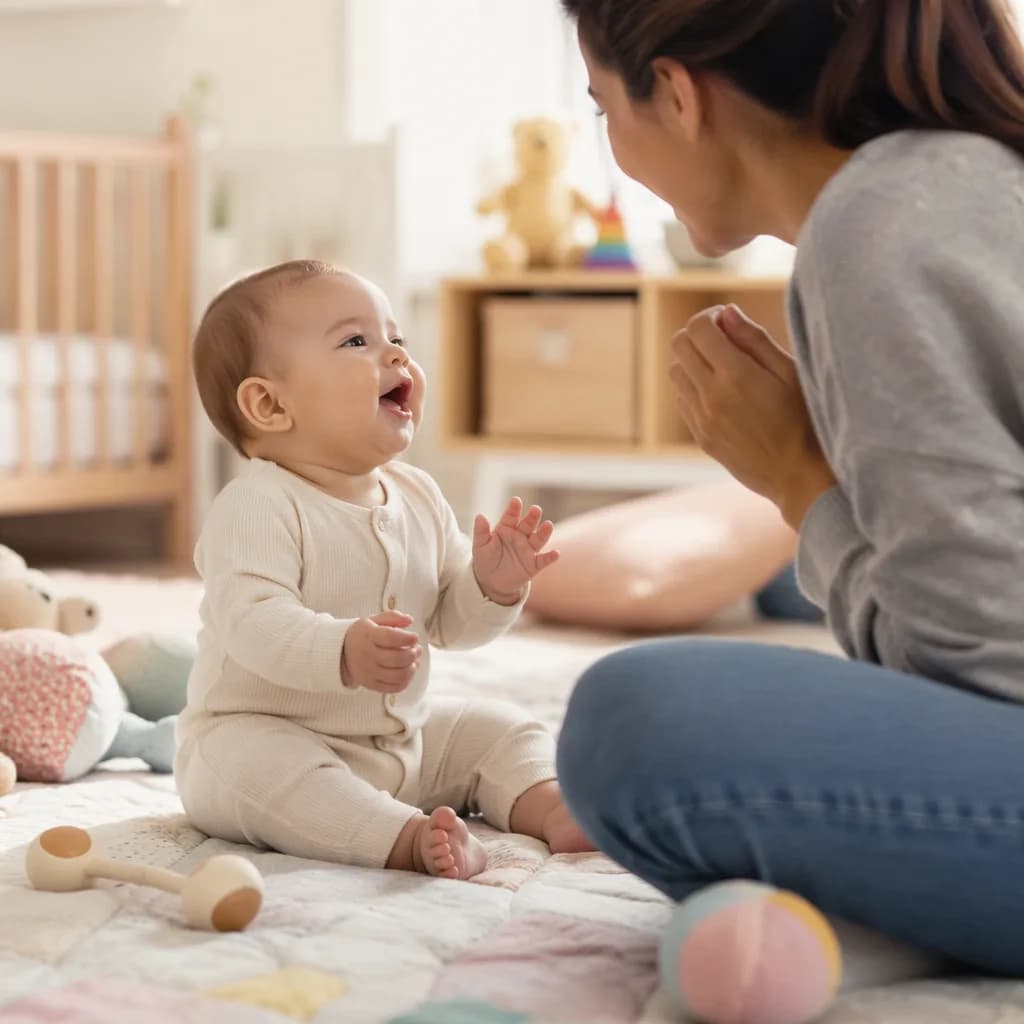
When do babies start talking?
Most babies say a clear first word around 12 months, but talking starts long before that sweet “mama,” “dada,” or “ball.”
In the early months, your baby is already learning how conversation works. They watch your face, listen to your voice, coo back at you, and begin to take turns with sounds. By 6 to 12 months, many babies are babbling, pointing, looking where you point, and starting to connect words with familiar things, like “cat” or “milk.” Those little gestures count. So does eye contact. So does understanding “where’s your nose?” before they can say “nose” themselves.
A first word is usually a word your baby uses clearly and consistently for the same thing. For example, if “ba” always means bottle, that may be a real word in your house.
There’s a wide normal range, though. Some babies talk a little earlier, some take more time, and children develop speech, language, and communication skills at different rates. Try to look at the whole picture instead of one single milestone. Our Baby Milestones Guide: Track Progress Without Stress can help with that calmer view, just like our guides on rolling over and crawling.
The best support is simple: talk, sing, copy their sounds, and look at books together. If you want an easy place to start, here’s more on reading to your baby. And yes, even hearing their own name, maybe something short and gentle like Rami, becomes part of how they learn language.
Baby talking milestones by age
Babies don’t wake up one morning suddenly “talking.” It builds in tiny, sweet steps: a look, a squeal, a babble from the back seat, then one day a very determined “no.”
Children develop speech, language, and communication skills at different rates, and knowing what’s typical can help you spot concerns early without turning every coo into a test. If you like tracking development gently, our Baby Milestones Guide: Track Progress Without Stress pairs well with this stage-by-stage view.
0-3 months
In the newborn months, communication is mostly cries, facial expressions, and body language. You may notice your baby has different cries for different needs, like hunger, tiredness, or discomfort.
Many babies startle at sound, calm when they hear a familiar voice, and begin making soft cooing or vowel-like sounds. This is why those sleepy little chats during feeds and diaper changes matter. Hold your baby close, look at their face, and talk about what you’re doing. Babies love faces, and they learn from that back-and-forth rhythm.
4-6 months
Around this stage, babies often get noisier in the best way. You may hear laughs, squeals, and playful sounds like “ah” and “oo.” They may turn toward sounds and copy simple tones, almost like they’re having their own tiny conversation with you.
Singing helps babies tune in to the rhythm of language, so this is a lovely age for simple songs. No performance needed. Your baby doesn’t care if you’re off-key.
This is also a busy season for physical milestones, so if you’re watching movement too, you might like When Do Babies Roll Over? Timeline and Safety Tips.
7-9 months
This is prime babbling territory. You may hear repeated sounds like “bababa,” “mamama,” or “dadada.” At first, these sounds may not be true words, even if Grandma is absolutely convinced “mama” counts.
Babies may respond to their name, use their voice to get attention, and enjoy games that involve taking turns, like peek-a-boo. Those little pauses, where you wait and they squeal back, are early conversation practice.
10-12 months
Near the end of the first year, communication gets more intentional. Your baby may wave, point, reach, and understand simple words like “no” or “bye-bye.” Some babies say a first word with meaning around this time.
Books can be especially fun now. You don’t have to read every word on the page. Just point and talk: “Dog. Big dog. Woof.” If you’re building that habit, here’s a gentle guide to Reading to Your Baby: When to Start and Why It Matters.
12-18 months
Many toddlers say several words in this window, follow simple one-step directions, and point to wanted objects or familiar people. If your child says “ca” while pointing at a cat, try answering naturally: “Yes, it’s a cat.” There’s no need to correct sharply. Just model the word.
Choices help too: “Apple or banana?” It gives your toddler a reason to use words, gestures, or both.
18-24 months
Vocabulary often grows quickly in this stage. Toddlers may begin using two-word phrases like “more milk,” “mama up,” or “shoe on.” They may name common objects and point to body parts when asked, like nose, foot, or ear.
Keep instructions short: “Get your coat.” “Shut the door.” Repetition helps words stick, so talking through ordinary routines is useful. Laundry counts. Snack time counts. So does looking for the missing blue shoe.
If your child is also busy scooting, pulling up, or chasing the dog, When Do Babies Crawl? Timeline, Signs, and Tips for Parents may help you place those movement milestones alongside language.
2-3 years
By age 2 to 3, many children use short sentences, ask simple questions, and are understood by familiar adults much of the time. If your child says “sock off,” you can stretch it slightly: “Yes, we’re taking your sock off.” That small expansion teaches sentence building without pressure.
Try getting your child’s attention before asking a question, then give them time to answer. Toddlers need a beat.
And just for fun, if your talkative toddler is suddenly very interested in names, you might enjoy looking up meanings together, like Rami: meaning & origin. Sometimes a name becomes their favorite new word.
What counts as a first word?
A first word doesn’t have to sound crisp or grown-up. It counts when your baby uses a sound consistently, intentionally, and with meaning.
So yes, “mama” counts if they use it for Mom and not for every person who walks into the room. “Ba” can count for bottle if they say it when they see the bottle, want the bottle, or reach for it. “Da” can count for the family dog if it shows up every time the dog trots past the high chair.
Animal sounds count too. If your baby says “moo” every time they see a cow in a book, that’s meaningful communication. So do sweet little approximations, like “nana” for banana or “uh-oh” when something drops. The sound doesn’t need to be perfect. It needs to be used on purpose.
What usually doesn’t count yet is random babbling that happens to sound like a word once or twice. Babies play with sounds for a long time before those sounds become labels. One “mama” during a diaper change might melt you completely, and fair enough, but you’re looking for a pattern.
This is a lot like other baby milestones: rolling, crawling, talking, and understanding words all unfold at their own pace. If tracking it starts to feel stressful, our Baby Milestones Guide: Track Progress Without Stress can help you keep perspective. And if you’re in the thick of books and pointing, reading to your baby is a lovely place to hear those early “words” start to take shape.
Talking and understanding are different skills
Babies usually understand more than they can say. For months, you may see little signs that your baby is taking in language long before clear words arrive.
Receptive language means what your baby understands. Expressive language means what your baby can say or sign. These grow side by side, but they don’t always move at the same speed.
A 13-month-old, for example, may bring their shoes when you say, “Get your shoes,” even if they can’t say “shoes” yet. That’s receptive language at work. They heard the word, connected it to the object, and knew what to do. Pretty amazing, honestly.
Expressive language can look like spoken words, but it can also look quieter than that. Pointing to the banana they want, waving bye-bye, lifting their arms to be picked up, clapping during a song, or using a simple sign for “more” are all meaningful communication. Those gestures count. They’re part of how babies tell us what they notice, want, and feel.
This is why milestone watching can feel a little tricky. One baby may say “mama” early, while another may be busy pointing, copying sounds, and following simple directions. Both are showing language growth. If you like having a calm big-picture view, our Baby Milestones Guide: Track Progress Without Stress can help you keep things in perspective, just like you might with movement milestones such as rolling over or crawling.
You can support both skills in ordinary moments. Name what you see, repeat your baby’s sounds back, sing, and look at books together. Even a few minutes with a board book counts, and reading to your baby gives them lots of chances to hear words paired with faces, pictures, and your voice.
How to help your baby learn to talk
The best speech practice usually happens in the tiny, ordinary moments you’re already living through: diaper changes, snack time, bath time, and stroller walks around the block.
Talk about what your baby can see, hear, touch, or do right now. During a diaper change, you might say, “Clean diaper,” “Feet up,” or “All done.” At snack time: “Blue cup,” “More banana,” “Daddy’s home.” Short, clear phrases are easier for babies to connect with real life, especially when you repeat them often.
Then pause.
That quiet little pause matters because conversation is more than words. Your baby might answer with a coo, a kick, a smile, a look toward the dog, or a hand reaching for more. When you leave room for that response, you’re teaching the rhythm of talking: I say something, then you get a turn.
Books help too, and they don’t need to be complicated. Simple board books are perfect. Point to the same pictures again and again: “Dog,” “baby,” “car,” “night-night.” You don’t have to read every word on the page. Naming what you see is enough, especially for babies who want to chew the corner halfway through. If you want more ideas, this guide on reading to your baby is a lovely place to start.
Songs are another easy win. Babies tune in to rhythm, and songs with actions add an extra cue. Clap during “If You’re Happy and You Know It,” wave during a goodbye song, or bounce gently to a nursery rhyme. The action helps the words stick.
As your baby gets older and starts using sounds or words, build on what they give you. If they say “ball,” you can say, “Big ball” or “Roll the ball.” If they point and say “Da,” you might answer, “Yes, dog.” No correction needed. Just give them the word clearly and warmly.
Try to keep background noise low when you can. TV, videos, or a radio playing in the background can make it harder for babies and toddlers to listen to your voice. They learn best from back-and-forth interaction with you.
And if you’re tracking other changes alongside talking, like rolling, crawling, or first words, it can help to keep a gentle eye on the bigger picture. Our baby milestones guide, rolling timeline, and crawling timeline can help you notice progress without turning every day into a checklist. Even saying your baby’s name often, whether it’s classic, modern, or something like Rami, gives them another familiar sound to listen for.
When to ask the doctor about speech delays
Speech milestones have a wide normal range, and some children are simply quieter while they’re busy working on other skills. Still, if something feels off, it’s always okay to ask. You’re not overreacting. You’re paying attention.
A good rule: bring up speech and hearing concerns at your child’s next visit, or sooner if you notice any of these signs:
- By 4 months, your baby doesn’t react to loud sounds or doesn’t make many sounds.
- By 6 months, they don’t laugh, squeal, or turn toward voices.
- By 9 months, they don’t babble or respond to their name most of the time.
- By 12 months, they don’t use gestures like pointing, waving, or reaching, or they have no clear babbling.
- By 15 months, they aren’t saying any meaningful words.
- By 18 months, they have very few words, don’t point to show interest, or seem to lose words they once used.
- By 24 months, they don’t use two-word phrases or are very hard for close family to understand.
If you’re worried, ask directly about a hearing check, speech therapy, or early intervention. Hearing and communication are closely tied, and getting support early can help you understand what your child needs next. Your doctor may also ask about the sounds your baby makes, how they respond to your voice, whether they use gestures, and how they communicate wants, like reaching for a cup or pointing to a snack.
It can help to look at speech alongside other milestones without turning it into a daily test. If you like having a calm reference point, our Baby Milestones Guide: Track Progress Without Stress pairs well with movement guides like When Do Babies Roll Over? Timeline and Safety Tips and When Do Babies Crawl? Timeline, Signs, and Tips for Parents.
At home, keep talking, singing, naming what you see, and sharing books. Even a quick board book after breakfast counts, and Reading to Your Baby: When to Start and Why It Matters has simple ways to make it feel natural. If your child’s name is short and clear, like Rami, try using it before a simple question: “Rami, where’s your ball?” Then pause. That little pause gives them room to answer in their own way.
What can affect when babies start talking?
Babies don’t all find their words on the same schedule. Speech and Language UK says children develop speech, language, and communication skills at different rates, and knowing what’s typical can help you spot possible concerns early.
Some things can make timing look different from one baby to the next. Hearing concerns, frequent ear infections, prematurity, oral-motor differences, and broader developmental delays are all reasons parents often keep a closer eye on speech. If something feels off, it’s completely reasonable to ask your child’s doctor or health visitor for guidance. You’re not overreacting. You’re paying attention.
Temperament plays a part too. Some babies are loud little experimenters, babbling through every nappy change. Others are quiet observers who watch your mouth, study the dog, and then surprise you later with a burst of words. That slower-to-speak style can feel worrying, especially if you’re comparing cousins at a birthday party, but milestones are best looked at as a pattern over time. Our Baby Milestones Guide: Track Progress Without Stress can help with that bigger-picture view.
Bilingual babies may also use words across two languages. A child might say “milk” in one language and “dog” in another, so their total word count can be spread out. Bilingualism by itself isn’t a reason to assume delay.
Siblings can shape speech in funny ways. A chatty older brother might model tons of language, just like books and songs do. But he might also answer every question for the baby: “She wants the blue cup!” Try gently pausing and giving the baby a turn.
The everyday stuff helps most: looking at books together, singing, naming what you see, and chatting during routines. If you want an easy place to start, try reading to your baby tonight, even if they mostly chew the corner. Motor milestones vary too, so it can help to read about rolling over and crawling with the same calm lens.
Frequently Asked Questions
What age do babies usually say their first word?
Many babies say a meaningful first word around 12 months, though some start a little earlier or later.
Is babbling considered talking?
Babbling is an early talking milestone. It is not the same as words, but it helps babies practice sounds and rhythm.
Should my 1-year-old be talking?
By 12 months, many babies use gestures, understand simple words, and may say one or two words. Ask your doctor if there is no babbling or gesturing.
Do boys start talking later than girls?
On average, girls may talk a bit earlier, but the normal range is wide. Any child can have a speech delay.
Can babies learn two languages without getting confused?
Yes. Bilingual babies can learn two languages well. Their words may be split between both languages, which is normal.
What is the best way to encourage first words?
Talk face-to-face, read daily, name real objects, pause for responses, and repeat simple words during routines.
Frequently asked questions
When do babies usually say their first word?
Does babbling count as talking?
How can I help my baby learn to talk?
When should I worry if my baby is not talking?
References
Sources
External research this article was grounded in.
- DO vs. MD: What's the Differencewebmd.com
- Ages and stages - Speech and Language UK: Changing young livesspeechandlanguage.org.uk
- Help your baby learn to talk - NHSnhs.uk
Related reading
More from the journal → development
When Do Babies Laugh? Milestones and Play Ideas
Most babies laugh around 3 to 4 months. Learn what early giggles mean, what can encourage them, and when to check in with your pediatrician.
8 min readAug 3, 2026- development
When Do Babies Start Babbling? Sounds and Stages
Most babies start babbling around 4 to 6 months, then build toward ba-ba and da-da sounds as speech skills grow.
11 min readAug 3, 2026 - development
When Do Babies Roll Over? Timing, Practice, Safety
Rolling can look wobbly at first. Learn what early practice looks like, how tummy time helps, and what safety changes once baby starts to roll.
11 min readAug 3, 2026