

Matan Hillel
Hebrew
Matan is a Hebrew boy name meaning “giving,” with a close sense of “gift.” Matan Hillel has a clear Hebrew sound: bright, gentle, and deeply rooted.
84
Strong, gentle, classic, or modern. Boy names from every tradition.
3,794 names
3,794 names
Hebrew
Matan is a Hebrew boy name meaning “giving,” with a close sense of “gift.” Matan Hillel has a clear Hebrew sound: bright, gentle, and deeply rooted.

Hebrew
Ilai is a Hebrew boy name associated with “ascend” or “go up,” and it can also be understood as “my God is high” or “God is exalted.” Paired with Moshe, it has a deeply Hebrew, faith-filled sound.

Hebrew
Roee is a Hebrew boy’s name meaning “shepherd.” Roee Shachar has a gentle, bright Hebrew sound, with Roee carrying the clearest sourced meaning.

Swahili
Fadhili is a Swahili boy name meaning “generosity,” “kindness,” “virtue,” or “compassion.” It comes through Swahili usage from the Arabic root fadl, meaning bounty or virtue.

Swahili
Abdalla means "servant of God" or "servant of Allah." It comes from Arabic Abd Allah, with abd meaning "servant" and Allah referring to God in Islam.

Swahili
Haji means “pilgrim” or “one who has performed the Hajj.” It comes from the Arabic title connected to the annual Muslim pilgrimage to Mecca.

Swahili
Shaaban is an Arabic-rooted boy name connected to Shaʿbān, the eighth month of the Islamic lunar calendar. Its older root carries the sense of separation, dispersion, or branching.

Swahili
Mbarak means "blessed" or "fortunate." It is a Swahili-used form connected to Arabic Mubarak, a name full of hope, favor, and good wishes.

Swahili
Sudi is a Swahili boy name usually understood as “lucky” or “fortunate.” Some name references also connect it with “luck” and “scholar,” though the Swahili meaning parents most often look for is simple and bright: lucky.

Swahili
Hamisi is a Swahili masculine name meaning "Thursday" or "born on Thursday." It comes from Arabic al-khamis, tied to the Semitic root for "five."

Nigerian
Abubakar is a Nigerian form of the Arabic Abu Bakr, a name strongly associated with Abu Bakr, the first caliph of the Rashidun Caliphate. The full name Abubakar Sani Abdullahi carries a distinctly Muslim Nigerian feel, especially in northern Nigeria.

Swahili
Jabali is generally used as a Swahili boy name meaning “rock” or “strong as a rock.” It has a steady, grounded feeling, with a sound that is bold but still easy to say.

Nigerian
Musa is the Arabic form of Moses, a major prophet in Islam. Ibrahim is the Arabic form of Abraham, and Gambo is a Hausa name meaning “born after twins.”

Nigerian
Afolayan is a Yoruba male name and surname from Nigeria meaning “one who struts with wealth.” The full name Saheed Olakunle Afolayan carries a distinctly Nigerian, Yoruba-linked family-name heritage, though the provided sources only verify the meaning of Afolayan.

Spanish
Martín Ezequiel Roldán has a strong, faithful feel, with Ezequiel meaning “may God strengthen him” or “strong.” Roldán is used as both a surname and a given name in Spanish-speaking contexts.

Nigerian
Hassan is an Arabic boys' name meaning "handsome," "good," or "benefactor." In the full Nigerian name Hassan Bashir Danjuma, Danjuma adds a Hausa-rooted family meaning often understood as "son of Juma."

Hindi
Ishan Dev is a Sanskrit-origin Hindu boy name meaning "Lord Shiva." It has a calm, devotional feeling, with the Devanagari form ईशानदेव.

Hindi
Vivaan Raj is a Hindi boy name built around Vivaan, a Sanskrit-origin name associated with being full of life, energetic, radiant, and linked with sunrise or dawn. Together, it has a bright, lively, dignified feel.

Hindi
Reyansh Veer is a Hindi boy name with a bright, devotional feel. Reyansh is commonly interpreted as “ray of light” or “part of Vishnu,” while Veer gives the full name a brave, strong finish.

Hindi
Arjun Pranav is a Hindi boy's name pairing Arjun, known from the Mahabharata as the heroic Pandava archer, with Pranav, a gentle Sanskrit-style name often used in Hindu families. Together, it feels brave, devotional, and calm.

Hindi
Vihaan Samar is a Hindi boy name with Sanskrit roots. Vihaan means “dawn” or “morning,” while Samar has Sanskrit meanings connected with “reward,” “fruit,” “war,” and “battlefield commander.”

Hindi
Kabir Rohan is a Hindi boy name pairing the saintly, poetic weight of Kabir with Rohan, which means “ascending” or “ascent” in Sanskrit and Hindi. Together, it feels thoughtful, grounded, and quietly upward-looking.

Hindi
Shaurya means “valour,” giving Shaurya Neel a brave, steady feeling. It’s a Hindi boy’s name with a strong first sound and a calm, graceful finish.

Hindi
Atharv Rudra is a strong Hindi boy name with deep Sanskrit roots. Atharv means “knower of the Atharva Veda” or “one with ancient wisdom,” giving the full name a learned, devotional, and grounded feel.

Hindi
Devansh means “part of the divine” or “part of God,” from Sanskrit elements connected with “god” and “part.” Devansh Arpit has a devotional Hindi feel, with Devansh carrying the sourced meaning of divine connection.

Hindi
Parth Dhruv is a Hindi boy's name built from two Indian given names. Parth is documented as a masculine Sanskrit name, while Dhruv is a familiar Indian given name with several public bearers.

Hindi
Vedant Arnav is a Hindi boy name with a thoughtful, expansive feel. Vedant connects to Vedanta, a major Hindu philosophical tradition, while Arnav comes from Sanskrit ārṇava, meaning "ocean" or "vast body of water."
Hindi
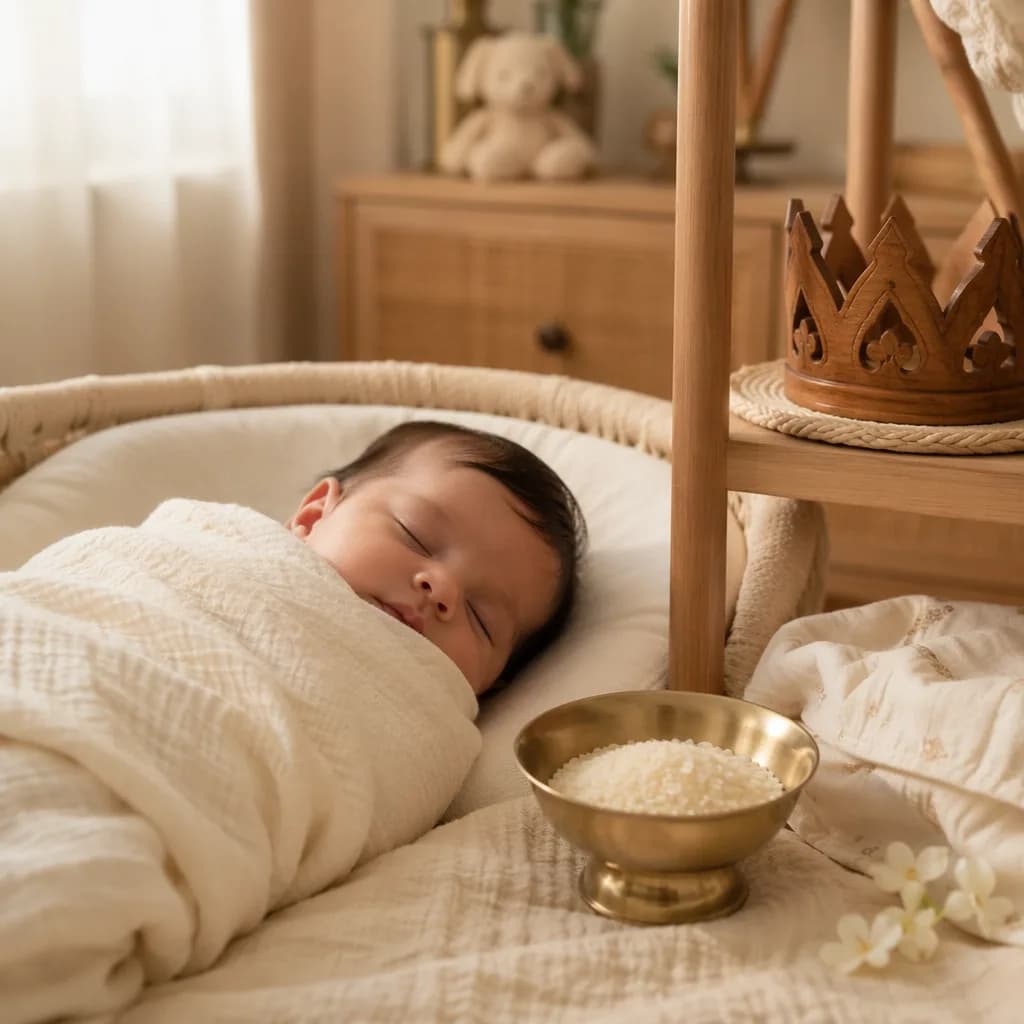
Yuvraj Akshat is a Hindi boy name with Sanskrit roots, meaning “crown prince” and “indestructible” or “sacred unbroken rice used in blessings.” Together, it feels regal, blessed, and steady.

Hindi
Tanay is a Hindi name meaning "son." Tanay Raghav feels affectionate and rooted, with Tanay carrying a direct sense of family belonging.

Hindi
Ritvik Abeer is a Hindi boy’s name pairing the contemporary Indian given name Ritvik with Abeer, an Arabic name meaning fragrance, aroma, perfume, or a beautiful scent. The result feels gentle, bright, and memorable.

Hindi
Siddharth Jay combines Sanskrit and Hindi naming roots: Siddharth means “one who has achieved his purpose,” while Jay is commonly understood as “victory.” Together, it gives the feeling of a boy who is purposeful, steady, and victorious.

Hindi
Manan Shlok is a Hindi boy's name pairing Manan, associated with reflection or contemplation in Indian philosophy, with Shlok, a traditional boys' name. Together, it has the thoughtful feel of “a reflective verse” or “contemplative sacred line.”

Hindi
Tanish Omkar is a Hindi boy name pairing Tanish with Omkar, a Sanskrit-origin Hindu name meaning “the sacred primordial sound of Om” and also associated with Shiva. The full name feels calm, devotional, and quietly strong.

Hindi
Krish Varun is a Hindi boy name pairing Krish with Varun, a Sanskrit-origin name meaning “God of waters and the cosmic ocean” or “lord of the waters.” Varun connects the name to Lord Varuna, the Vedic deity associated with water, sky, and cosmic order.

Hindi
Lakshya Aditya is a Hindi boy's name with Sanskrit roots, meaning “goal” or “aim” paired with “of Aditi” and, in Hindu usage, a name associated with the sun god Surya. Together, it feels purposeful, bright, and steady.

Spanish
Saúl is the Spanish form of Saul, a biblical name traditionally understood as “asked for” or “prayed for.” Benjamín adds the warm biblical meaning “son of the right hand,” while Ledesma is a Spanish surname associated in the provided source with origins in Granada, southern Spain.

Hebrew
Nadav is a Hebrew boy name meaning “generous” or “noble,” with a related sense of “to give.” Paired with Elisha, it feels deeply Hebrew, gentle, and purposeful.

Hebrew
Tomer Amichai is a Hebrew boy's name with a grounded, hopeful feeling. Amichai means "my nation lives," while Tomer is a Hebrew given name written תומר.

Hebrew
Uriel is a Hebrew boy name meaning "God is my light." Uriel Noam has a gentle, luminous sound, with Uriel carrying the documented meaning from Hebrew roots for "light, flame" and "God."

Hebrew
Ariel Itamar is a Hebrew boy name with a calm, lyrical sound. In the supplied sources, Itamar means “island of palms,” giving the full name a nature-rich, steady feeling.

Hebrew
Omer Gilad is a Hebrew boy's name built around Omer, an ancient Israelite dry measure mentioned in biblical context for grain and dry goods. Gilad gives the full name a strongly Hebrew sound, familiar as both a personal and family name.

Hebrew
Yair Akiva is a Hebrew and Jewish name pairing. Akiva is a Jewish name that arose in Aramaic from Hebrew Ya'akov, making it cognate with Jacob.

Hebrew
Erez is a Hebrew boy name meaning “cedar tree.” Erez Neria has a grounded, nature-rich feel, with Erez carrying images of strength, steadiness, and noble character.

Hebrew
Harel Moshe is a Hebrew boy's name pairing Harel, commonly understood as "mountain of God," with Moshe, the Hebrew form of Moses. Together, it has a grounded, faithful feeling: steady strength joined with a name tied to one of the central biblical figures.

Hebrew
Kfir is a Hebrew boy name meaning "lion cub" or "young lion." Kfir Elad feels strong, bright, and distinctly Hebrew, with a gentle kind of courage at its center.

Hebrew
Eitan Boaz is a Hebrew boy's name with a strong, thoughtful feel. Boaz is traditionally understood as “swiftness,” with biblical interpretations also connecting it to strength.

Hebrew
Ilai Shahar is a Hebrew boy's name pairing Ilai, often connected with height or being above, with Shahar, the Hebrew word for dawn. Together it gives the feeling of rising light, quiet strength, and a new beginning.

Spanish
Joel comes from the Hebrew Yo'el, meaning "Yahweh is God." In Spanish, Joel Bautista Villalba has a clear, faithful sound with a bright first name, a devotional middle name, and a surname-style finish.

Russian
Akimi Sergeyevich Fedotov combines an uncommon given name with a Russian patronymic and surname. The surname Fedotov comes from Fedot, a name borrowed from Greek Theodotos, meaning “given by God.”

Russian
Arseniy Pavlovich Sokolov is a Russian masculine full name with a bright, formal sound. The surname Sokolov comes from Slavic sokol, meaning “falcon,” with the Russian family-name ending -ov carrying the sense of “descendant of.”