
Pincer Grasp Development: Ages, Signs, and Easy Play
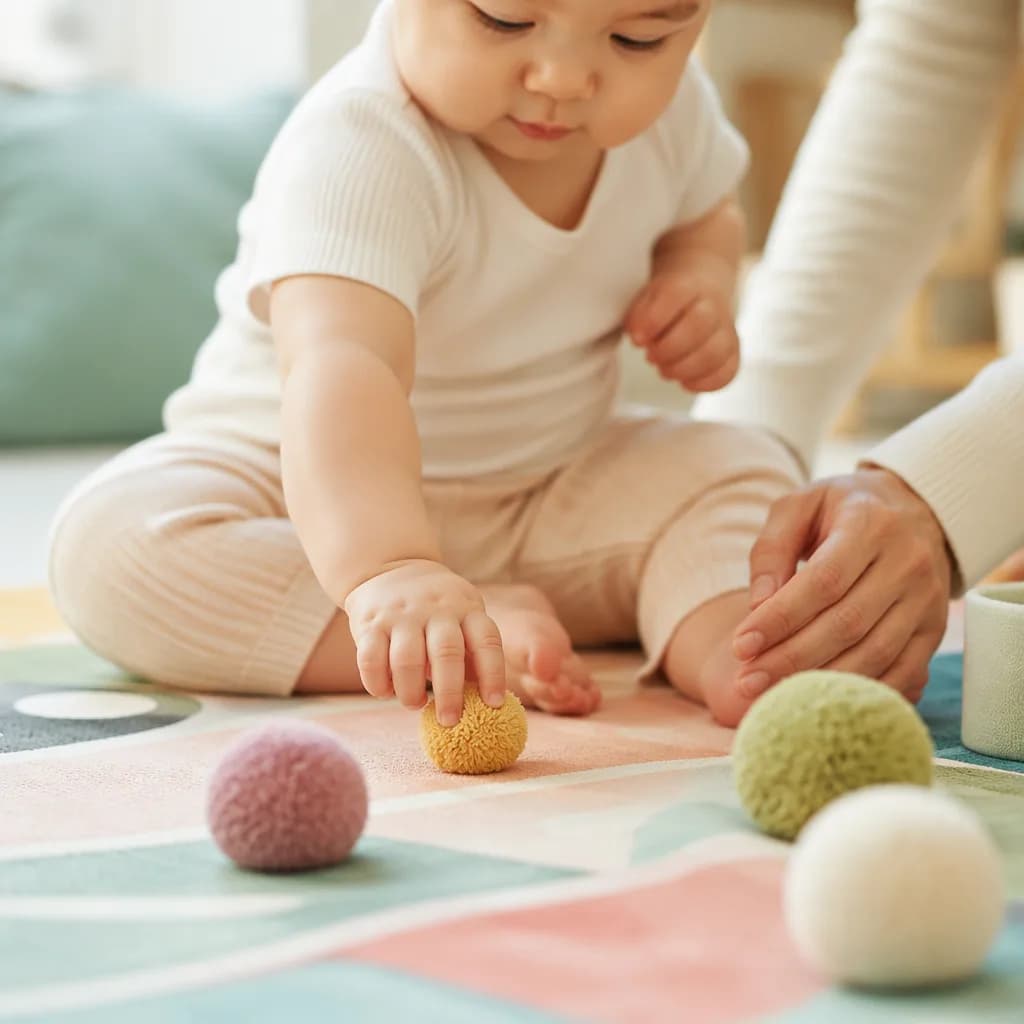
What is the pincer grasp?
The pincer grasp is the small but mighty skill of using the thumb and index finger to pick up tiny objects. Think of a baby carefully grabbing a soft pea from the highchair tray, pinching the corner of a board book page, or trying to catch the little pull on a zipper.
Before this looks precise, it usually looks messier. A raking grasp is when baby uses the whole hand or fingers to drag an object toward the palm, like scooping cereal with a tiny rake. An inferior pincer grasp is closer: baby uses the thumb and index finger, but more with the pads or side of the fingers. A neat pincer grasp is the refined version, using the tips of the thumb and index finger together.
The word “pincer” can also mean a claw-like tool or the claw of a crab, which is a helpful image. Baby’s fingers are learning to pinch and hold with control.
This is one part of fine motor skills baby development, alongside reaching, grasping, and releasing. It sits in the same everyday growth story as early social moments like baby smiles, bigger movement skills like crawling, and the practical changes you may notice around 6 month milestones and 9 month milestones.
Pincer grasp age: when does it usually start?
Many babies begin working toward a pincer grasp around 7-9 months. At first, though, it doesn’t look neat at all. It may look like your baby smearing banana across the high chair tray, patting at a puff, then finally dragging it into their palm with pure determination.
That messy practice counts.
A more precise pincer grasp often shows up around 9-12 months, when babies start using the thumb and fingertip together to pick up small things. This is the skill parents usually picture: thumb, index finger, tiny snack, big proud face. If you’re watching this stage closely, our guide to 9 Month Baby Milestones: Skills, Sleep, and Worries pairs nicely with what you may be seeing at the table and on the play mat.
The usual progression goes something like this:
- Whole-hand grabbing, where baby scoops or clutches with the palm
- Raking with the fingers, often pulling objects toward the body
- Thumb-side pickup, using the thumb side of the hand more purposefully
- Thumb and fingertip pickup, the more precise pincer grasp
It’s also normal for this to overlap with other big skills. Around this stretch, some babies are busy sitting, babbling, or starting solids, which we talk about in 6 Month Baby Milestones: Sitting, Babbling, Solids. Others are putting their energy into movement, like the stages covered in When Do Babies Crawl? Signs, Stages, and Tips.
Try not to compare too hard. Babies develop at different speeds, and babies born early may follow their own adjusted timeline. Just like smiles arrive in their own sweet window, as we share in When Do Babies Smile? Early Grins and Social Smiles, hand skills build little by little. One day it’s a fistful of cereal. Then suddenly, it’s one tiny puff between two tiny fingers.
Signs your baby is getting close
You’ll often see the pincer grasp coming before it fully clicks. It starts with curiosity.
Your baby may stare hard at tiny things, like a puff on the tray, then poke at it with one finger instead of grabbing right away. That little point-and-poke moment is a clue that they’re noticing small details and trying to use their fingers with more purpose.
Another common sign is raking. Baby might drag cereal, puffs, or soft bits of food toward the palm first, then work hard to lift them. It can look clumsy, but it’s useful practice. One day they’re sweeping everything into a sticky fist. Another day they’re chasing one pea around the highchair tray, missing it three times, then finally pinching it between finger and thumb.
You may also notice the thumb side of the hand getting more involved. Instead of grabbing with the whole fist, baby starts scooping or trapping objects against the thumb side. Small change, big deal.
Passing toys from one hand to the other is another helpful sign, especially if baby can let go on purpose. Dropping a block into your hand, releasing a spoon, or tossing a teether off the tray all count as practice with control.
These skills often show up alongside other busy baby changes, like the ones parents watch for in 6 Month Baby Milestones: Sitting, Babbling, Solids and 9 Month Baby Milestones: Skills, Sleep, and Worries. Growth comes in little bursts. Sometimes it’s a grin, like in When Do Babies Smile? Early Grins and Social Smiles. Sometimes it’s movement, like in When Do Babies Crawl? Signs, Stages, and Tips. And sometimes, it’s one tiny pea.
Simple play activities that help the pincer grasp
Pincer grasp practice doesn’t need fancy toys. It’s often the tiny, ordinary stuff: picking up a soft bite of banana, tugging a scarf from a box, or trying to peel the corner of a sticker while you hold the tray steady.
If your baby is developmentally ready for solids, offer large, safe finger foods during meals. Think soft banana pieces or well-cooked carrot strips cut in a safe shape for your baby. Sit close, watch carefully, and let them try to pick food up on their own before you help. Mealtime can be practice, but it should still feel calm, not like a skills test. If you’re around the solids stage, you may also like this gentle guide to 6 month baby milestones.
A muffin tin is surprisingly useful. Place chunky toys, soft blocks, or fabric squares in a few cups and let your baby reach in, grab, and pull them out. The little “dip” of each cup gives their fingers a reason to work. You can sit across from them and drop items back in, almost like a slow, silly game of fill and empty.
Try an empty tissue box, too. Stuff it with scarves or clean washcloths, leaving one corner peeking out. Babies often love pulling one fabric piece after another. Then show them how to push a cloth back in. Pulling and releasing both matter.
Large stickers can be fun with close supervision. Stick a few onto a tray, lift one edge, and let your baby pinch and peel with your help. Stay right there, since stickers can go straight to the mouth.
Crumpled paper play is another easy one. Offer larger pieces of paper to pinch, scrunch, and tear while you supervise. The sound alone can be a big hit.
Keep it short. A few playful minutes count.
Some days your baby will be more interested in chewing the washcloth than pulling it. That’s normal baby life. Milestones tend to show up alongside lots of other changes, like social play, movement, and curiosity. If you’re watching the bigger picture, these posts on early smiles, crawling signs, and 9 month baby milestones can help you see what else may be unfolding.
Safety tips for baby picking up food and small objects
Pincer grasp practice gets exciting fast, especially when a baby spots one tiny crumb on the highchair tray and goes after it with total focus. Still, safety comes first.
Choose practice items that fit your baby’s age, chewing skills, and sitting ability. A baby who is still working on steady sitting, like many babies around the stage described in 6 Month Baby Milestones: Sitting, Babbling, Solids, usually needs bigger, easier-to-handle items and close support. If your baby is closer to the stage covered in 9 Month Baby Milestones: Skills, Sleep, and Worries, you may see more precise finger work, but supervision still matters every time.
Avoid common choking hazards during practice, including:
- Whole grapes
- Nuts
- Popcorn
- Coins
- Beads
- Button batteries
- Small toy parts
Food practice should happen while your baby is sitting upright and you’re right there. Not across the room. Not half-watching while unloading the dishwasher. Right there, close enough to notice if something goes wrong.
Small non-food objects can be useful for guided practice, but they’re not for independent play. A large pom-pom in your hand during a short activity is very different from a baby exploring a bin of tiny craft supplies alone. If your baby still mouths everything, or has trouble sitting steadily, start with bigger objects that are easier to see, hold, and remove.
This stage sits inside a much bigger pattern of development, just like early social skills in When Do Babies Smile? Early Grins and Social Smiles or movement changes in When Do Babies Crawl? Signs, Stages, and Tips. Tiny fingers are learning a lot. Our job is to keep the practice safe.
When to ask your pediatrician or therapist
Most babies build hand skills in small, uneven steps. One week they rake at cereal with the whole hand, the next they’re suddenly trying to pinch a soft banana piece between finger and thumb. Still, if something is sitting in your gut, ask.
A question is enough reason to check in.
Bring it up with your pediatrician if your baby isn’t using both hands, keeps one hand in a very tight fist, or seems unusually floppy or stiff. You can also ask if you’re seeing no progress toward finger feeding or a thumb-side grasp by around 12 months. That doesn’t mean something is wrong. It means your baby deserves a closer look and you deserve clearer guidance.
If your baby was born early, remember to think in corrected age. A 10-month-old who arrived 2 months early may be working more like an 8-month-old in some areas, and that context matters.
Your pediatrician may suggest watching for a few more weeks, trying simple play ideas, or getting an early intervention evaluation. Early intervention can sound heavy, but it’s often very practical: someone showing you how to place toys, how to support posture, or how to make snack time easier.
Milestones connect, too. Hand skills often grow alongside sitting, reaching, crawling, and social play, so it can help to look at the whole picture through guides like 6 Month Baby Milestones: Sitting, Babbling, Solids, 9 Month Baby Milestones: Skills, Sleep, and Worries, or When Do Babies Crawl? Signs, Stages, and Tips.
Frequently Asked Questions
What is the pincer grasp?
The pincer grasp is when a baby uses the thumb and index finger to pick up a small item, like a puff or tiny piece of soft food.
What age does the pincer grasp develop?
Many babies start working on it around 7-9 months, with a cleaner thumb-and-fingertip grasp often showing up around 9-12 months.
Is baby picking up food a sign of fine motor development?
Yes. Picking up food helps babies practice finger control, hand-eye coordination, grasping, and releasing.
What comes before the pincer grasp?
Most babies first grab with the whole hand, then rake objects toward the palm, then start using the thumb side of the hand.
How can I help my baby practice the pincer grasp?
Try safe finger foods, pulling scarves from a tissue box, picking toys from a muffin tin, and supervised sticker play.
When should I worry about the pincer grasp?
Ask your pediatrician if your baby is not making progress toward thumb-side grasping by about 12 months, or if one hand seems much weaker.
Frequently asked questions
What age do babies develop the pincer grasp?
What are signs my baby is close to a pincer grasp?
How can I help my baby practice the pincer grasp safely?
Should I worry if my baby is not using a pincer grasp yet?
References
Sources
External research this article was grounded in.
- Pincer movement - Wikipediaen.wikipedia.org
- pincerの意味・使い方・読み方 | Weblio英和辞書ejje.weblio.jp
- PINCER | English meaning - Cambridge Dictionarydictionary.cambridge.org
Related reading
More from the journal → baby-development
When Do Babies Smile? Early Grins and Social Smiles
Learn when babies first smile, how newborn grins differ from social smiles, and what to watch for if your baby isn't smiling yet.
9 min readJul 15, 2026 baby-development
When Do Babies Crawl? Signs, Stages, and Tips
Most babies crawl between 6 and 10 months, but there’s a wide normal range. Learn signs, stages, crawling styles, and simple ways to help.
12 min readJul 3, 2026- baby-development
9 Month Baby Milestones: Skills, Sleep, and Worries
Wondering what’s typical at 9 months? Here’s a calm guide to movement, babbling, feeding, sleep shifts, and when to call the doctor.
15 min readJul 3, 2026