
When Do Babies Smile? Early Grins and Social Smiles
When do babies smile for the first time?
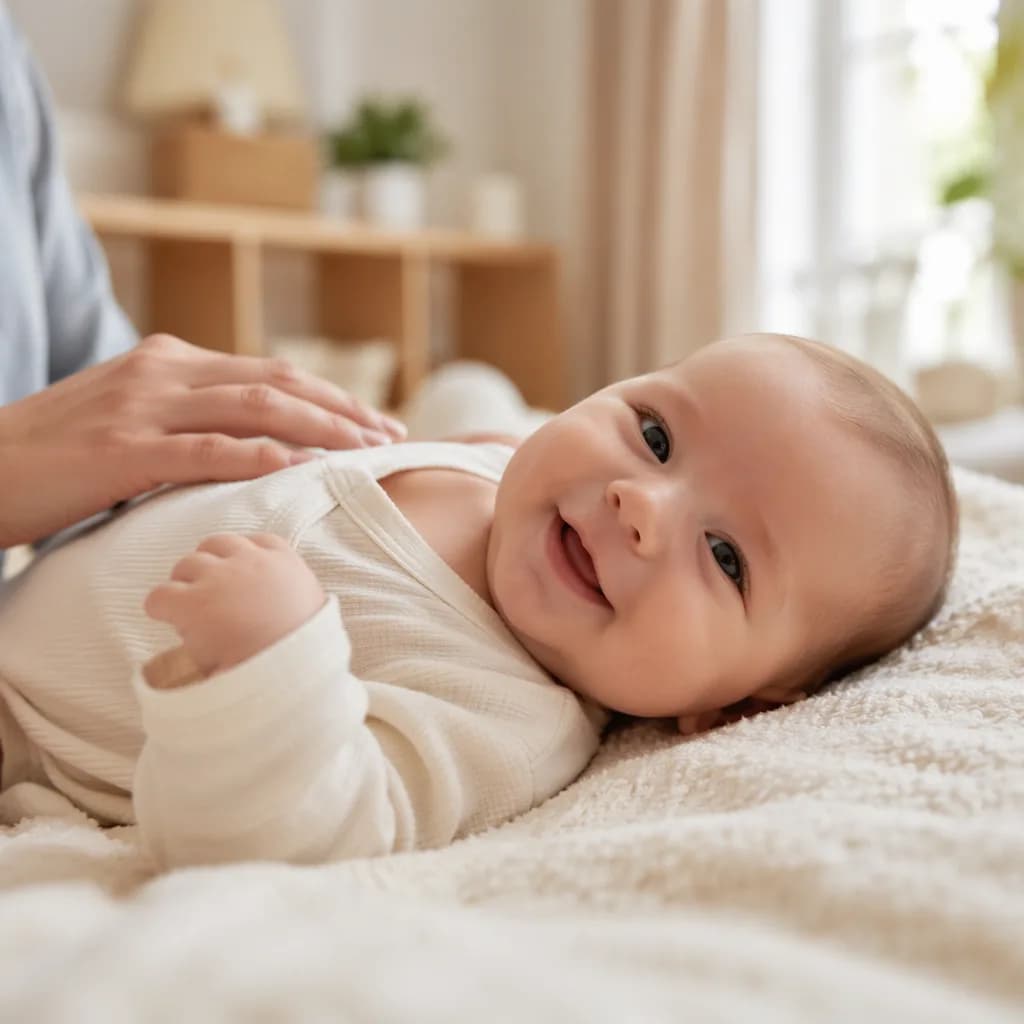
Most babies show little smiles in the first few weeks, often while they’re asleep, drowsy, or peacefully relaxed. These early grins can make your heart flip, but they’re usually quick and not clearly connected to something you did.
A true social smile usually shows up around 6 to 8 weeks, though some babies smile a little earlier or later. This is the smile that feels like a tiny conversation. Your baby sees your face, hears your voice, or feels you playing gently, then responds with a bright, intentional smile.
By about 2 months, many babies begin smiling back when a parent leans close, talks in a soft voice, or makes a familiar silly sound. Picture this: your 7-week-old is lying on a blanket, Dad leans in and says, “Hi, buddy,” and suddenly that little face lights up with a wide, gummy smile. That’s the kind of moment parents remember.
The difference is response. A newborn grin may appear during sleep or after feeding, then disappear just as fast. A social smile is more clearly aimed at another person. It often comes with eye contact, a calmer body, and that sweet look of recognition.
If your baby isn’t smiling right at 6 weeks, try not to panic. Babies grow on their own timelines, just like later skills such as sitting, babbling, and movement. If you like tracking what comes next, you may also enjoy our guides to 6 Month Baby Milestones: Sitting, Babbling, Solids and When Do Babies Crawl? Signs, Stages, and Tips.
Newborn smiling: reflex, gas, or something else?
Those tiny newborn smiles can stop you in your tracks. One minute your baby is asleep on your chest, and the next there’s a little grin that makes the whole room go quiet.
In the newborn stage, smiling is usually reflexive, especially during sleep or those drowsy, half-awake moments. These early grins can happen because of normal nervous system activity, comfort, or body sensations. Your baby’s brain and facial muscles are still maturing, so they’re also practicing tiny movements: grimaces, lip twitches, sleepy smirks, and yes, sweet little smiles.
Gas can cause facial movements too. A baby might scrunch, stretch, relax, and look like they’re smiling after a feed. But not every newborn smile is “just gas,” and you don’t have to brush it off like it doesn’t count. It may not be a social smile yet, but it’s still a real part of getting to know your baby.
I think of these early smiles like the early wiggles before bigger skills later on. Over time, those little body experiments turn into more purposeful movement, the kind you’ll see in 6 month baby milestones, 8 month baby milestones, and eventually questions like when do babies crawl. For now, enjoy the sleepy grin. It’s normal, it’s lovely, and it’s yours to remember.
What is a baby social smile?
A baby social smile is a smile that happens in response to someone or something around them. It might show up when you talk in a sing-song voice, make a silly popping sound, lean in close, or smile at them first.
This is different from a tiny sleepy grin that seems to come and go on its own. A social smile feels more connected. Your baby is reacting to you.
You might notice eye contact along with it. Their whole face may brighten, almost like a little light switched on. Some babies add soft coos, wiggle their arms and legs, or kick with excitement. Others are quieter. They may simply lock eyes, soften their body, and give you a slow, sweet smile.
This baby smile milestone is one of the first clear signs of social connection. It’s one of those moments where you think, “Oh, you see me.” And yes, it can feel huge.
Early on, babies may smile more at familiar voices and simple, high-contrast faces. So if your baby beams when you lean over the crib and say the same goofy phrase every morning, that counts. If they calm when you pick them up, look toward your face, and then smile, that counts too.
A few signs to watch for:
- Smiling back after you smile or make a funny sound
- Bright eyes and a more alert face during interaction
- Little coos, squeaks, or excited arm and leg movements
- Calming in your arms, then smiling at your voice or face
Like other milestones, social smiling is one piece of a much bigger picture. Later, you’ll see connection show up in new ways, from babbling in 6 month baby milestones to playful movement in 8 month baby milestones and early mobility in when babies crawl.
Typical baby smile milestone timeline
Baby smiles don’t arrive on one exact day. They build slowly, and some of the earliest ones happen before your baby is really smiling at you.
From 0 to 4 weeks, sleepy smiles and reflexive grins are common. You might see a tiny corner-of-the-mouth smile while your baby is drifting off, stretching, or full and relaxed. It’s sweet. It counts as an early grin, even if it isn’t social yet.
Around 4 to 6 weeks, some babies begin giving brief smiles while awake. These can still be inconsistent. One day you’ll get a little flash during a diaper change, then nothing for three days, even with your best silly voice. Very normal.
By 6 to 8 weeks, many babies start social smiling in response to faces and voices. This is the smile that feels like a tiny conversation. You lean close, talk softly, and your baby’s face lights up back at you.
At 2 to 3 months, smiles often become easier to trigger. You may notice cooing joining the fun, especially during face-to-face time after a feed or nap. This is one of those early baby milestones that can make the long nights feel a little lighter.
By 3 to 4 months, babies may smile, laugh, and show excitement during familiar games like peekaboo. The game might be simple, but to your baby, your disappearing and reappearing face is big entertainment.
Due dates matter here. If your baby was born early, this milestone may line up more closely with adjusted age than actual birth age.
And remember, every stage has its own rhythm. Today it’s smiles. Later, you’ll be watching for sitting, babbling, and play skills in guides like 6 Month Baby Milestones: Sitting, Babbling, Solids, 8 Month Baby Milestones: Crawling, Clapping, Play, and When Do Babies Crawl? Signs, Stages, and Tips.
How to encourage your baby to smile
The sweetest way to invite a smile is also the simplest: get close, slow down, and let your baby study you. In the early weeks, hold your face about 8 to 12 inches from theirs so they can see you clearly. Then soften your eyes, smile gently, and wait.
Babies need a little processing time. Use a warm, quiet voice and leave pauses, almost like you’re having a tiny conversation. You might say, “Good morning, sleepy one,” then give them a few seconds to blink, wiggle, coo, or try a little grin.
Simple routines help because babies love familiar moments. Try a big smile during the morning diaper change, a short song after feeding, or a calm face-to-face chat before a nap. Nothing fancy. Just you, your voice, and a few peaceful minutes.
Copy your baby, too. If they open their mouth, open yours. If they coo, coo back. If they raise their eyebrows, raise yours. That back-and-forth is often what makes babies light up.
Watch for “I need a break” signs. If your baby turns away, yawns, fusses, stiffens, or arches, pause. Too much smiling, singing, and face-making can feel like a lot. Try again later when they’re calmer.
Those early smiles are one small piece of a much bigger pattern of growing connection. Later on, you’ll see new social and movement skills in stages like 6 month baby milestones, 8 month baby milestones, 9 month baby milestones, and eventually crawling signs in When Do Babies Crawl?
Why some babies smile later than others
Some babies hand out smiles like confetti. Others study your face with a tiny professor expression, taking everything in before they give you that gummy grin.
Temperament really does matter. A baby who seems more serious may simply be an observer first and a big smiler later. That doesn’t mean they’re unhappy, and it doesn’t mean you’re missing something.
Smiles can also be harder to catch on ordinary fussy days. Sleepiness, hunger, reflux, illness, or too much noise and activity can all make a baby less likely to beam at you. Think about the timing. A baby who won’t smile during a loud family visit may still soften and connect during a quiet diaper change.
Premature babies may follow an adjusted timeline, so it can help to look at their development with that context in mind. This is true for many skills, not just smiling, as you’ll see across guides like 6 Month Baby Milestones: Sitting, Babbling, Solids and 9 Month Baby Milestones: Skills, Sleep, and Worries.
Also, connection isn’t only a smile. Your baby may gaze into your eyes, calm when they hear your voice, or turn toward familiar sounds. Those are sweet little “I know you” moments.
Try to watch patterns over time, not one quiet afternoon. Babies grow in spurts, just like they do with movement skills in When Do Babies Crawl? Signs, Stages, and Tips.
When to ask the pediatrician about smiling
If your baby isn’t smiling at people by about 3 months, it’s a good idea to check in with the pediatrician. Try not to panic. A delay doesn’t always mean something is wrong, but it does deserve a real conversation, especially if you’re also noticing limited eye contact or your baby doesn’t seem to respond much to familiar voices.
Call sooner if something feels more urgent. For example, if your baby seems very floppy, unusually stiff, hard to wake for feeds, or stops doing a skill they used to do, don’t wait for the next routine visit. Those are the kinds of changes your pediatrician will want to hear about right away.
Sometimes a baby may not smile back because they aren’t clearly seeing your face or hearing your voice. Hearing and vision can both affect how babies respond socially, so it’s fair to ask, “Could this be related to what my baby can see or hear?” Simple questions like that can help move the visit from vague worry to a useful plan.
If you’re already close to the 2-month or 4-month visit, bring it up there. You don’t need to sit at home comparing every grin, half-smile, and sleepy smirk. Pediatricians are used to these questions.
Milestones keep unfolding over the first year, from early smiles to later skills like sitting, babbling, clapping, and crawling. If it helps you see the bigger picture, you can also read about 6 month baby milestones, 8 month baby milestones, 9 month baby milestones, and when babies crawl.
Frequently Asked Questions
When do babies smile on purpose?
Most babies start smiling on purpose around 6 to 8 weeks, often in response to a parent's face, voice, or playful expression.
Can a baby smile at 2 weeks old?
Yes. A 2-week-old may smile, but it is usually a reflexive newborn smile rather than a social smile.
What does a baby social smile look like?
A baby social smile happens in response to you. Your baby may make eye contact, brighten their face, coo, or move excitedly.
Is it normal if my 6-week-old hasn't smiled yet?
Yes, it can be normal. Many babies begin social smiling between 6 and 8 weeks, and some need a bit more time.
When should I worry if my baby doesn't smile?
Talk with your pediatrician if your baby isn't smiling at people by about 3 months, or sooner if you notice poor eye contact, little response to sound, or loss of skills.
Do premature babies smile later?
They may. Premature babies often follow milestones based on adjusted age, which counts from the due date rather than the birth date.
Frequently asked questions
When do babies start smiling on purpose?
Are newborn smiles real smiles or just gas?
What does a baby social smile look like?
Should I worry if my baby is not smiling at 6 weeks?
References
Sources
External research this article was grounded in.
- Do — Definition, Examples, Synonyms & A2 Guide | English - SubLearnsublearn.com
- DO Definition & Meaning | Dictionary.comdictionary.com
- DO | English meaning - Cambridge Dictionarydictionary.cambridge.org
- CDC's Developmental Milestones | Learn the Signs. Act Early. | CDCcdc.gov
- When Do Babies Start Smiling? (and Other First-Month Firsts) | Kirkland Newborn Medicinekirklandnewborn.com
Related reading
More from the journal → baby-development
Pincer Grasp Development: Ages, Signs, and Easy Play
Baby's pincer grasp starts messy, then gets precise. Learn the usual age range, early signs, simple play ideas, and when to ask for help.
9 min readJul 21, 2026 baby-development
When Do Babies Crawl? Signs, Stages, and Tips
Most babies crawl between 6 and 10 months, but there’s a wide normal range. Learn signs, stages, crawling styles, and simple ways to help.
12 min readJul 3, 2026- baby-development
9 Month Baby Milestones: Skills, Sleep, and Worries
Wondering what’s typical at 9 months? Here’s a calm guide to movement, babbling, feeding, sleep shifts, and when to call the doctor.
15 min readJul 3, 2026