
9 Month Baby Development: Milestones, Food, Play
What most babies are doing at 9 months
At 9 months, your baby can feel suddenly bigger. More opinionated. More wiggly. More aware of where you are, especially when you step out of the room.
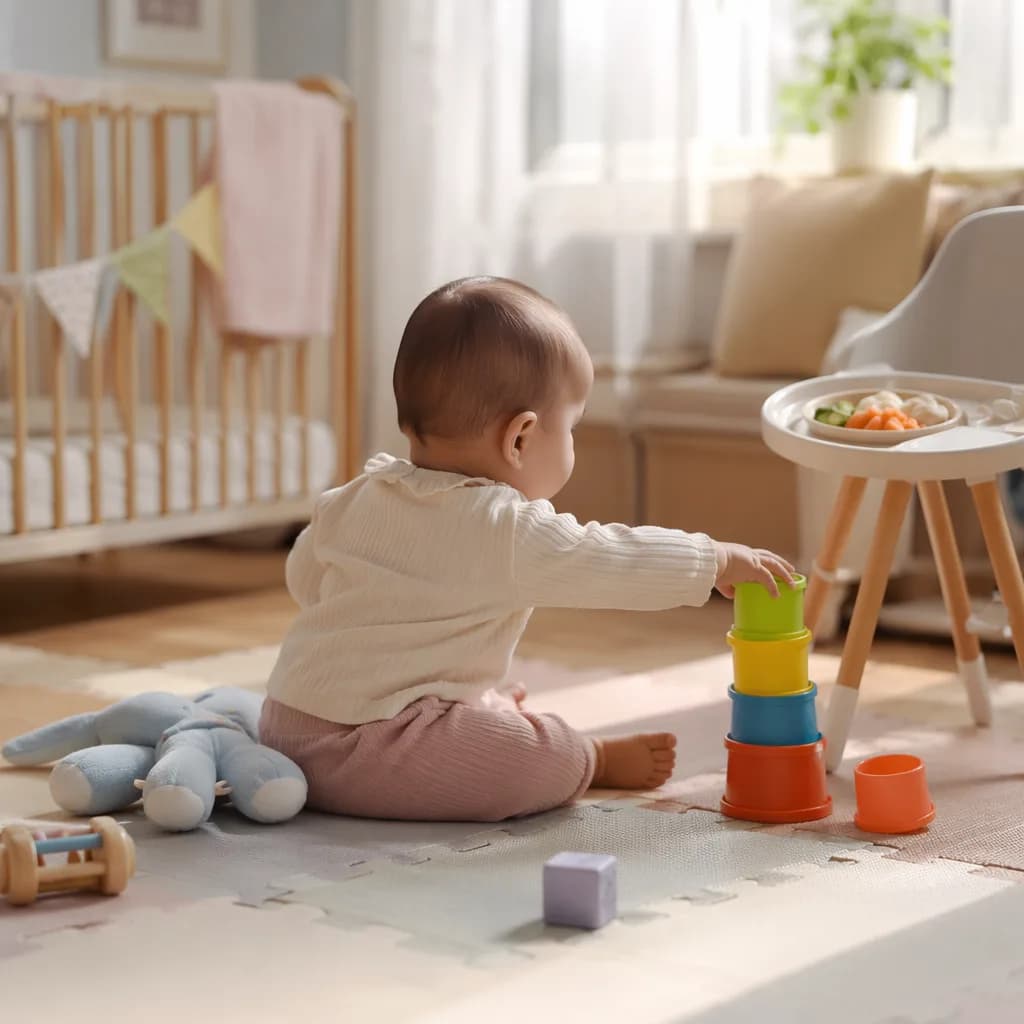
The CDC describes 9-month milestones across how babies play, learn, speak, act, and move. Many babies this age are sitting without support, reaching for toys, moving objects from one hand to the other, raking food toward themselves with their fingers, and looking for things that drop out of sight. You may also hear lots of repeated sounds, like “mamamama” or “babababa,” and see your baby lift their arms to be picked up.
Development can be uneven right now, and that’s very normal. One baby may be determined to move toward every interesting object but be quieter with babbling. Another may love finger foods and peek-a-boo but not be crawling yet. If you’re wondering how crawling fits into the bigger picture, this guide on when babies start crawling may help.
A real 9-month-old day might look like this: your baby army crawls straight to the dog bowl, bangs two blocks together with great seriousness, then cries the second you leave the room. That mix of curiosity, problem-solving, movement, and strong attachment is very much part of this age.
Socially, many babies react to familiar people, show preferences, smile or laugh during peek-a-boo, and may seem shy or clingy around strangers. Sleep and feeding routines still matter too. The CDC notes that 4- to 12-month-olds need 12 to 16 hours of sleep a day, including naps.
If your baby was born early, adjusted age can matter when looking at milestones. And if something worries you, or your baby has lost a skill, it’s always okay to ask your child’s doctor.
Crawling, pulling up, and other movement milestones
At 9 months, movement can look wonderfully different from baby to baby. Some babies do a classic hands-and-knees crawl. Some army crawl on their bellies, scoot on their bottoms, roll across the rug to reach a toy, rock back and forth on hands and knees, or pivot while seated so they can grab what they want.
All of that counts as problem-solving with a body that’s getting stronger.
The CDC lists several movement milestones many babies reach by 9 months, including sitting without support, getting into a sitting position by themselves, moving things from one hand to the other, and using fingers to “rake” food toward themselves. You may see this at lunch when your baby drags soft bits of banana closer with their whole hand, then proudly smears half of it on the tray.
Some babies skip crawling and go straight toward cruising or walking. That can be okay. What we’re watching for is steady progress: more strength, more coordination, and more curiosity about getting to people, toys, and furniture. If you want a fuller look at crawling timing and styles, When Do Babies Start Crawling? Milestones Explained can help you compare patterns without turning it into a race.
Pulling up often changes the whole house overnight. Once your baby grabs the coffee table and wobbles to standing, hot mugs need to move far back, dangling cords need a new home, and sharp corners deserve a second look. Babies this age don’t understand “careful” yet. They understand, “I can reach that now.”
You can support movement by placing a toy just out of reach on a play mat and cheering when your baby rolls, scoots, or crawls toward it. Those early floor skills build from the same kind of practice many families started months ago with Tummy Time for Newborns: Safe Tips for the First Weeks, and you may remember the big changes that showed up around 4 Month Baby Milestones: Sleep, Feeding, Play.
Ask your pediatrician if your baby’s body seems very stiff or very floppy, if they use one side much more than the other, if they aren’t sitting, or if they show no interest in bearing weight. You know your baby best, and it’s always okay to ask early.
Babbling, gestures, and social development
At 9 months, baby communication can feel wonderfully noisy. You may hear long babbling strings like “ba-ba-ba” or “da-da-da,” squeals from across the room, belly laughs during peekaboo, and little sound “conversations” where you say something, pause, and your baby answers in their own way.
Those “mama” and “dada” sounds are exciting, but they may still be practice sounds rather than true words every time. If your baby says “dadadada” while chewing a spoon, looking at the dog, or staring at the ceiling fan, that still counts as useful practice. Their mouth, voice, and brain are getting ready for real words.
Socially, many 9-month-olds are much more tuned in. They may look when you call their name, react when you leave by reaching or crying, lift their arms to be picked up, and show big facial expressions like happy, sad, angry, and surprised. Some babies are shy, clingy, or fearful around strangers. Peekaboo often gets a real laugh now. You may also see early gestures like waving bye-bye, clapping, or reaching toward something they want.
The best language practice happens during regular life. During a diaper change, narrate one tiny thing: “Clean diaper. Socks on.” At the high chair, label foods: “Banana. Soft banana.” Then pause. Let your baby grunt, squeal, babble, or bang the tray before you answer. Sturdy board books are great too. You don’t have to read every word. Point to one picture and say, “Dog. Woof.”
If you’re thinking back to earlier baby stages, our guide to 4 Month Baby Milestones: Sleep, Feeding, Play can help you see how much has changed.
Bring up concerns with your doctor if your baby isn’t babbling, doesn’t make back-and-forth sounds, has limited eye contact, doesn’t respond to familiar voices, or has lost skills they once had. You know your baby best.
Feeding a 9 month old: milk, solids, and finger foods
At 9 months, breast milk or formula is still a major source of nutrition. Solids are doing a different job too: helping your baby practice new textures, flavors, chewing motions, and self-feeding.
A common rhythm is 2 to 3 meals a day, with optional snacks if your baby seems hungry between meals. Milk feeds can be spaced around solids in whatever way fits your baby’s appetite and your family routine. Some babies nurse or take a bottle before breakfast, then sit down for banana and oatmeal. Others do better with solids first and milk afterward. Both can be workable.
This age can feel very different from the early feeding days you may remember from 4 Month Baby Milestones: Sleep, Feeding, Play. Now meals are more hands-on. Messier, too.
Good finger foods are soft enough to mash between your fingers and shaped so baby can manage them safely. Try soft ripe banana strips, avocado pieces, well-cooked pasta, shredded chicken, soft beans, steamed carrot sticks, and toast strips with a thin spread. You can also offer mashed foods, soft lumps, minced foods, and foods your baby can pick up with fingers. Expect a lot of raking, squishing, dropping, and trying again. That’s practice.
Stay close during meals. Avoid whole grapes, popcorn, nuts, hard raw vegetables, chunks of hot dog, spoonfuls of nut butter, and round slippery foods unless they’re cut safely. If you’re offering common allergens and your pediatrician hasn’t advised a different plan, practical options include peanut powder thinned into yogurt, well-cooked egg strips, or tiny fish flakes mixed into a soft food.
Offer a little water with meals in an open cup or straw cup. It’s fine if most of it lands on the bib at first. Avoid honey before age 1, and don’t use cow’s milk as the main drink before the first birthday.
Mealtimes also support the same exploring, reaching, and sitting skills that show up around this stage, much like the movement practice in When Do Babies Start Crawling? Milestones Explained. If you’re chatting while baby eats, name the foods, the colors, even family names you love, like Aurora or Tanmay Suresh Upadhyay. Tiny conversations count.
A sample 9 month baby schedule
A 9 month baby schedule usually has a rhythm you can recognize: milk feeds, meals, floor play, 2 naps, wake windows around 2.5 to 3.5 hours, and a calm bedtime routine. It doesn’t need to run like a clock. It just needs enough predictability that your baby starts to know what comes next.
Here’s a realistic sample day:
- 7:00 am: Wake and milk feed
- 7:45 am: Breakfast, with time to practice finger feeding
- 8:30 am: Floor play, peek-a-boo, books, and crawling practice
- 9:45 am: Nap
- 11:15 am: Milk feed
- 12:00 pm: Lunch
- 12:45 pm: Outdoor time or a short walk
- 2:15 pm: Nap
- 3:30 pm: Milk feed
- 5:30 pm: Dinner
- 6:15 pm: Bath
- 6:35 pm: Book, quiet cuddles, milk feed
- 7:00 pm: Bed
At this age, babies are busy. The CDC notes that many 9 month olds sit without support, move things from one hand to the other, rake food with their fingers, look for dropped objects, bang two things together, and make sounds like “mamamama” and “bababababa.” So yes, your schedule may include a lot of picking spoons off the floor.
Some babies still wake at night, especially with teething, illness, separation anxiety, or brand-new motor skills. A baby working hard on crawling may need more floor time than container time during the day. If you’re wondering what that practice can look like, this guide on when babies start crawling is a helpful next read.
If naps are short, try moving bedtime earlier instead of stretching the last wake window too far. Keep meals low-pressure. Watch sleepy cues like rubbing eyes, staring off, or extra clinginess.
Think development, not perfection. The same baby who once needed simple routines during 4 month milestones is now reaching, reacting, babbling, and exploring. Floor time still matters too, just in a more active way than those early tummy time days.
And if you’re filling out a baby book during this stage, maybe between naps and snack cleanup, you might find yourself saving sweet name pages like Aurora or Tanmay Suresh Upadhyay for later.
9 month old baby activities that actually help
At 9 months, the best activities are usually the ones you can set up in 30 seconds with things already on the floor, in the kitchen, or in the laundry basket.
Try a couch-cushion crawling path. Put a few cushions on the floor, keep them low and stable, then place a favorite toy just beyond reach. Stay right beside your baby. This gives them a little challenge as they crawl, scoot, roll, reach, and figure out how to get where they want to go. If you’re watching those early movement changes closely, you might like this guide on when babies start crawling.
A muffin tin can become a surprisingly good baby activity. Add large baby-safe balls or toys that can’t fit in your baby’s mouth, then let them reach in, grab, drop, and find the toy again. It practices reaching and grasping, and it also plays into object permanence, especially when a toy disappears into one of the cups.
Peekaboo still earns its place. Use a burp cloth and say the words out loud: “Where’s Mama? There she is.” Pause long enough for your baby to look, smile, reach, or pull the cloth away. The CDC lists smiling or laughing during peekaboo as a common 9 month milestone, which makes this simple game feel even sweeter.
Make a kitchen band. A wooden spoon and a plastic container are enough. Your baby bangs, hears a sound, tries again, and learns cause and effect. Yes, it’s loud. Joy often is.
Read the same sturdy board book every day. Let your baby pat the pages, chew the corners, and hear the same familiar words. Reading at this age can simply mean pointing at pictures and naming them. If you saved favorites from earlier months, this is a lovely bridge from 4 month baby play into more active exploring.
Before bath, try supervised water play on the floor with a shallow tray and a sponge. Squeeze. Pat. Splash a little.
One gentle caution: avoid long stretches in jumpers, walkers, or seats. Babies need free floor time to build crawling, balance, and strength, much like they needed early practice during tummy time.
And if you’re naming stuffed animals during play, anything goes. Today the bear can be Aurora, tomorrow the spoon can be Tanmay Suresh Upadhyay. Babies don’t mind. They just love hearing your voice.
Sleep changes and separation anxiety at 9 months
Nine months can be a wobbly sleep stage, even for babies who were doing pretty well. Your baby may be moving more, practicing getting into a sitting position, transferring toys hand to hand, or trying to reach things just out of grasp. If crawling is suddenly the big project in your house, our guide to when babies start crawling can help you connect the dots.
Attachment feelings can get bigger now too. The CDC notes that many 9-month-olds react when a parent leaves, by looking, reaching, or crying. They may also be shy, clingy, or fearful around strangers. So bedtime can feel different: your baby now understands more clearly that you can leave the room.
For sleep totals, the CDC says babies 4 to 12 months need 12 to 16 hours of sleep in 24 hours, including naps. In plain parent terms, many 9-month-olds land around 12 to 15 hours total, usually split between nighttime sleep and naps.
A simple bedtime rhythm helps. Keep it short: diaper, pajamas, feed if that’s part of your routine, book, song, bed. Use the same sleepy phrase each night, like “It’s sleep time. I love you. I’ll see you soon.” If you use a comfort object, make sure it’s safe and age-appropriate for your baby’s sleep space. During check-ins, stay calm and boring. A gentle pat, your phrase, then out again.
Practice separation during the day in tiny doses. Step behind the door and come right back. Wave “bye-bye,” since the CDC suggests teaching that skill, then return with a cheerful “I’m back.” It’s small, but it builds trust.
Ask your doctor for help if night waking comes with loud snoring, breathing pauses, poor weight gain, extreme sleepiness, or feeding problems. And if you’re comparing earlier sleep stages, 4 Month Baby Milestones: Sleep, Feeding, Play may be useful too. Keep bedtime reading soothing. Baby books beat scrolling name pages like Aurora: meaning & origin or Tanmay Suresh Upadhyay: meaning & origin until after your baby is asleep.
When to call the pediatrician about development
If something feels off, you’re not being dramatic. You’re paying attention. At 9 months, babies can be wonderfully unpredictable, but a parent’s concern is still a good reason to check in.
The CDC says to talk with your child’s doctor if your baby isn’t meeting one or more milestones, has lost skills they once had, or if you have other concerns. That includes things like not sitting with support, no babbling sounds such as “mamamama” or “bababababa,” not responding to sounds, not making eye contact, not reaching for objects, very poor feeding, or losing a skill they used to do.
Bring up movement concerns too. Call if you notice one hand is always fisted, your baby seems to drag one side, their legs feel very stiff, their posture seems very floppy, or they show no interest in moving toward toys. Some babies crawl later than others, but if you’re wondering what’s typical, our guide on when babies start crawling can help you sort through the range.
Feeding and safety concerns are also worth a prompt call: frequent choking, coughing with most feeds, trouble handling textures, or fewer wet diapers. At this age, babies are practicing with tastes, textures, finger foods, and a small amount of water in a cup, so mealtimes can be messy. Scary or repeated trouble is different.
One practical tip: take a short video of what worries you. Babies have a funny way of doing the exact opposite in the exam room. A 20-second clip of stiff legs during play or coughing during a feed can help your pediatrician understand what you’re seeing.
If you’ve been tracking changes since earlier months, you may also find it helpful to compare with 4 month baby milestones or revisit early movement basics like tummy time.
Frequently Asked Questions
What should my 9 month old be doing?
Many 9 month olds sit well, move toward toys, babble, respond to familiar people, eat soft solids, and show stronger opinions. The exact mix varies.
Is it normal if my 9 month old is not crawling?
Yes, it can be normal. Some babies scoot, roll, army crawl, or skip crawling. Ask the doctor if your baby is not sitting, seems weak, or uses one side much more.
How many meals should a 9 month old eat?
Many babies eat 2 to 3 small meals a day, sometimes with a snack. Breast milk or formula is still the main drink before age 1.
What are good 9 month old baby activities?
Try peekaboo, crawling games, board books, stacking cups, finger foods at meals, music with pots and spoons, and supervised water play in a shallow tray.
What is a good 9 month baby schedule?
A common schedule has morning wake-up, milk, breakfast, play, 2 naps, lunch, dinner, bedtime routine, and milk feeds as needed across the day.
How much should a 9 month old sleep?
Many 9 month olds sleep about 12 to 15 hours in 24 hours, often with 2 naps. Night waking can still happen, especially during teething or separation anxiety.
Should my 9 month old be saying words?
Usually not yet. Babbling like ba-ba, da-da, and ma-ma is common, but true words often come closer to 12 months or later.
When should I worry about 9 month baby development?
Call the pediatrician if your baby is not sitting, not babbling, not responding to sounds, avoids eye contact, has feeding trouble, or loses a skill.
Frequently asked questions
What should a 9 month old baby be doing?
Is it okay if my 9 month old is not crawling yet?
What foods can a 9 month old eat?
How much sleep does a 9 month old need?
When should I call the doctor about 9 month milestones?
References
Sources
External research this article was grounded in.
- 9 (2009 animated film) - Wikipediaen.wikipedia.org
- Milestones by 9 Months | Learn the Signs. Act Early. | CDCcdc.gov
- 9-Month-Old Baby: Milestones and Developmentwhattoexpect.com
- Baby Developmental Milestones By Monthmy.clevelandclinic.org
Related reading
More from the journal → baby-development
Pincer Grasp Development: Ages, Signs, and Easy Play
Baby's pincer grasp starts messy, then gets precise. Learn the usual age range, early signs, simple play ideas, and when to ask for help.
9 min readJul 21, 2026 baby-development
When Do Babies Smile? Early Grins and Social Smiles
Learn when babies first smile, how newborn grins differ from social smiles, and what to watch for if your baby isn't smiling yet.
9 min readJul 15, 2026 baby-development
When Do Babies Crawl? Signs, Stages, and Tips
Most babies crawl between 6 and 10 months, but there’s a wide normal range. Learn signs, stages, crawling styles, and simple ways to help.
12 min readJul 3, 2026