
3 Month Baby Milestones: Smiles, Strength, and Play
What are the main 3 month baby milestones?
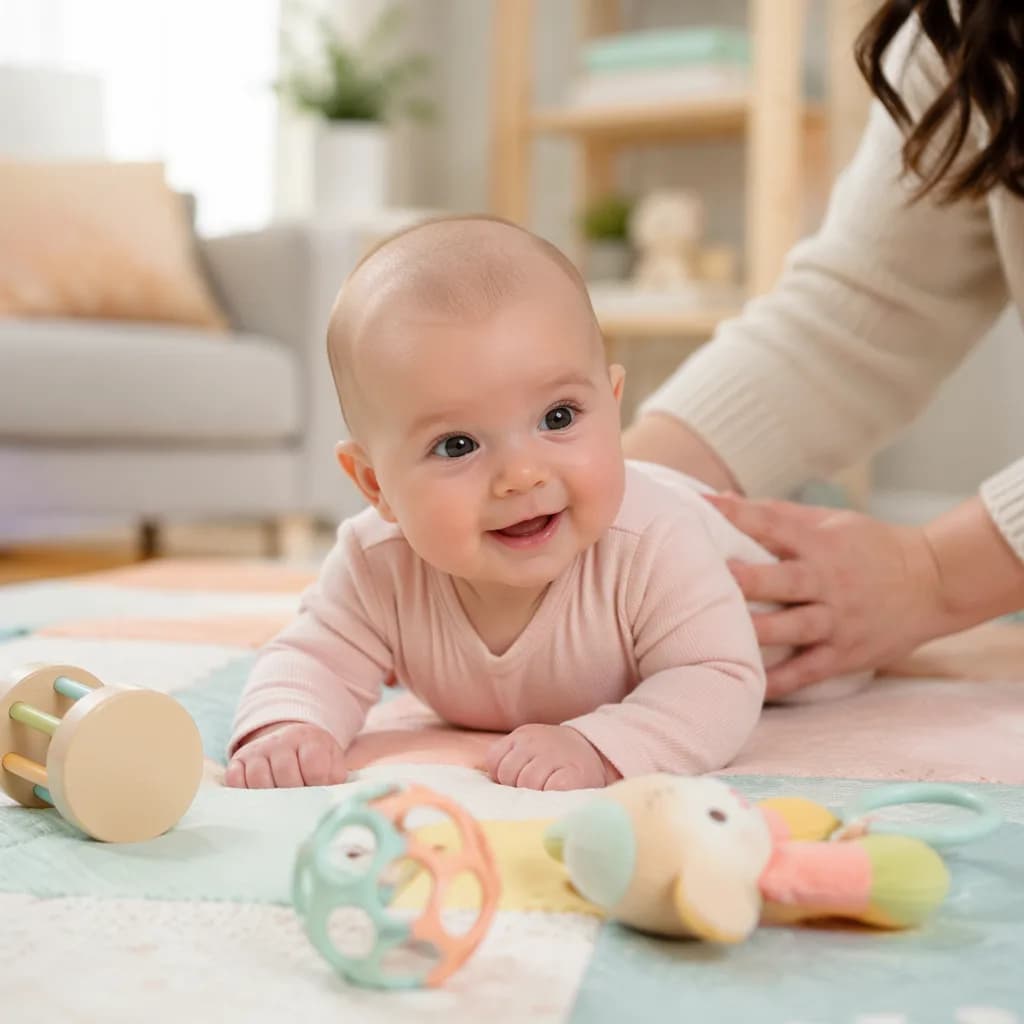
At 3 months, many babies start to feel a little more “here” with us. They may look into your face longer, smile back when you smile, and seem more interested in the voices and movement around them.
A parent-friendly snapshot looks something like this: socially, your baby may respond to you with smiles or brighter expressions. For movement, you might notice stronger head control, especially during tummy time, when they lift their head for a few seconds and look around. With language, those tiny cooing sounds can start showing up, often when you talk, sing, or pause and wait for them to “answer.” Sensory skills are growing too. Your baby may follow a toy with their eyes as you slowly move it from side to side.
These changes can feel small, but they’re real. A baby who stared past you last month might suddenly grin at your morning hello. If you’ve been watching from the 2 month baby milestones stage, this can feel like such a sweet shift.
Still, babies don’t all move on the same timeline. Some are chatty with coos before they’re steady in tummy time. Some love faces but aren’t very interested in toys yet. Babies born early may follow a slightly different pace, and that’s something your child’s healthcare provider can help you think through.
Milestones are guideposts, not a pass-fail checklist. They help us notice patterns, support play, and know what to ask about. After this stage, you can peek ahead to 4 month milestones, 6 month milestones, and 9 month development when you’re ready. And if you’re also in the middle of naming conversations, Tanmay Suresh Upadhyay: meaning & origin is there for a quiet scroll during nap time.
Social smiles and early connection at 3 months
At 3 months, one of the sweetest changes is how personal your baby’s smile can start to feel. A social smile is the kind that shows up in response to you: your face leaning close, your voice saying hello, or your attention settling on them for a quiet minute.
Earlier smiles can look dreamy, sleepy, or tied to a tiny tummy rumble. Those count as part of your baby’s early expressions too, so there’s no need to sort every grin into a category. The difference many parents notice around this stage is the back-and-forth feeling. You smile, pause, and then your baby seems to answer with their whole face.
You might also see other small signs of connection. Your baby may watch your face more closely, calm when they hear a familiar voice, or wiggle with excitement when you come near. If you’ve been watching changes since 2 Month Baby Milestones: Smiles, Sounds, Sleep, this stage can feel like your baby is joining the conversation a little more.
Picture this: your baby is lying on the changing table, staring up at you. You start the same silly diaper song you’ve sung all week. They lock eyes, their mouth opens into a grin, and suddenly the whole diaper change feels like a tiny shared joke.
To encourage connection, keep it simple. Talk for a few seconds, then pause so your baby has space to respond. Copy their coos. Smile back when they smile at you. Try short face-to-face moments when they’re fed, rested, and relaxed.
No performance needed.
These early exchanges are a gentle bridge toward the next stages too, from 4 Month Baby Milestones: Sleep, Feeding, Play to 6 Month Baby Milestones: Sitting, Solids, Sleep and 9 Month Baby Development: Milestones, Food, Play. And if you’re saving memories in a baby book, even a name note like Tanmay Suresh Upadhyay: meaning & origin can sit right beside “first real smile.”
Baby head control and upper body strength
Around the 3 month mark, head control is one of those changes parents often notice in tiny, everyday moments. During tummy time, your baby may start lifting their head for longer stretches, even if it’s still wobbly. When you hold them upright against your shoulder, their head may feel steadier than it did back in the newborn weeks.
You might see little bursts of strength. A baby lying on their tummy may push up on their forearms, lift their chest a bit, and turn their head from side to side to look for your voice or a toy. During supported sitting on your lap, there may be less bobbing than before, though “less” doesn’t mean “gone.”
That part matters.
Full head control usually takes more time, so keep supporting your baby’s neck and head when you pick them up, carry them, or move them from one position to another. Think of this stage as practice, not mastery. If you’ve recently read about earlier skills in 2 Month Baby Milestones: Smiles, Sounds, Sleep, this is the kind of gradual progress that can feel small one day and suddenly obvious the next.
For tummy time, keep it simple and safe: short sessions, several times a day, only when your baby is awake, and always with you watching. A minute or two still counts. So does a calm reset if your baby fusses.
If tummy time is unpopular in your house, try changing the setup. Place your baby tummy-down on your chest while you recline, so they can look at your face. Tuck a small rolled towel under their chest with their arms forward. Put a favorite face-level toy just in front of them, close enough to see but slightly out of reach.
By 4 months, many babies are working on even stronger upper body movement, and later milestones build from here, including the sitting practice you’ll read about in 6 Month Baby Milestones: Sitting, Solids, Sleep and active floor play in 9 Month Baby Development: Milestones, Food, Play. And if you’re browsing names during nap time, Tanmay Suresh Upadhyay: meaning & origin is a sweet little side read.
Movement, hands, and sensory changes you may notice
At 3 months, many babies start to look a little less “newborn” in the way they move. Those jerky arm and leg motions may begin to smooth out, and you might see more purposeful wiggling during floor time, diaper changes, or after a good nap.
Hands get very interesting around now.
Your baby may bring hands toward the mouth, open and close fingers, or stare at their own hands like they’ve just discovered a brand-new toy. You may also notice early reaching attempts. A baby might swipe at a dangling toy on a play gym, bat at soft animals hanging from a stroller bar, or briefly hold a lightweight rattle if you place it in their hand. It may only last a few seconds. That still counts.
Sensory changes can feel especially sweet at this age. Your baby may track a moving object with their eyes, turn toward familiar sounds, or show extra interest in high-contrast patterns and bright toys. One very real 3 month moment: baby locks eyes on the ceiling fan, completely fascinated, then suddenly turns their head when an older sibling laughs across the room.
If you’re comparing this stage with last month, our guide to 2 Month Baby Milestones: Smiles, Sounds, Sleep can help you see what’s changing. And if you’re curious about what comes next, 4 Month Baby Milestones: Sleep, Feeding, Play is a helpful next read.
A quick safety note from one parent to another: once hands start heading to the mouth, check the floor often. Keep small objects, loose strings, and toys with tiny parts out of reach. This habit will matter even more as your baby grows toward the stages covered in 6 Month Baby Milestones: Sitting, Solids, Sleep and 9 Month Baby Development: Milestones, Food, Play.
3 month old activities that support development
At 3 months, play can be beautifully simple. You don’t need a basket of special toys or a perfect setup. The best activities often happen on the changing mat, across your lap, or during those quiet few minutes after a feed.
Start with face-to-face play. Hold your baby where they can see your face, then talk, sing, and make gentle expressions. Try opening your eyes wide, smiling slowly, or softly saying, “Hi, I see you.” Then pause. That little pause matters because it gives your baby space to answer with a coo, a wiggle, or a smile. If you remember those early social moments from 2 Month Baby Milestones: Smiles, Sounds, Sleep, this is the same idea, just with a bit more back-and-forth.
Tummy time can be short and kind. Place your baby on their tummy for a minute or two, then put a board book, baby-safe mirror, or soft toy in front of them. You can lie down too, face-to-face, so you’re the “toy.” If your baby lasts 45 seconds, that still counts. Try again later.
For tracking games, slowly move a rattle or high-contrast card from one side to the other while your baby watches. Go slow. Really slow. Stop in the middle and let their eyes catch up before moving again. This can be done while they’re on a play mat, in your arms, or lying on a blanket beside you.
Diaper changes are great for touch and body awareness. Gently bicycle their legs, clap their hands together, and name body parts as you go: “Here are your feet. Here are your knees. Here’s your belly.” It feels playful, and it turns an ordinary moment into connection.
Watch for signs your baby needs a break: looking away, fussing, arching, yawning, or hiccuping. Stop before play turns into a struggle.
Soon enough, you’ll see these little games grow into the next stage in 4 Month Baby Milestones: Sleep, Feeding, Play, then later into sitting practice in 6 Month Baby Milestones: Sitting, Solids, Sleep and busy floor play in 9 Month Baby Development: Milestones, Food, Play. And if you’re also saving meaningful name ideas during these quiet baby days, Tanmay Suresh Upadhyay: meaning & origin is a lovely one to keep nearby.
Feeding and sleep patterns around 3 months
Feeding and sleep are a big part of 3 month baby development, even though there’s still a wide range of normal. Some babies feel fairly predictable by now. Others still seem to change their minds every other day.
For breastfed babies, you might notice feeds are quicker or more focused than they were during the newborn weeks. Or your baby may still want plenty of comfort feeds, especially in the evening. Formula-fed babies may take larger bottles than before, with longer gaps at times, but rigid schedules can create more stress than help. A softer rhythm usually works better: feed, burp, cuddle, watch cues, repeat.
Sleep can be just as varied. Some babies begin giving parents one longer stretch at night around this stage. Lovely when it happens. Many others still wake often, need help settling, or nap in short little bursts. If you’re comparing this month with earlier weeks, our guide to 2 Month Baby Milestones: Smiles, Sounds, Sleep can help you see the gentle progression.
A growth spurt can also shake things up for a few days. Extra feeds, fussiness, clingier evenings, and shorter naps can all show up, then ease again. It doesn’t mean you’ve done anything wrong.
Before adding cereal, solids, water, or changing your baby’s feeding plan, check with your pediatrician. That’s especially helpful if your baby seems uncomfortable, isn’t feeding well, or you’re unsure what’s appropriate. Solids come later for many families, and you can peek ahead at 4 Month Baby Milestones: Sleep, Feeding, Play, 6 Month Baby Milestones: Sitting, Solids, Sleep, and 9 Month Baby Development: Milestones, Food, Play when you’re ready.
Tiny side note for parents saving baby notes and names together: Tanmay Suresh Upadhyay: meaning & origin is there if you’re browsing name pages during nap time.
When to ask your pediatrician about milestones
At three months, babies are still wonderfully uneven. One day they’re smiling at the ceiling fan, the next they’re too sleepy to show off. So this isn’t about panic. It’s about trusting your gut and asking questions early, especially if something feels different from your baby’s usual pattern.
Bring up any concerns at your well-child visit, even if they seem small. Your pediatrician would much rather hear, “I’m not sure, but...” than have you sit at home worrying.
A few things worth mentioning:
- No social smile yet, especially if your baby doesn’t seem to brighten or engage when you talk, smile, or lean close.
- A body that feels very floppy, very stiff, or hard to settle into a comfortable position.
- Poor feeding, such as tiring quickly, struggling to latch or suck, or taking much less than usual.
- Not following movement with their eyes, like your face or a toy moving slowly side to side.
- Not responding to loud sounds.
- Baby head control concerns, including not lifting the head at all during tummy time, or always turning the head to one side.
Head turning can be easy to miss. For example, if every photo shows baby looking right, and they fuss when you gently encourage them left, that’s worth a quick call.
Some signs need prompt care, not a wait-and-see approach: trouble breathing, blue lips, signs of dehydration, fever in a young baby, or a sudden major change in behavior. If your baby seems unusually limp, hard to wake, or “not like themselves,” it’s okay to act quickly.
Well-child visits are also a good time to talk through three month old milestones if your baby was premature or had a NICU stay. You can compare what you noticed at 2 months, what may come next at 4 months, and later changes around 6 months and 9 months. And if you’re saving baby memories alongside name notes, pages like Tanmay Suresh Upadhyay: meaning & origin can be a sweet little keepsake.
Frequently Asked Questions
What should my baby be doing at 3 months?
Many 3 month olds smile socially, coo, follow faces or toys with their eyes, lift their head during tummy time, and bring their hands toward their mouth.
How much head control should a 3 month old have?
A 3 month old often has better head control and may lift their head during tummy time, but they still need support when being picked up or carried.
What are good 3 month old activities?
Try tummy time, face-to-face talking, singing, slow toy tracking, mirror play, gentle bicycle legs, and reading short board books.
Should my 3 month old be laughing yet?
Some babies laugh around 3 months, but many start with smiles, squeals, and coos first. Laughter often becomes more regular over the next month or two.
When should I worry about 3 month baby milestones?
Call your pediatrician if your baby never smiles, seems very stiff or floppy, does not follow movement, does not react to loud sounds, or cannot lift their head at all.
Frequently asked questions
What should my baby be doing at 3 months?
How much tummy time does a 3 month old need?
Should my 3 month old be smiling and cooing?
What toys are best for a 3 month old baby?
When should I worry about 3 month milestones?
References
Sources
External research this article was grounded in.
- 3 - Wikipediaen.m.wikipedia.org
- 3 (number) - New World Encyclopedianewworldencyclopedia.org
- Three | Phones, Broadband & SIM Only dealsthree.co.uk
- 3 (company) - Wikipediaen.wikipedia.org
Related reading
More from the journal → baby-development
Pincer Grasp Development: Ages, Signs, and Easy Play
Baby's pincer grasp starts messy, then gets precise. Learn the usual age range, early signs, simple play ideas, and when to ask for help.
9 min readJul 21, 2026 baby-development
When Do Babies Smile? Early Grins and Social Smiles
Learn when babies first smile, how newborn grins differ from social smiles, and what to watch for if your baby isn't smiling yet.
9 min readJul 15, 2026 baby-development
When Do Babies Crawl? Signs, Stages, and Tips
Most babies crawl between 6 and 10 months, but there’s a wide normal range. Learn signs, stages, crawling styles, and simple ways to help.
12 min readJul 3, 2026