
3 Month Old Milestones, Play Ideas, and Daily Rhythm
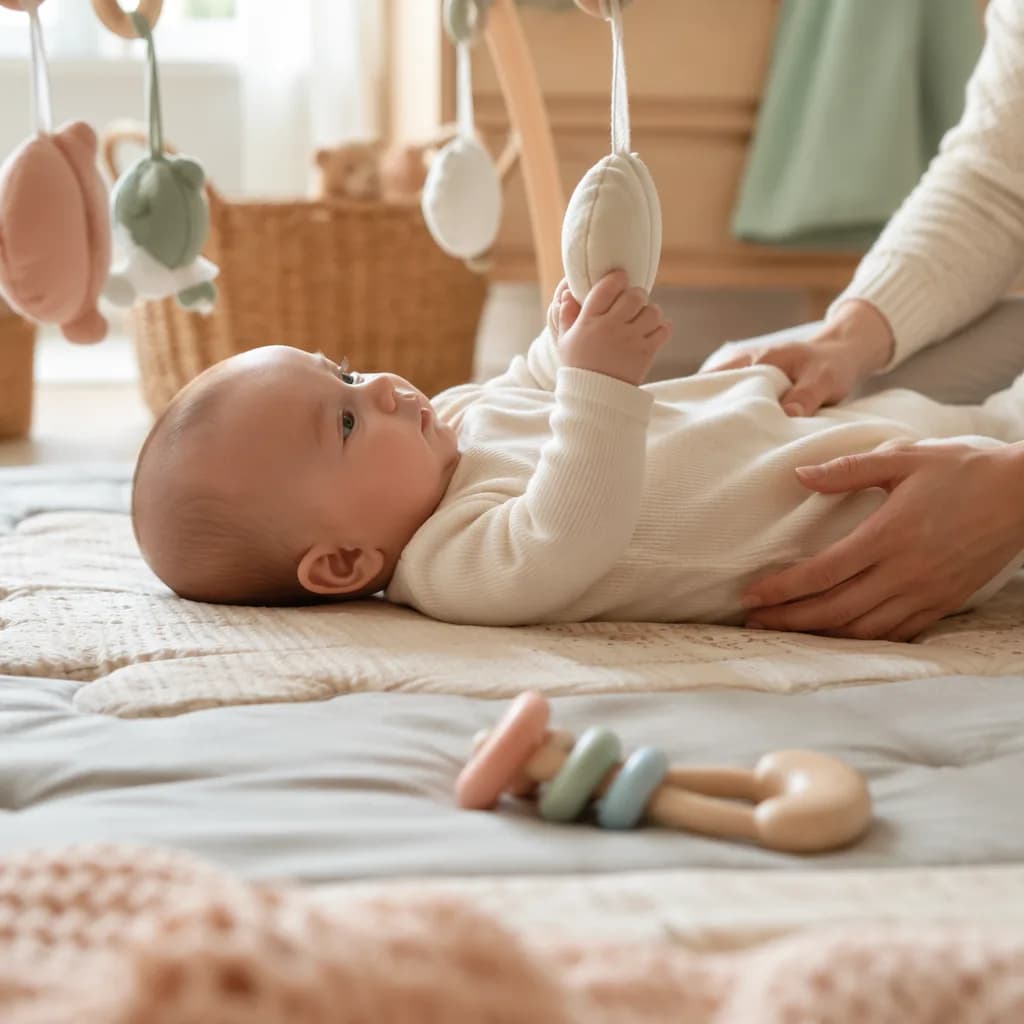
What are the main 3 month old milestones?
At 3 months old, your baby may suddenly seem more awake to the world. You might notice steadier head control, more interest in faces, and little “conversations” made of coos, pauses, and wide-eyed looks.
Common 3 month old milestones often show up in a few areas:
- During tummy time, your baby may lift their head and the front part of their chest, sometimes pushing up on their forearms.
- Their hands may be more open now, and if you place a rattle in their hand, they may hold onto it on purpose.
- They may start bringing their hands toward their mouth, staring at their fingers like they’ve just discovered a fascinating new toy.
- Your baby may follow your face or a toy with their eyes as you move across the room.
- Socially, you may see more smiles back at you, especially when you talk softly or make a silly face.
- Communication may sound like cooing, little vowel sounds, or those sweet back-and-forth noises that feel almost like chatting. If you’re curious about what comes next, this guide on when babies start talking can help you picture the bigger language path.
Some babies do these things earlier, some later. Babies born early may follow a slightly different timeline, and that’s okay. What matters most is the pattern over time, not whether your baby performs one skill on one exact day.
For example, one wobbly tummy time session doesn’t tell the whole story. But if, over a couple of weeks, your baby is lifting their head a bit more, looking toward your voice, and trying to engage with you, those small changes count. They’re building toward later skills too, like supported sitting, which you can read about in when babies sit up.
Movement and motor skills at 3 months
At 3 months, many babies are starting to look a little less wobbly. Head and neck control is getting stronger, and you may notice your baby holding their head steadier when you carry them upright against your shoulder. They still need support, especially during dressing, bathing, and position changes, but those tiny muscles are working hard.
Tummy time often changes around this age too. Your baby may lift their head and the upper part of their chest while pushing up on their forearms. Some babies begin turning their head from side to side to look around, even if they only manage it for a few seconds at a time. Short, frequent sessions usually go better than one long stretch. Think two minutes after a nappy change, then another little try later on a play mat.
A rolled towel under the chest can help during supervised tummy time. Keep it low and snug, with your baby’s arms forward, and stay right there with them. Place a soft toy or crinkly cloth just within sight, not too far away, so they have a reason to lift, look, and turn. These early floor skills are part of the path toward bigger milestones like sitting and crawling, which you can read about in When Do Babies Sit Up? Signs, Timeline, and Tips and When Do Babies Crawl? Signs, Timeline, and Tips.
Hands are getting busier now as well. Fists may be open more often, and your baby might bat at a dangling toy, briefly hold a rattle placed in their hand, or stare at their own fingers like they’ve just discovered something amazing.
It’s a good idea to ask your Child and Family Health Nurse or GP if your baby’s body seems very stiff or very floppy, one hand is always clenched, or head control doesn’t seem to be improving. You can also keep an eye on early social and sound milestones alongside movement, especially with guides like When Do Babies Start Talking? Milestones by Age.
Social, emotional, and communication development
At 3 months, your baby is starting to feel more like a tiny social partner. You may see a smile that’s clearly meant for you, not just a sleepy reflex. They may calm when they hear your familiar voice, settle into face-to-face time, or kick their legs and wave their arms when you lean close and start talking.
Communication is still simple, but it’s growing. Many babies begin making coos, soft vowel sounds, little squeals, and different cries for different needs. After a while, you may notice one cry sounds like “I’m hungry,” while another feels more like “I’m tired” or “something’s uncomfortable.” If you’re curious about what comes next, this guide on when babies start talking gives a gentle age-by-age view.
A lovely example is this: your baby coos, you pause, smile, and say, “Oh, you have a lot to tell me.” Then you wait again. That back-and-forth teaches them that their sounds matter.
Some babies are quieter. That can be completely okay, especially if they make eye contact, react to sound, and show interest in people around them. You don’t need to perform or fill every silence.
Just talk through normal care moments. “Fresh diaper coming.” “One arm in the sleeve.” “Milk time.” These small, warm conversations during feeding, dressing, and changes are enough. As their body gets stronger too, you may also start noticing early foundations for later skills like sitting, which you can read about in when babies sit up.
Vision, hearing, and sensory changes
At 3 months, your baby may seem much more “awake” to the world. You might notice them watching your face for longer, following you with their eyes as you move across the room, or staring at bold patterns and moving toys. Mirrors can be fun too, even though they don’t understand who they’re seeing yet.
Hearing is becoming part of that sweet back-and-forth between you. Your baby may quiet when you speak, turn toward familiar voices, or make little sounds as if they’re answering you. Those tiny “conversations” matter. If you’re curious about how early sounds grow into speech later on, this guide to when babies start talking can help you see the bigger picture.
Keep sensory play simple. Try brushing a soft muslin, a cotton onesie, or a textured blanket gently against their hand. Sing the same calm song during nappy changes. Sit outside in the shade and let them look at leaves moving in the breeze.
A few safety habits are worth keeping close: skip loud toys near their ears, avoid bright screens, and keep small objects well out of reach since babies are beginning to show more interest in grasping. Short, supported play is enough right now, and it also pairs nicely with early strength-building before later skills like sitting up. Here’s more on when babies sit up.
Simple 3 month old activities that actually help
At 3 months, play doesn’t need to look like much. A calm face, a soft voice, a rattle, and a few minutes on the floor can be plenty.
Try these during a calm awake window, after a feed has settled and before baby gets overtired:
- Tiny tummy time: Start with 2 to 5 minutes several times a day. Lay baby on their tummy on a firm, safe surface, then get down face-to-face. At this age, many babies can lift their head and upper chest while resting on their forearms, but they still tire quickly. Add time slowly as baby tolerates it.
- Face games: Copy your baby’s sounds. Smile, raise your eyebrows, open your mouth wide, then pause. That quiet pause matters because it gives baby a chance to “answer” with a wiggle, coo, or little stare. These back-and-forth moments support early connection and communication, which ties beautifully into later speech skills like the ones in When Do Babies Start Talking? Milestones by Age.
- Simple toy play: Slowly move a rattle side to side and watch whether baby tracks it. Place a crinkly cloth near their hands, or hang a soft toy within batting range so those waving arms have something fun to find.
- Supported sitting: Hold baby securely in your lap for a short look around the room. Three-month-olds may start sitting briefly with good support, so keep it gentle and brief. If you’re curious about what comes later, here’s a helpful guide on when babies sit up.
- One small book: A sturdy board book with simple pictures is enough. If baby looks away after two pages, that still counts. Reading, singing, and talking from an early age all help baby learn through your voice and attention.
Stop before baby melts down. Truly.
Short and happy beats long and fussy every time, and those tiny playful minutes are doing real work.
A realistic 3 month old schedule
At 3 months, a “schedule” is usually more of a rhythm than a clock-based plan. Think pattern, not pressure. Your baby is still learning the difference between busy awake time and restful sleep time, and some days will look tidy while others feel like someone shook the whole plan out of your hands.
A common awake stretch at this age is around 60 to 90 minutes, though some babies need a shorter window and some can happily stay awake a little longer. Watch the baby in front of you. Zoning out, turning away, rubbing eyes, or getting fussy during play can be your cue to slow things down.
Naps can be all over the place too. Many 3 month olds take 3 to 5 naps across the day, and those naps may be very uneven. One might be long and cozy. Another might be 23 minutes, right when you finally sat down with coffee. Annoying, yes. Also very normal for this stage.
A simple flow might look like this:
- Wake
- Feed
- Diaper change
- A little play and face-to-face chatting
- Tummy time
- Calm cuddle, song, or book
- Nap
Tresillian notes that babies learn through connection, play, books, music, and everyday interactions with caregivers, so those little “nothing special” moments really do count. Talking back and forth during a diaper change is part of development. If you’re curious about early sounds, this guide on when babies start talking can help you know what to watch for later.
For feeding rhythm, breastfed babies may feed about every 2 to 3 hours, while formula-fed babies often go about every 3 to 4 hours, with plenty of variation based on your baby and medical guidance.
Bedtime may still move around at 3 months. Night waking is still normal too. Your job isn’t to force a perfect routine, but to offer a steady, loving pattern your baby can begin to recognize.
Sleep at 3 months: what is normal?
At 3 months, many babies sleep about 14 to 17 hours across 24 hours, but the total can look different from baby to baby. Some are sleepy little cats who nap often. Others seem to wake the second you put the kettle on.
Night sleep can also be uneven at this age. Some 3 month olds begin giving one longer first stretch after bedtime, then wake later for feeds. Others still wake often because they’re hungry, uncomfortable, or simply need help settling. That doesn’t mean you’re doing anything wrong.
Safe sleep basics matter every single time. Place your baby on their back for sleep, use a firm, flat sleep surface, and keep loose blankets, pillows, and stuffed animals out of the sleep space. If your baby is showing signs of rolling, it’s time to talk with your pediatrician about moving away from swaddling and follow current safe sleep guidance.
A gentle routine can help your baby’s day feel more predictable, which supports what Tresillian describes as a baby-led daily pattern. Keep it simple: dim the lights, feed, burp, change the diaper, sing one short song, then place baby in their sleep space.
This is also a sweet age for connection during awake windows. Talk, sing, and read together, even if bedtime feels messy. If you’re curious about early communication, you might like When Do Babies Start Talking? Milestones by Age. And if you’re watching head control and supported sitting, When Do Babies Sit Up? Signs, Timeline, and Tips pairs nicely with this stage.
Feeding and growth around 3 months
At 3 months, it’s easy to compare ounces, minutes, and feeding schedules with another baby in your parent group. Try to zoom out a little. Steady growth, regular wet diapers, and alert, connected awake periods often tell you more than one single feed ever can.
Breastfed babies may have some feeds that are quick and sleepy, and others where they want to stay close for longer. Bottle-fed babies can have the same kind of variation, with bigger feeds at one time of day and smaller ones at another. Neither pattern is “better.” They’re just different ways babies get what they need.
You may also notice growth spurts or cluster feeding, where your baby seems hungry again soon after eating. Some babies get distracted during feeds around this age because they’re starting to notice more of the world. Spit-up can change too, sometimes seeming more frequent on wiggly days or after a fuller feed.
Most babies aren’t ready for solid foods at 3 months unless your clinician gives specific medical guidance. For now, feeding is still about milk, comfort, and those sweet face-to-face moments that support connection and development.
Call your pediatrician if you notice fewer wet diapers, poor feeding, repeated forceful vomiting, blood in the stool, or if your baby seems unusually sleepy or hard to wake.
If you’re watching the next skills coming, you might like When Do Babies Start Talking? Milestones by Age, When Do Babies Sit Up? Signs, Timeline, and Tips, and When Do Babies Crawl? Signs, Timeline, and Tips.
When to call the pediatrician
If something feels off, call. You don’t need to have the perfect words or a clear explanation before asking for help. Sometimes it’s just a quiet parent feeling: “This isn’t like my baby.” That counts.
At around 3 months, it’s a good idea to check in with your pediatrician, Child and Family Health Nurse, or GP if your baby isn’t showing a social smile, doesn’t react to loud sounds, isn’t following movement with their eyes, has very poor head control, or doesn’t seem to move both sides of the body. Babies develop at their own pace, but these are the kinds of signs worth bringing up early.
Call promptly for health concerns too, especially fever, breathing trouble, signs of dehydration, feeding refusal, blue lips, or a weak, high-pitched cry. Those are not “wait and see” moments.
If your baby was born premature, ask how your doctor wants you to track milestones using corrected age. This can make expectations feel much clearer and fairer. For example, head control and supported sitting may be discussed differently for a baby born early, and your care team can help you know what to watch for. If you’re already reading ahead, our guide on when babies sit up can be useful later, and so can this gentle look at when babies start talking as those early sounds grow.
Asking early doesn’t mean something is wrong.
It means your baby gets support sooner if they need it, and you get to stop carrying the worry alone.
Frequently Asked Questions
What should a 3 month old be able to do?
Many 3 month olds lift their head better, smile socially, coo, watch faces, follow moving objects, and bring hands toward the mouth.
How much tummy time does a 3 month old need?
Aim for short supervised sessions several times a day. Even 2 to 5 minutes at a time helps if your baby is still building strength.
What is a typical 3 month old schedule?
Most follow a loose rhythm of feeding, diaper change, short play, tummy time, calming, and nap, with wake windows around 60 to 90 minutes.
How many naps should a 3 month old take?
Many 3 month olds take 3 to 5 naps a day. Nap length can vary a lot, and short naps are common.
What are good 3 month old activities?
Try tummy time, face-to-face talking, copying coos, reading a simple board book, tracking a rattle, and letting baby bat at soft toys.
Should my 3 month old be sleeping through the night?
Some babies give a longer night stretch by 3 months, but many still wake for feeds or comfort. Both can be normal.
When should I worry about 3 month old milestones?
Call your pediatrician if baby doesn't respond to sound, doesn't watch faces, has very poor head control, doesn't smile, or seems unusually stiff or floppy.
Frequently asked questions
What should my 3 month old be doing?
How much tummy time does a 3 month old need?
What are good play ideas for a 3 month old?
What is a typical daily rhythm for a 3 month old?
When should I worry about 3 month old milestones?
References
Sources
External research this article was grounded in.
- 12 Makanan Khas Padang yang Menggugah Selera | Popmama.compopmama.com
- Baby Development Milestones | Baby Milestonestresillian.org.au
- 5 Resume Formats That Will Dominate 2026 (And 3 That Are Now Obsolete) - The Interview Guysblog.theinterviewguys.com
- Baby Developmental Milestones By Monthmy.clevelandclinic.org
Related reading
More from the journal → development
When Do Babies Laugh? Milestones and Play Ideas
Most babies laugh around 3 to 4 months. Learn what early giggles mean, what can encourage them, and when to check in with your pediatrician.
8 min readAug 3, 2026- development
When Do Babies Start Babbling? Sounds and Stages
Most babies start babbling around 4 to 6 months, then build toward ba-ba and da-da sounds as speech skills grow.
11 min readAug 3, 2026 - development
When Do Babies Roll Over? Timing, Practice, Safety
Rolling can look wobbly at first. Learn what early practice looks like, how tummy time helps, and what safety changes once baby starts to roll.
11 min readAug 3, 2026