
6 Month Baby Milestones: Sitting, Babbling, Play

What are the main 6 month baby milestones?
At 6 months, many babies suddenly feel more “in the room” with us. They’re watching faces, reaching for what they want, making louder sounds, and showing us tiny opinions about food, toys, and people.
A helpful snapshot looks like this: your baby may roll from tummy to back, work toward rolling both ways, push up with straight arms during tummy time, and sit while leaning on their hands or with your support nearby. You might notice more purposeful play too, like reaching for a toy just out of reach, grabbing it, then putting it straight in their mouth to explore.
Communication gets fun around now. Many 6 month olds take turns making sounds with you, blow raspberries, squeal, laugh, and respond to familiar voices or familiar people. A real-life example: you say “ba ba ba,” your baby pauses, squeals back, then grins because you answered. That back-and-forth is learning.
Feeding signs can show up too. Some babies get excited when they see food, open their mouth for a spoon, or close their lips and turn away when they’re done. Breast milk or formula is still the main food at this age, so solids are more about practice, taste, and learning. For more on that stage, you may like 6 Month Baby Milestones: Sitting, Solids, Sleep.
Milestones are guideposts, not a report card. If your baby was born early, corrected age can change what you expect, so it’s always reasonable to ask your baby’s doctor how to think about timing. You can also look back at 3 Month Baby Milestones: Smiles, Strength, and Play or ahead to 9 Month Baby Development: Milestones, Food, Play to see the bigger pattern.
The baby sitting milestone at 6 months
At 6 months, sitting can look a few different ways, and all of them can be part of normal practice. Some babies do a “tripod” sit, leaning forward with both hands on the floor. Some can sit for a few seconds without using their hands. Others still need your hands around their trunk or a firm support behind them.
The CDC lists “leans on hands to support herself when sitting” as a movement milestone most babies do by 6 months. So if your baby is propped on those chubby little arms, wobbling and working hard, that counts.
You may also notice other signs that sitting strength is coming along. Better head control is a big one. So is pushing up with straight arms during tummy time, which the CDC also includes at this age. Reaching for a toy while supported is another lovely clue, because your baby is starting to use their middle while their arms and eyes get busy. If you remember the early head-lifting days from 3 Month Baby Milestones: Smiles, Strength, and Play, this is that same strength growing into something more steady.
For practice, keep it simple and safe. Sit on the floor with your baby between your legs, or place pillows nearby in case of a slow topple. Put a favorite rattle just a little to the side, close enough to reach but interesting enough to make them shift their weight. Short sessions are plenty. A minute or two of good effort can be more useful than a long stretch with a tired, frustrated baby.
Skip couch cushions, beds, or any high surface for sitting practice. Babies can tip suddenly. High chairs should only be used with proper support and straps, and not as a place to “train” sitting if your baby isn’t ready.
Check in with your pediatrician if your baby has very poor head control, seems floppy, or feels very stiff. You can also bring up sitting at your regular visit, along with questions about play, feeding, and sleep from 6 Month Baby Milestones: Sitting, Solids, Sleep. By 9 months, sitting often looks much more confident, so this wobbly stage is real practice.
Rolling, reaching, and stronger hands
At 6 months, movement starts to look much more purposeful. The CDC lists several common 6 month milestones, including rolling from tummy to back, pushing up with straight arms during tummy time, and leaning on hands for support while sitting. If you remember the early head-lifting work from 3 Month Baby Milestones: Smiles, Strength, and Play, this is one of those sweet “oh, that practice mattered” moments.
You may also see more wiggling, turning, and reaching on the floor. Some babies pivot on their tummy, bring feet toward their hands, or rock their weight from side to side as they try to get closer to a toy. It doesn’t always look graceful. It often looks like effort, grunts, and one very determined eyebrow.
Hands get busy too. The CDC notes that many babies reach to grab a toy they want and put things in their mouth to explore. You might also notice your baby passing a toy from one hand to the other, patting at objects, or later in the solids stage, raking at small soft foods with their fingers. For more on feeding and sitting together, see 6 Month Baby Milestones: Sitting, Solids, Sleep.
A simple play setup: during tummy time, place a soft crinkle toy just out of reach. Put it slightly to one side so your baby has to reach, shift weight, and maybe roll or scoot a little. Stay close and cheer the tiny attempts.
Because everything goes to the mouth right now, keep small objects, button batteries, magnets, and loose toy parts out of reach. This stage builds toward the bigger floor-play skills you’ll see in 9 Month Baby Development: Milestones, Food, Play, but today’s job is simple: safe space, interesting toy, patient parent.
And if you’re comparing this stage with earlier baby sounds and smiles, 2 Month Baby Milestones: Smiles, Sounds, Sleep is a gentle look back. For a totally different kind of meaning rabbit hole, we also have Tanmay Suresh Upadhyay: meaning & origin.
Babbling, laughing, and early communication
At 6 months, baby “conversation” can be wonderfully noisy. You may hear squeals, little laughs, vowel sounds, and those wet, funny raspberries where your baby sticks out their tongue and blows. Many babies also start playing with early consonant sounds like “ba,” “ma,” or “da.”
And yes, “ma-ma” at breakfast can absolutely melt everyone at the table.
Still, those repeated sounds may not mean “mama” yet. At this age, your baby is practicing how their mouth, tongue, and voice work together. The meaning comes later, but the back-and-forth is already teaching them something big: sounds get a response.
Try treating those little noises like real conversation. Say something, then pause. Give your baby time to answer with a squeal, grunt, raspberry, or babble. Copy their sound back to them. If they say “ba,” you can smile and say “ba-ba-ba,” then wait again.
Simple routines are perfect for this. During a diaper change, name what’s nearby: “Clean diaper. Warm wipes. Tiny socks.” On a walk, point out cars, trees, and animals. Short songs help too, especially the ones you don’t mind singing twelve times while making lunch.
Socially, many 6-month-olds know familiar people, enjoy looking at themselves in a mirror, and react to your tone of voice. A cheerful “Good morning!” may bring a grin. A softer voice may help when they’re tired or unsure. If you remember the early coos from 2 Month Baby Milestones: Smiles, Sounds, Sleep or the bigger smiles in 3 Month Baby Milestones: Smiles, Strength, and Play, this stage can feel like the next lively step.
Ask your baby’s doctor if you’re not seeing smiles or laughs, if your baby has little response to sound, or if there’s no back-and-forth sound play. You can also bring it up during a broader 6-month check-in, like the one we cover in 6 Month Baby Milestones: Sitting, Solids, Sleep. By 9 months, these early sound games often become even more interactive.
Starting solids around 6 months
Around 6 months, food starts to get interesting. Your baby may be sitting with support, holding their head and neck more steadily, bringing toys and hands to their mouth, and watching your plate like it’s the most fascinating thing in the room. Those are the kinds of readiness signs parents often look for before offering first tastes.
At this age, breast milk or formula is still the main source of nutrition. Solids are practice: new smells, new textures, tiny spoonfuls, funny faces, and learning how food feels in the mouth. The CDC also notes that babies this age may close their lips, turn away, or push food away when they’ve had enough, so we can let those cues lead.
Good first foods often include iron-rich choices, such as pureed meat, iron-fortified infant cereal, mashed beans, lentils, eggs, and yogurt. You can also offer avocado and soft cooked vegetables. Start small. A teaspoon or two is plenty for many babies at first.
Texture can be simple. Purees are fine. Mashed foods are fine. If you’re using a baby-led weaning style, safely prepared soft finger foods can be part of the plan too. Think soft enough to squish between your fingers, cut in a shape your baby can manage, and served while your baby is sitting upright and closely supervised.
For allergens, many families choose to offer common allergen foods in safe forms, one at a time, so it’s easier to notice a reaction. For example, smooth peanut butter can be thinned into yogurt or cereal instead of served in a sticky glob. If your baby has severe eczema or a known food allergy, ask your doctor before introducing common allergens.
Choking safety matters every single time. Avoid whole grapes, nuts, popcorn, chunks of meat or cheese, raw hard vegetables, and globs of nut butter. If you’re unsure about a food, pause and ask your baby’s doctor.
For the bigger picture on this stage, you may like 6 Month Baby Milestones: Sitting, Solids, Sleep. If you’re comparing how quickly things change, 3 Month Baby Milestones: Smiles, Strength, and Play and 9 Month Baby Development: Milestones, Food, Play can help you see the arc.
Sleep changes parents often see at 6 months
Around 6 months, some babies start giving parents longer stretches of sleep. Lovely when it happens. Still, night waking can be normal too, especially during a busy developmental window.
The CDC lists several common 6-month milestones that can show up right at bedtime: rolling from tummy to back, leaning on hands while sitting, pushing up with straight arms during tummy time, taking turns making sounds, and knowing familiar people. So if your baby suddenly seems wide awake practicing rolls, “talking” in the crib, or fussing when you leave the room, it may be connected to all that new learning. This can feel like a step backward after the sleep patterns you saw in 2 Month Baby Milestones: Smiles, Sounds, Sleep or 3 Month Baby Milestones: Smiles, Strength, and Play.
A simple bedtime routine helps. Try the same small steps most nights: diaper, pajamas, feeding, book or song, lights low, into a dark sleep space. Place baby down on their back to start sleep, in a safe sleep space. If your baby can roll independently, you don’t need to spend the whole night flipping them back, but the start position still matters.
Solids may be part of this age, but try not to count on them as a sleep fix. The CDC still describes breast milk or formula as the most important source of “food” at 6 months. For more on this stage, see 6 Month Baby Milestones: Sitting, Solids, Sleep, and peek ahead to 9 Month Baby Development: Milestones, Food, Play when you’re ready.
Play ideas that support six month old milestones
At 6 months, play can be wonderfully simple. Your baby is learning through faces, sounds, reaching, rolling, mouthing safe objects, and trying to sit with support. The CDC lists common 6 month milestones like laughing, taking turns making sounds, reaching for toys, rolling from tummy to back, pushing up on straight arms during tummy time, and leaning on hands while sitting.
Peekaboo is a great place to start. Hide behind your hands, then pop back with a smile. Pause and give your baby a turn to squeal, laugh, or kick. That little back-and-forth is social play, and it builds on the sound-copying games many babies were starting around the stage we talked about in 2 Month Baby Milestones: Smiles, Sounds, Sleep and 3 Month Baby Milestones: Smiles, Strength, and Play.
For language, keep board books close. You don’t need to read every word. Point to one bright picture and say, “Doggy. Woof woof.” If your baby babbles back, answer like it’s a real conversation: “Yes, that’s the doggy!” Textured books are especially nice now because babies explore by touching and putting things in their mouths.
Give plenty of floor time. Containers can be helpful for short moments, but babies need room to roll, reach, push up, and practice sitting. Try this: sit on the floor, place your baby between your legs, and roll a soft ball slowly toward their hands. If they reach, tap, grab, or just watch closely, that counts.
Tummy time is still useful for strength. Put a rattle, teether, soft block, mirror, or nesting cup just out of reach and let your baby work toward it. Choose toys that do enough without doing too much: rattles, soft blocks, teethers, textured books, mirrors, and nesting cups are all good options because your baby gets to be the active one.
Everyday routines count too. Name socks during a diaper change. Let baby feel a cool spoon before lunch. Sing while you wipe their hands. For more on this age, see 6 Month Baby Milestones: Sitting, Solids, Sleep, and if you’re peeking ahead, 9 Month Baby Development: Milestones, Food, Play can help you see what may come next.
Red flags to discuss with your pediatrician
First, a gentle breath. Babies don’t all hit milestones on the same Tuesday, and one wobbly skill doesn’t automatically mean something is wrong. Still, if your gut is tapping you on the shoulder, it’s a good reason to call your pediatrician.
At 6 months, the CDC says most babies are doing things like rolling from tummy to back, pushing up with straight arms during tummy time, leaning on hands while sitting, reaching for toys, bringing things to the mouth to explore, laughing, squealing, and taking turns making sounds with you. If those skills feel far away, it’s worth bringing up.
Call or schedule a visit if you’re seeing concerns like:
- No rolling in either direction
- Poor head control
- A body that feels very stiff or very floppy
- Not reaching for objects
- Not bringing hands to mouth
- No smiles or laughter
- No response to sounds
- Trouble swallowing
- Frequent coughing with feeds
- Poor weight gain
- No interest in eating after readiness signs are present
Loss of skills is different from slow progress. If your baby used to do something and no longer can, like rolling, making sounds, smiling, or using their hands in a familiar way, call promptly and say exactly what changed.
It helps to bring specifics. A 20-second video of sitting practice on the floor can show your pediatrician more than we can explain while juggling a diaper bag. Same with feeding: record a short clip if your baby coughs often, turns away every time, or seems uncomfortable swallowing.
If you’re comparing notes from earlier months, our guides to 2 month baby milestones and 3 month baby milestones can help you see the bigger pattern. For a broader 6-month overview, see 6 Month Baby Milestones: Sitting, Solids, Sleep, and for what may come next, peek at 9 Month Baby Development: Milestones, Food, Play.
A simple 6 month milestone checklist
Six months is a sweet, busy age. Your baby doesn’t need to check every box the morning they turn 6 months old. Use this list as a memory helper for well visits, not as a scorecard at playgroup.
Movement
- Rolls from tummy to back
- Pushes up on straight arms during tummy time
- May sit while leaning on hands on the floor
- Enjoys floor time on a mat with toys just out of reach
Hands and exploring
- Reaches for a toy they want
- Puts toys or safe objects in their mouth to explore
- Drops a toy and watches what happens when you pick it up
Communication
- Takes turns making sounds with you
- Blows raspberries
- Makes squealing noises
- Responds when you copy their babbles or “read” a picture book together
Social skills
- Knows familiar people
- Laughs
- Likes looking at themself in a mirror
- Smiles back when you smile
Feeding
- May close lips, turn away, or push food away to show they’re done
- May open their mouth for a spoon or get excited when they see food
- Breast milk or formula is still the main food source
Play
- Looks where you point when you name things, like “tree” or “doggy”
- Enjoys songs, music, whispers, claps, and funny noises
- Calms with soft talking, rocking, singing, fingers, or a pacifier
If you saved notes from 2 months or 3 months, bring them along too. For a wider look at this stage, see 6 month milestones for sitting, solids, and sleep, then peek ahead to 9 months.
Frequently Asked Questions
What should a 6 month old baby be doing?
Many 6 month olds roll, sit with support, reach for toys, babble, laugh, recognize familiar people, and show interest in solids. Some skills may come a little earlier or later.
Should my 6 month old be sitting up alone?
Some babies sit alone briefly at 6 months, but many still need hands or pillows nearby for support. Steady independent sitting often improves over the next month or two.
What sounds should a 6 month old make?
A 6 month old may squeal, laugh, blow raspberries, make vowel sounds, and start babbling sounds like ba, da, or ma.
How often should a 6 month old eat solids?
Many babies start with one small solids meal a day, then slowly build from there. Breast milk or formula still provides most nutrition at this age.
What are good first foods for a 6 month old?
Good first foods include iron-fortified infant cereal, pureed meat, mashed beans, lentils, avocado, egg, yogurt, and soft cooked vegetables prepared safely.
How much tummy time does a 6 month old need?
Aim for several short floor sessions across the day, as long as baby is awake and supervised. Tummy time can include reaching for toys, pivoting, and pushing up.
When should I worry about 6 month old development?
Call your pediatrician if your baby has poor head control, seems very stiff or floppy, does not reach for objects, does not respond to sounds, or loses a skill they had.
Frequently asked questions
What milestones should my baby reach at 6 months?
Should my 6 month old be sitting independently?
How can I help my 6 month old practice sitting safely?
Is babbling a 6 month milestone?
References
Sources
External research this article was grounded in.
Related reading
More from the journal →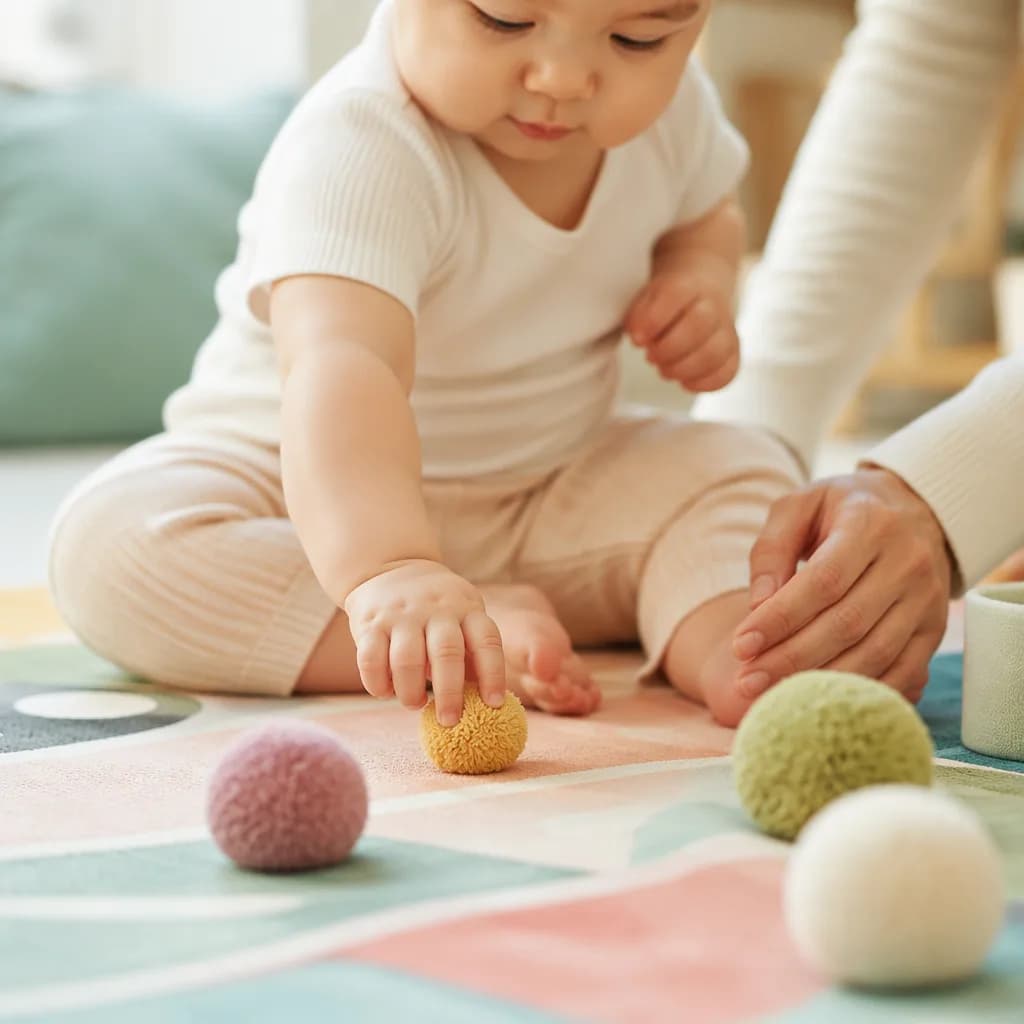 baby-development
Pincer Grasp Development: Ages, Signs, and Easy Play
Baby's pincer grasp starts messy, then gets precise. Learn the usual age range, early signs, simple play ideas, and when to ask for help.
9 min readJul 21, 2026 baby-development
When Do Babies Smile? Early Grins and Social Smiles
Learn when babies first smile, how newborn grins differ from social smiles, and what to watch for if your baby isn't smiling yet.
9 min readJul 15, 2026- baby-development
When Do Babies Crawl? Signs, Stages, and Tips
Most babies crawl between 6 and 10 months, but there’s a wide normal range. Learn signs, stages, crawling styles, and simple ways to help.
12 min readJul 3, 2026